
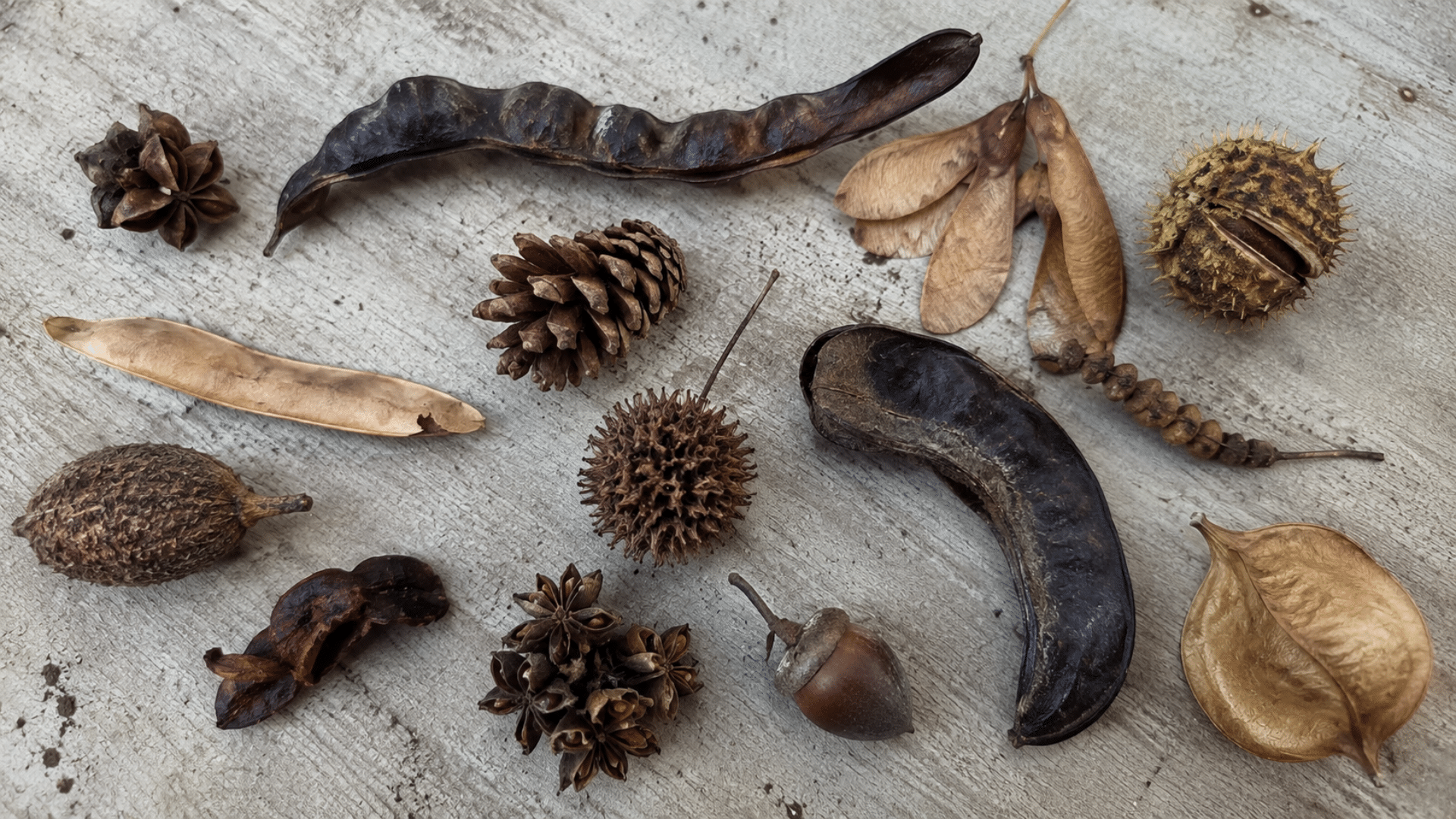
Tree seed pods come in a variety of unexpected shapes and sizes, and knowing how to read them is one of the best ways to identify a tree, even if you don’t find any leaves.
From flat, twisted legumes to spiky pods, samaras with wings of paper, and tough woody capsules, each pod has a story to tell about the tree that made it.
This tree seed pods identification list is organized by type to help you determine what category your mystery pod falls into, and then narrowed down to specific trees to help you identify it to species.
Note that some are common finds in your local ecosystem while others are more special in certain biomes.
What Tree Seed Pods Can Show You About the Tree
Seed pods might look small or strange, but they’re a big clue when it comes to learning about trees. Trees grow seed pods to spread their seeds; it’s how they make sure new trees can grow.
These pods come in many shapes, sizes, and colors depending on the tree. That’s what makes them so helpful.
Sometimes, the leaves and bark on different trees look a lot alike. But their seed pods? Not so much. A pod might twist, snap open, hang in clusters, or float away in the wind.
These unique traits can make it easier to tell trees apart.
Pods are especially useful in the late summer and fall, when they’ve matured and start falling to the ground.
So even when the leaves change or drop, you still have a solid way to figure out what kind of tree you’re looking at, just by checking the pod.
Tree Seed Pods Identification Basics
Some seed pods are easy to spot and name. Others can be tricky. It depends on how clear their shape is, how common they are in your area, and how much they’ve changed with weather or time.
When you start with tree seed pod identification, look closely at these things first:
- Shape: Is it flat, round, curved, spiky, or twisted?
- Size: Is it tiny like a pea or long like a bean?
- Texture: Smooth, rough, bumpy, or fuzzy?
- Color: Fresh green, brown, red, black, or something in between?
- Time of Year: Pods often fall in late summer or autumn, but some trees drop them in winter or spring too.
One big reason to begin with pods is that they stick around even after leaves fall. So when branches are bare, pods still give you something to work with.
Classic Landscape Legume Trees

This group covers pod-bearing trees most people already have growing somewhere on their street or in their own yard.
| S no. | Species | Pod Shape | Size | Color |
|---|---|---|---|---|
| 1 | Honey Locust | Long, flat, twisted strip | 12–18 in | Reddish brown |
| 2 | Black Locust | Smooth, flat, straight | 2–4 in | Reddish brown |
| 3 | Kentucky Coffeetree | Thick, leathery, curved | 5–10 in | Dark reddish brown |
| 4 | Eastern Redbud | Thin, flat, pea-like | 2–4 in | Pinkish brown to dark brown |
| 5 | Western Redbud | Flat, slightly curved | 2–3 in | Green, brown, and purple |
| 6 | Mimosa (Silk Tree) | Flat, straw-like strip | 4–7 in | Straw to tan |
Once you can pick these six apart, the rest of the pod shapes on this list start falling into place a lot faster.
Honey locust and black locust in particular get confused for each other constantly,
and telling their pods apart season by season is worth a closer look on its own.
Mediterranean & Fragrant Legume Trees

This group leans into warm-climate legumes known for scent, shade, or pods with culinary history.
- Carob Tree: Thick, dark brown pods with sweet pulp, used to make carob powder and syrup.
- Tamarind: Curved, brittle brown pods with sticky, tangy pulp used widely in cooking.
- Golden Chain Tree (Laburnum): Slim, flat pods follow cascading yellow flowers; seeds are toxic.
- American Yellowwood: Flat, thin pods form after fragrant white spring flower clusters.
- Mesquite: Narrow, curved pods with a sweet smell, once ground into flour.
- Screwbean Mesquite: Small pods twist into a tight corkscrew spiral, golden brown in clusters.
Between carob’s sweetness and the screwbean’s tight spiral, this group shows real variety within one plant family.
Southwestern & Tropical Legume Trees

This group covers legume trees suited to hot, dry climates and tropical landscapes.
| S No. | Species | Pod Shape | Size | Color |
|---|---|---|---|---|
| 13 | Blue Palo Verde | Flat, slightly curved | 2–4 in | Light brown |
| 14 | Jerusalem Thorn | Long, narrow, slightly constricted | 3–6 in | Yellowish brown |
| 15 | Royal Poinciana | Broad, flat, woody | 12–24 in | Dark brown to black |
| 16 | Rain Tree | Flat, straight | 4–8 in | Dark brown |
| 17 | Coral Tree | Long, narrow, constricted between seeds | 4–8 in | Dark brown |
| 18 | Chinese Scholar Tree | Fleshy, bead-like constrictions | 2–4 in | Yellowish green to brown |
Each of these trees carries pods built to survive heat and dry stretches, which shows in their tougher, woodier textures.
Desert & Pacific Legume Trees

This group features legumes adapted to arid deserts and Pacific coastal regions.
- Texas Mountain Laurel: Thick, woody pods with hard red seeds, toxic if eaten.
- Koa: Flat, curved pods with a slight twist, native to Hawaiian forests.
- Monkeypod Tree: Broad, dark pods with sweet pulp, popular shade tree in the tropics.
- Desert Ironwood: Short, fuzzy pods with dense, extremely hard wood underneath.
- Sweet Acacia: Slim, cylindrical pods with a fragrant yellow flower puff beforehand.
- Silver Wattle: Flat, papery pods following silvery foliage and yellow flower clusters.
Desert and coastal conditions push these pods toward tougher shells and drought-ready seed coats built to wait out dry spells.
Capsule & Cigar-Shaped Pod Trees

This group covers trees with long, cylindrical or woody capsule pods rather than true legume pods.
| S No. | Species | Pod Shape | Size | Color |
|---|---|---|---|---|
| 25 | Judas Tree | Flat, slightly curved | 3–4 in | Reddish brown |
| 26 | Northern Catalpa | Long, slender, cylindrical | 8–20 in | Green to dark brown |
| 27 | Southern Catalpa | Long, slender, cylindrical | 8–16 in | Green to dark brown |
| 28 | Empress Tree (Paulownia) | Oval, woody capsule | 1–2 in | Green to brown |
| 29 | Silk Floss Tree | Round, woody capsule | 4–6 in | Green to brown |
| 30 | Kapok Tree | Oblong, woody capsule | 4–8 in | Green to brown |
These capsule pods split open along a seam to release seeds, unlike true legumes that open along two edges.
Spiky & Round Pod Trees

This group includes trees with rounded, often spiky seed casings rather than flat pods.
- Baobab: Large, oval, hard-shelled pods with dry, powdery fruit pulp inside.
- Horse Chestnut: Round, spiny green husks that split to reveal glossy brown seeds.
- Ohio Buckeye: Spiny, leathery husks with one or two smooth, dark brown seeds.
- Sweetgum: Round, spiky seed balls that hang from long stems through winter.
- American Chestnut: Dense, spiky burs enclosing two or three flattened brown nuts.
- European Beech: Beech is one of the easier deciduous trees to place once you know how it fits into its wider forest setting, from bark texture to the company it tends to keep.
These rounder, spikier casings trade the flat legume shape for protection, using sharp textures to deter animals from the seeds inside.
Winged & Papery Pod Trees

This group features trees with thin, winged pods built for wind dispersal.
| S No. | Species | Pod Shape | Size | Color |
|---|---|---|---|---|
| 37 | Sugar Maple | Paired, winged samara | 1–1.5 in | Light brown |
| 38 | Red Maple | Paired, winged samara | 0.5–1 in | Reddish brown |
| 39 | Silver Maple | Paired, winged samara | 1.5–2 in | Light brown |
| 40 | White Ash | Single, paddle-shaped wing | 1–2 in | Light brown |
| 41 | American Elm | Flat, round, papery disc | 0.5–1 in | Pale green to tan |
| 42 | Boxelder | Paired, winged samara | 1–1.5 in | Light brown |
These papery, winged pods rely on wind rather than animals or gravity to carry seeds away from the parent tree.
Follicle Pod Trees

This group covers trees whose pods split open along a single seam, known botanically as follicles.
- Southern Magnolia: Cone-like cluster releasing bright red seeds from individual pockets.
- Star Anise: Star-shaped cluster of woody pods, each holding one shiny seed.
- Bottlebrush Tree: Small, woody, cup-shaped pods clustered tightly along the stem.
- Stewartia: Woody, oval capsules that split into five sections when ripe.
- Sourwood: Small, dry, five-parted capsules hanging in drooping clusters.
- Tulip Tree: Cone-shaped cluster of winged seeds that scatter individually when ripe.
Follicle pods open along just one side, a simpler split than the two-seam legume pod or the multi-part capsule.
Flowering Ornamental Pod Trees

This group highlights ornamental trees grown mainly for their flowers, with pods as a secondary feature.
| S No. | Species | Pod Shape | Size | Color |
|---|---|---|---|---|
| 49 | Jacaranda | Round, flat, woody | 2–3 in | Brown |
| 50 | African Tulip Tree | Long, boat-shaped, woody | 6–10 in | Dark brown |
| 51 | Golden Shower Tree | Long, cylindrical, hanging | 12–24 in | Dark brown to black |
| 52 | Flame Tree | Broad, flat, woody | 12–24 in | Dark brown to black |
| 53 | Orchid Tree (Bauhinia) | Long, flat, splitting sharply | 6–10 in | Brown |
| 54 | Pride Of Barbados | Flat, slightly curved | 3–4 in | Dark brown |
Even on trees prized for showy flowers, the pods that follow tend to be tough, woody, and slow to break down.
Exotic & Uncommon Pod Trees

This group features lesser-known pod trees with unusual shapes or uses.
- Golden Rain Tree: Papery, lantern-shaped capsules that turn from green to pink to brown.
- Chinaberry: Small, round, yellow drupes that persist on bare branches through winter.
- Moringa (Drumstick Tree): Long, ridged, drumstick-shaped pods used widely in cooking.
- Japanese Angelica Tree: Small, dark berries in large, showy clusters at branch tips.
- Silk Oak: Woody, boat-shaped pods following feathery, fern-like leaves.
- Frangipani: Long, paired, horn-shaped pods releasing winged seeds when split.
These pods lean toward unusual shapes, from drumsticks to lanterns, that make them stand out even to casual observers.
Palm & Coastal Pod-Bearing Trees

This group covers palms and coastal trees whose seed casings are built to survive salt, sand, and water.
| S No. | Species | Pod Shape | Size | Color |
|---|---|---|---|---|
| 61 | Coconut Palm | Round, fibrous husk | 12–18 in | Green to brown |
| 62 | Date Palm | Small, oblong drupe | 1–2 in | Yellow to dark brown |
| 63 | Areca Palm | Small, oval drupe | 1–1.5 in | Orange to red |
| 64 | Red Mangrove | Long, cigar-shaped propagule | 6–12 in | Green to brown |
| 65 | Black Mangrove | Flat, bean-shaped propagule | 1–1.5 in | Light green |
| 66 | Sea Hibiscus | Round, woody capsule | 1 in | Brown |
These coastal seed casings favor buoyancy and salt tolerance, since many are built to float and disperse across water.
Cone-Bearing Trees Often Searched As Pods

This group covers conifers whose woody cones get commonly searched alongside true seed pods.
- Ponderosa Pine: Large, prickly cones with sharp, outward-curving scale tips.
- Douglas Fir: Cones with distinctive three-pointed bracts sticking out between scales.
- Norway Spruce: Long, cylindrical cones that hang downward from branch tips.
- Colorado Blue Spruce: Light brown cones with thin, papery, flexible scales.
- Eastern White Pine: Slender, curved cones with smooth, resin-coated scales.
- Loblolly Pine: Small, prickly cones with sharp spines on each scale.
Though not true pods, these cones show up in the same searches since they serve the same seed-protecting purpose on the tree.
Miscellaneous Woody Pod Trees

This group covers woody pod and seed types that don’t fit neatly into the other categories.
| S No. | Species | Pod Shape | Size | Color |
|---|---|---|---|---|
| 73 | Chinese Wisteria | Long, flat, velvety pod | 4–6 in | Brown |
| 74 | American Sycamore | Round, bristly seed ball | 1 in | Brown |
| 75 | Hophornbeam | Small, bladder-like husk | 0.5–1 in | Pale green to tan |
| 76 | Carolina Silverbell | Four-winged, woody capsule | 1.5 in | Light brown |
| 77 | Osage Orange | Large, round, wrinkled fruit | 4–5 in | Yellow-green |
| 78 | Black Walnut | Round, thick, husked nut | 1.5–2 in | Green to black |
This mixed group proves that “seed pod” often gets stretched to cover almost any hard, protective seed casing on a tree.
Rare & Regional Legume Trees

This group features lesser-known legumes found in specific regions or specialty landscapes.
- Bladder Senna: Inflated, papery pods that make a soft popping sound when squeezed.
- Siberian Pea Shrub: Small, slender pods that curl and twist as they dry.
- Indigo Bush: Tiny, curved pods packed tightly along slender flower spikes.
- New Mexico Locust: Flat, reddish pods similar to black locust but smaller.
- Amur Maackia: Small, flat, brown pods following creamy white flower spikes.
- Panama Tree: Star-shaped woody pods that split open to release winged seeds.
These regional legumes rarely show up outside their native ranges, which makes their pods a useful clue for specific climates.
Unusual Tropical Pod Trees

This group closes out the list with tropical trees known for their unusual, oversized, or eye-catching pods.
| S No. | Species | Pod Shape | Size | Color |
|---|---|---|---|---|
| 85 | Sausage Tree | Long, cylindrical, hanging | 12–24 in | Gray-brown |
| 86 | Candle Tree | Long, flat, hanging like a candle | 24–36 in | Dark green to brown |
| 87 | Silk Cotton Tree | Oval, woody capsule | 4–6 in | Green to brown |
| 88 | Trumpet Tree | Long, slender, cylindrical | 6–8 in | Brown |
| 89 | Cannonball Tree | Large, round, woody shell | 6–8 in | Brown to rust |
| 90 | Powderpuff Tree | Flat, slightly curved | 3–5 in | Brown |
| 91 | Ice Cream Bean Tree | Long, ridged, bean-like | 12–24 in | Green to brown |
From the sausage tree’s hanging pods to the cannonball tree’s rock-hard shell, this final group rounds out the full range of shapes a tree seed pod can take.
How Leaves, Bark, and Tree Shape Help Confirm Identification
Seed pods give you a good start, but leaves, bark, and tree shape can seal the deal.
Leaf Shape and Arrangement: Look at how the leaves grow; are they opposite each other or staggered? Are they simple (one piece) or compound (many leaflets)? Redbud has heart-shaped leaves. Ash has compound leaves. These patterns are hard to miss once you know what to look for.
Bark Texture and Color: Bark can be rough, smooth, peeling, or deeply grooved. Some trees have light gray bark; others are dark brown. Bark stays put even when pods and leaves fall, great for winter ID.
Tree Height and Form: Is the tree tall and narrow, short and wide, or umbrella-shaped? Tree shape can rule out species quickly.
When you find a pod, check it against what you see on the rest of the tree. Matching pod traits with leaf, bark, and shape clues helps you confirm your guess with more confidence.
Regional Tips for Tree Seed Pod Identification
Where you live plays a big role in which seed pods you’ll come across. Trees grow based on climate, soil, and human planting choices, so the pods you see in Texas won’t always match what’s found in northern states.
- Southern and Texas Trees: Warm-weather trees like mesquite, Texas mountain laurel, and acacia drop tough, woody pods. These trees often grow in dry areas and have pods built to last. Some, like golden rain trees, are planted for shade and produce odd-shaped or papery pods in summer and fall.
- Northern and Temperate Trees: You’ll see more maples, elms, ash, and buckeye. These drop lighter, flatter pods or winged seeds in spring and fall. Many grow in forests, parks, and older neighborhoods.
- Urban vs Wild Areas: Cities often have non-native trees like mimosa or tree of heaven. In wild areas, native species like black locust or walnut are more common. If you’re on the West Coast, working out which native and ornamental species surround you makes pod season a lot less confusing.
Knowing what grows in your region helps narrow your search and helps you avoid guessing trees that don’t even grow near you.
Are Tree Seed Pods Dangerous?
Some seed pods are safe to touch, but others can be harmful, especially to kids or pets who might try to chew or eat them.
A few trees have toxic pods or seeds. For example:
- Black locust: Pods and seeds are poisonous if eaten.
- Kentucky coffeetree: Seeds can be toxic when raw.
- Texas mountain laurel: Bright red seeds are very poisonous, especially to kids.
- Buckeye: Both the pod and seeds are unsafe if swallowed.
Safety Tips:
- Don’t let pets chew on pods in the yard.
- Teach kids not to pick up or open strange pods.
- Wear gloves if you’re cleaning up large amounts of pods you don’t recognize.
When Cleanup Helps: If a tree drops sharp, spiky, or toxic pods (like sweetgum or black locust), it’s smart to clean them up. This keeps play areas safe and walkways clear, especially during fall when pod drop is heaviest.
Final Thoughts
If you found one peculiar pod on your hike or trying to identify every tree on your property, this tree seed pods identification list starts with the shape, the easiest way to differentiate.
This list is broad on purpose, ranging from the most common types of backyard trees to obscure regional varieties that you might find once in a lifetime.
Bookmark this page to reference it the next time you find an unknown seed pod and comment below telling me which species you think should be included on the list.




2 Responses
in childhood there was a row of these stately trees about 50′ tall, slender, their pods were 1/2″ hollow and open on ground, their were these little antennas on each end of the pods, the leaves were not needle kind but kinda like ‘silver Oak” forgot that was 65 years ago
l never saw a tree like it again… tree was upright with no boughs (sp) 50’ trunk had aggresive bark probably 2 ‘ diam beautiful,
deliberately chosen to border a community meeting building. what kind of tree u think it waz 1930’s perhaps planted
I enjoyed reading this blog. I have been collecting seed pods for a long time, as I find them interesting. Currently, I am painting seed pods in watercolor and acrylic. This will help me with some identification. Thank you.