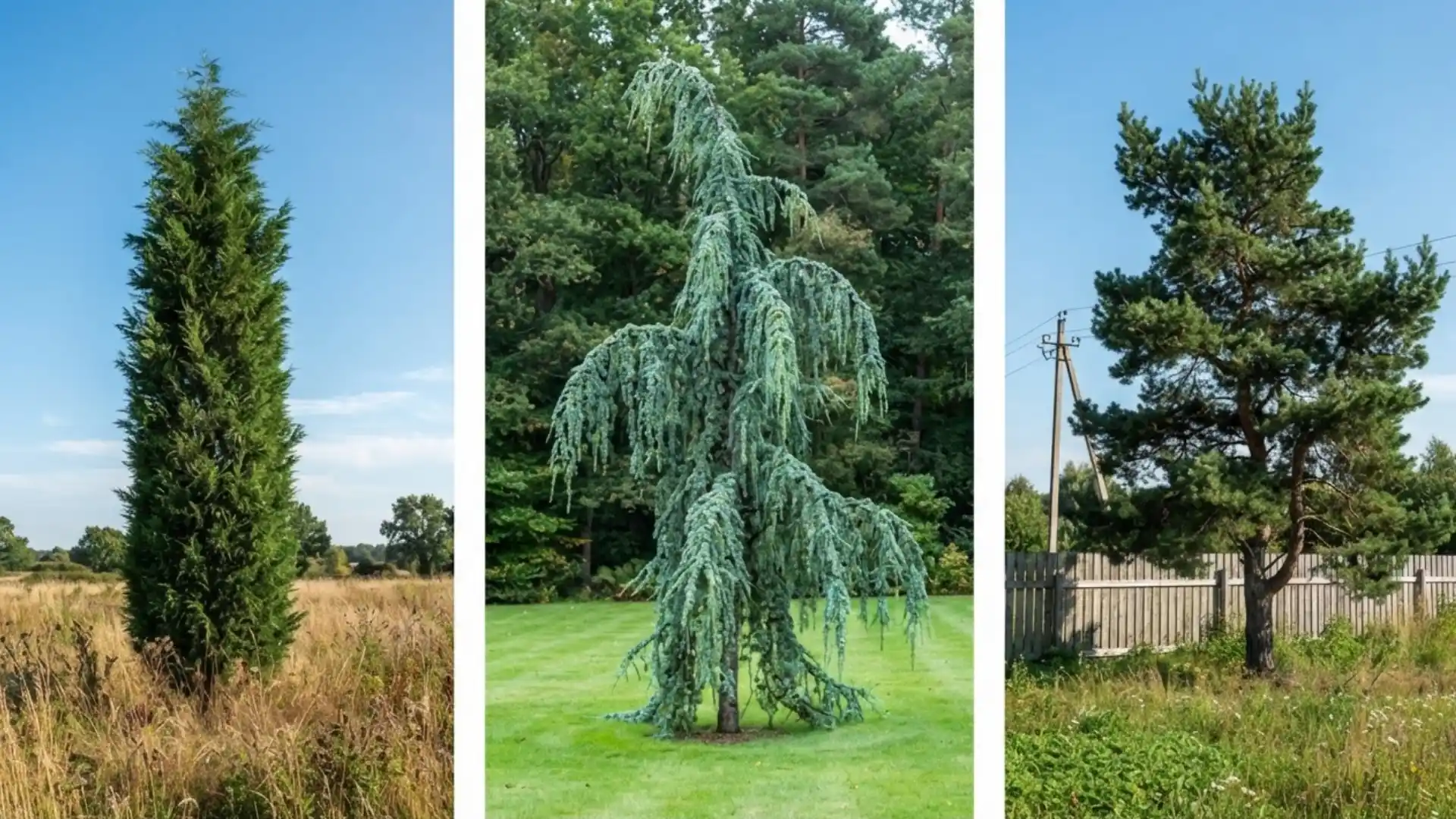
I have always found cypress trees hard to ignore. Their tall shapes, soft evergreen foliage, and calm presence can make an ordinary yard feel more private, polished, and complete.
The different types of cypress trees can vary widely in shape, growth speed, climate needs, and mature size.
That is where I usually slow down and look beyond appearance.
Knowing how tall do cypress trees grow can save you from planting a beautiful young tree that later crowds a roof, fence, walkway, or nearby plants.
Cypress Trees: An Overview
This section explains what cypress trees are and their key characteristics.
Cypress trees vary widely in height, growth rate, and climate tolerance, making species selection important based on landscape goals.
|
Attribute |
Details |
|
Family |
Cupressaceae |
|
Type |
Mostly evergreen; Bald Cypress is deciduous |
|
Common Genera |
Cupressus (true cypress), Chamaecyparis (false cypress), Taxodium (Bald Cypress) |
|
Native Regions |
North America, Mediterranean, East Asia |
|
Growth Rate |
Slow to fast, depending on species |
|
Common Uses |
Privacy hedges, windbreaks, ornamental accents, timber |
|
Climate Tolerance |
Ranges from drought-tolerant to wetland-adapted |
|
Foliage |
Scale-like or needle-like, typically dense |
How Tall Do Cypress Trees Grow?
Cypress trees can grow anywhere from a few feet tall to more than 100 feet, depending on the species and growing conditions.
Large types, such as bald cypress, can reach 70 to 100 feet or more when they have enough space, moisture, and sunlight.
Soil quality, climate, water, sunlight, and pruning can all affect the final height.
Before planting, check the mature size of the exact variety so the tree has enough room to grow without crowding buildings, fences, or nearby plants.
Types of Cypress Trees
Comparing the main types of cypress trees helps you choose one that suits your space, soil, and design goals best. The types below highlight the key differences that can help you choose more confidently.
1. Leyland Cypress (Cupressus × Leylandii)

Leyland cypress is a fast-growing evergreen valued for creating dense privacy screens and windbreaks.
Its soft, feathery foliage forms a tall, pyramidal shape that fills open spaces quickly. It grows best in full sun with well-drained soil and needs enough room for airflow.
- Height: 50-70 feet
- Spread: 12-20 feet
- Hardiness: USDA Zones 6-10
2. Italian Cypress (Cupressus Sempervirens)

Italian cypress stands out for its narrow, upright form and dark green evergreen foliage.
It is commonly planted beside entrances, driveways, walls, and formal gardens where vertical structure is needed without taking up much ground space.
This Mediterranean tree prefers full sun and well-drained soil and becomes quite drought-tolerant after its roots are established.
- Height: 40-70 feet
- Spread: 3-6 feet
- Hardiness: USDA Zones 7-10
3. Arizona Cypress (Hesperocyparis Arizonica)

Arizona cypress is a rugged evergreen with attractive blue-green to silvery foliage and a naturally conical crown.
Native to the southwestern United States and Mexico, it handles heat, dry weather, and poor soils better than many other cypresses.
It works well as a specimen tree, windbreak, or privacy planting in sunny landscapes with good drainage.
- Height: 30-50 feet
- Spread: 15-25 feet
- Hardiness: USDA Zones 7-9
4. Monterey Cypress (Cupressus Macrocarpa)

Native to California’s rugged coastline, Monterey Cypress is famed for its wind-sculpted, flat-topped canopy shaped by relentless ocean gusts.
The iconic Lone Cypress at Pebble Beach is its most photographed specimen.
In cultivated settings without coastal wind exposure, it grows into a dense, conical evergreen with aromatic, scale-like foliage.
It thrives in salty, sandy soils and is often planted as a windbreak in seaside landscapes.
- Height: 40-90 ft
- Spread: 20-30 ft
- Hardiness: USDA Zones 7-10
5. Lawson Cypress (Chamaecyparis Lawsoniana)

A graceful, pyramidal evergreen native to the Pacific Northwest, Lawson Cypress features drooping branch tips and soft, feathery, blue-green to gray-green foliage.
Widely used in ornamental landscaping, it’s the parent species behind popular dwarf cultivars like Ellwoodii.
It prefers cool, humid climates and consistently moist, well-drained soil, making it less suited to hot, dry regions.
- Height: 50-80 ft
- Spread: 15-25 ft
- Hardiness: USDA Zones 5-7
6. Hinoki Cypress (Chamaecyparis Obtusa)

Revered in Japanese garden design, Hinoki Cypress is a slow-growing, compact evergreen with glossy, fan-like foliage arranged in distinctive whorled sprays.
Its reddish-brown, peeling bark and refined, layered branching give it an elegant, sculptural quality prized in bonsai and formal landscapes.
The wood is also highly valued in Japan for temple construction due to its durability and fragrance.
Its layered form also suits a Japanese garden design built around restraint and structure.
- Height: 50-75 ft (dwarf cultivars: 3-6 ft)
- Spread: 10-20 ft
- Hardiness: USDA Zones 4-8
7. Pond Cypress (Taxodium Ascendens)

Closely related to Bald Cypress but notably smaller and narrower, Pond Cypress is a deciduous conifer native to the shallow ponds and wetlands of the southeastern U.S.
Its upright, thread-like foliage and slender, columnar shape distinguish it from its broader-crowned cousin.
Like Bald Cypress, it develops knobby “knees” in waterlogged soil, aiding oxygen uptake, and turns a warm russet-orange before dropping needles each fall.
- Height: 40-60 ft
- Spread: 10-15 ft
- Hardiness: USDA Zones 5-9
8. Nootka Cypress (Cupressus Nootkatensis)

Native to the cool, moist forests of the Pacific Northwest and Alaska, Nootka Cypress is a striking evergreen recognized by its pendulous, drooping branches and shaggy, fibrous bark.
Its blue-green foliage carries a sharp, resinous scent, and mature trees develop a distinctly weeping, almost mournful silhouette.
Highly rot-resistant, its timber is prized for boatbuilding and outdoor furniture. It tolerates cold climates far better than most cypress species.
- Height: 40-70 ft
- Spread: 15-20 ft
- Hardiness: USDA Zones 4-7
9. Sawara Cypress (Chamaecyparis Pisifera)

Originating from Japan, Sawara Cypress is an ornamental evergreen known for its soft, thread-like or feathery foliage that ranges from deep green to golden-yellow depending on cultivar.
Its loose, airy branching creates a delicate, textured appearance distinct from denser cypress types.
Popular cultivars like Filifera and Plumosa are widely used as specimen plantings or hedging. It adapts well to varied soils, but dislikes prolonged drought.
- Height: 50-70 ft (cultivars vary widely)
- Spread: 15-25 ft
- Hardiness: USDA Zones 4-8
10. Kashmir Cypress (Cupressus Cashmeriana)

Native to the Himalayan foothills of Bhutan and India, Kashmir Cypress is celebrated as one of the most ornamentally striking conifers, with long, silvery-blue, weeping foliage cascading in graceful sprays.
Often called the “weeping cypress,” it holds religious significance in Bhutanese Buddhist culture and is frequently planted near monasteries.
- Height: 30-45 ft
- Spread: 10-15 ft
- Hardiness: USDA Zones 9-11
11. Gowen Cypress (Hesperocyparis Goveniana)

A rare, endemic species confined to a handful of coastal California locations near Monterey, Gowen Cypress is a small, shrubby to low-branching evergreen adapted to nutrient-poor, sandy soils.
Its rounded crown and grayish-green, resinous foliage give it a rugged, weathered look suited to exposed, fog-influenced habitats.
Due to its limited native range and fire-dependent seed release, it holds conservation value and is rarely cultivated outside specialty native-plant gardens.
- Height: 20-40 ft
- Spread: 10-20 ft
- Hardiness: USDA Zones 8-10
Which Cypress Tree is Best for Your Yard?
Choosing the right cypress tree depends on your available space, climate, soil, and the look you want. Use this quick comparison to narrow down the best option for your yard.
|
If You Want… |
Cypress to Consider |
|---|---|
|
A tall, narrow tree |
Italian cypress |
|
Fast-growing privacy |
Leyland cypress |
|
Better wet-soil tolerance |
Bald cypress |
|
A smaller ornamental |
Golden Mop cypress |
|
Blue-green foliage |
Arizona cypress |
|
Better coastal tolerance |
Monterey cypress |
|
A weeping focal tree |
Weeping Nootka cypress |
|
Japanese garden style |
Hinoki cypress |
Common Cypress Tree Problems
Cypress trees are generally hardy, but they can develop problems when growing conditions are poor, or pests and diseases take hold. Spotting the warning signs early can help prevent serious damage.
- Cypress Canker: This fungal disease can cause sunken bark, branch dieback, and browning foliage. Infected branches should be removed promptly.
- Root Rot: Poor drainage and overly wet soil can damage the roots, leading to yellowing foliage, weak growth, and eventual decline.
- Spider Mites: These tiny pests feed on foliage and may cause yellow, bronze, or dry-looking leaves, especially during hot, dry weather.
- Bagworms: Bagworm larvae feed on cypress foliage and can strip branches when infestations become severe. Their hanging, bag-like cases are easy to spot.
- Browning Foliage: Brown needles may result from drought, overwatering, winter damage, disease, or transplant stress.
Conclusion
Some varieties grow tall and narrow, while others spread wider, stay compact, or handle wet soil better.
Knowing how tall cypress trees grow also helps you avoid planting one too close to your home, fence, or other plants.
If you need privacy, a striking focal point, or a smaller ornamental option, there is likely a cypress that fits your yard well.
Take time to compare mature height, spread, and hardiness before planting.
Share your favorite variety in the comments below with other gardeners reading along.
Frequently Asked Questions
How Much Space Does a Cypress Tree Need?
Most cypress trees need enough room for their mature width, usually 6 to 20 feet apart, depending on the species, purpose, and exact planting location.
Can Cypress Trees Be Kept Small?
Yes, some cypress trees can be kept smaller with regular pruning, but choosing a naturally compact or dwarf variety is easier and healthier long-term.
Which Type of Cypress Tree is Best for Texas?
Arizona cypress and Italian cypress are popular Texas choices because they tolerate heat and drought, while bald cypress performs well in wetter areas across Texas.