Most people start shopping for cabinets by looking at paint swatches and photos in the showroom.
The salesperson might briefly mention how the cabinets are built, and it’s common to just nod without really understanding.
Framed vs. frameless cabinets is the choice that sets a kitchen’s character.
The construction behind the doors decides how the room looks, how far each cabinet opens, and how the whole run holds up over years of daily cooking and cleaning.
But you’ll notice the difference between framed and frameless cabinets long after installation.
Taking a few minutes to understand the difference before you order can help you avoid second-guessing your decision later.
What are Framed Cabinets?
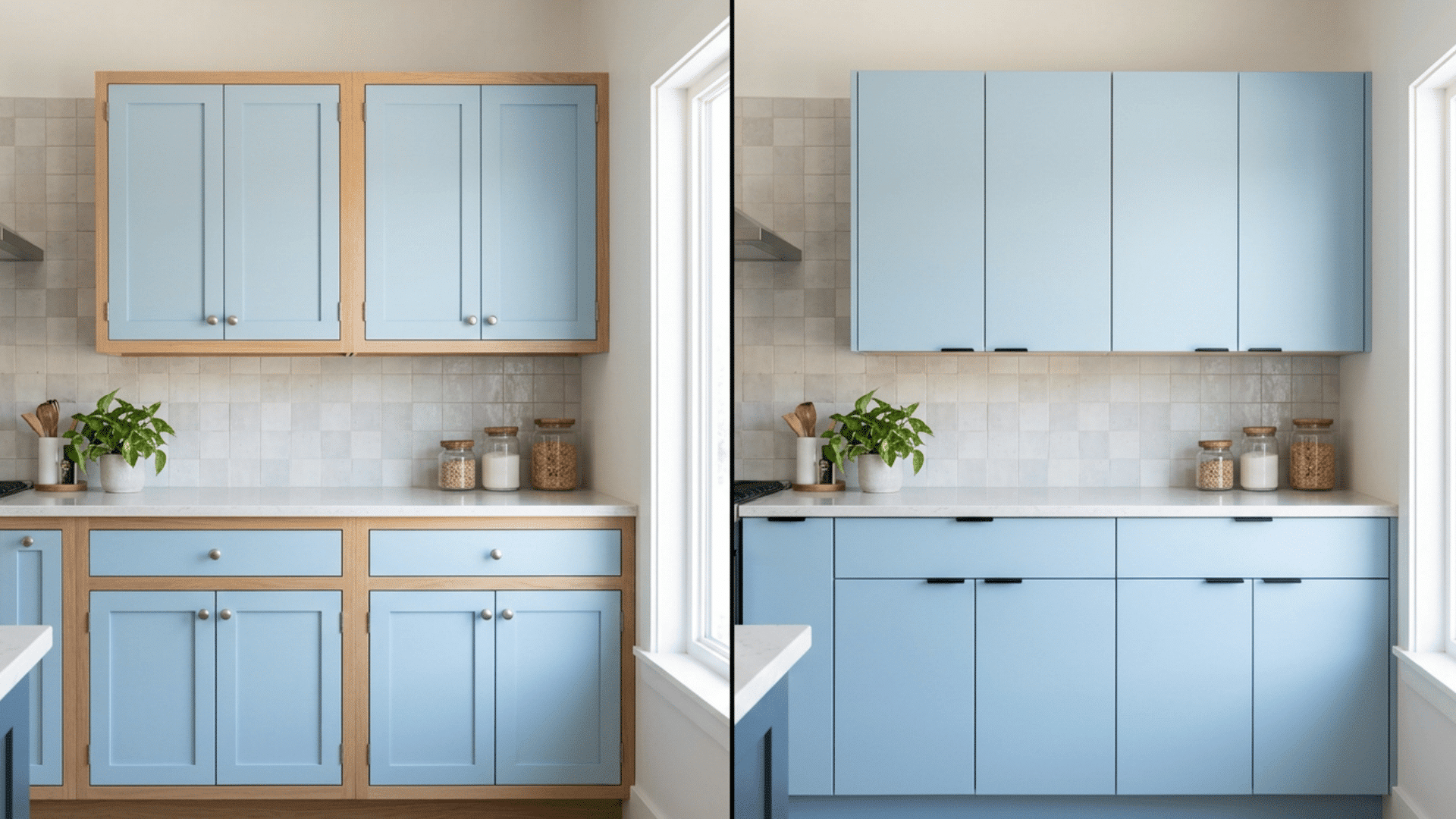
Framed cabinets, also called face-frame or American-style cabinets, have a solid frame attached to the front of the cabinet box.
The frame runs along the edges of each door, giving the cabinet both its structure and its distinctive look.
Doors and drawers attach directly to the frame, making the cabinet feel very sturdy.
Doors can either sit flush inside the frame opening (inset) or cover the frame partly (standard overlay) or almost completely (full overlay).
I like that visible edging in a traditional kitchen; it also fits farmhouse details and other classic finishes.
The visible border adds charm to these designs.
What are Frameless Cabinets?
Frameless cabinets skip the front framework, mounting doors and drawers directly to the cabinet box so the doors cover the front edges.
Without a frame narrowing the opening, you get full-width access, making it easier to reach cookware, especially when the cabinet is packed.
The front looks smooth and continuous, giving it a polished and purposeful feel. These are often called European-style or full-access cabinets.
They work well in modern and contemporary kitchens where a sleek, seamless look is important.
Framed vs. Frameless Cabinets: Side-by-Side Comparison
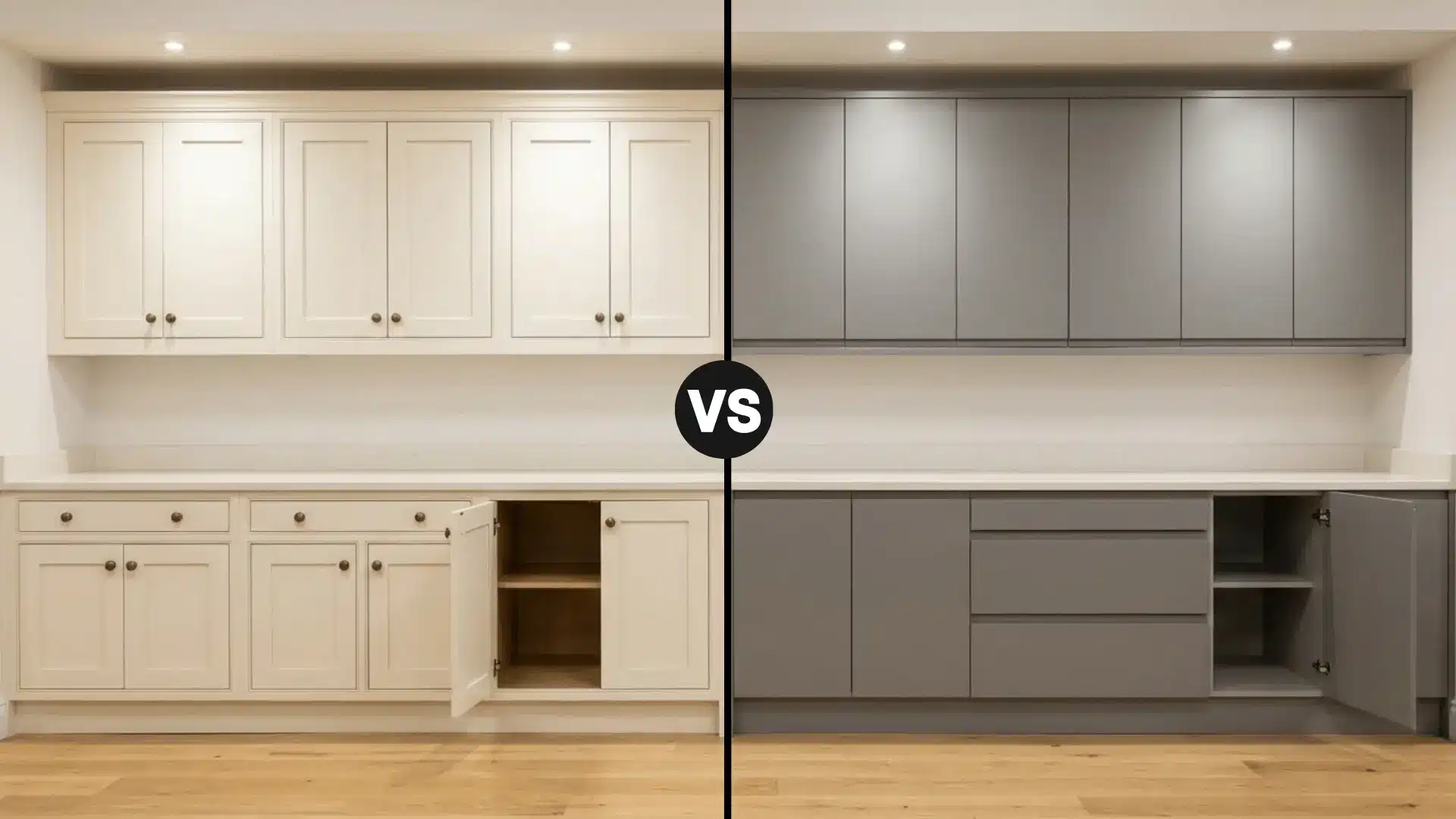
Framed cabinets give up some interior access for a face frame that adds rigidity, while frameless cabinets give easier access and often, but not always, cost more.
1. Construction
Framed cabinets have a solid face frame attached to the front, which adds strength and stability.
Frameless cabinets lack this frame and rely on the box itself for support. Frameless cabinets use thicker side panels and tighter joints to stay strong without a frame.
The strength of either type depends on the materials and how well they are made.
2. Appearance
Framed cabinets feel cozy and traditional, while frameless cabinets look modern and stylish.
-
Framed cabinets have a warm, classic look with visible borders around each door.
-
Frameless cabinets have a smooth, seamless front that looks modern and tidy.
The choice depends on whether your kitchen style is more classic or contemporary.
Framed cabinets with full overlay doors can look similar to frameless ones, but inset doors highlight the frame as a design feature.
3. Storage and Access
Frameless cabinets open all the way, so you can easily reach everything inside.
The face frame on framed cabinets reduces the opening, which can make it a bit harder to access the contents.
If you cook a lot and need as much cabinet space as possible, this difference can matter more than you might think. It is especially noticeable in base cabinets, where frameless drawers are wider, and in small kitchens where every inch counts.
How to Choose the Right Cabinet Material
The material you choose for the cabinet box is just as important as the frame.
Plywood resists moisture better than particleboard, which can swell when it gets wet and usually does not return to its original shape.
Medium-density fiberboard is a good choice for painted doors because it takes paint evenly, but it is not as strong for supporting heavy loads.
Solid wood is often used for face frames and doors, but it expands and contracts with humidity more than plywood.
Frameless cabinets rely on their panels for strength, so plywood is usually the better option.
If a spec sheet says the box is made entirely of plywood, that is a good sign.
Pros and Cons of Framed and Frameless Cabinets
Framed cabinets work well in kitchens where structure and easy installation are important. Frameless cabinets are a good choice for kitchens that focus on open space and a modern, clean look.
Framed Cabinets
Framed cabinets are a timeless choice; however, the added frame is the deciding factor in whether they’re the right fit for your kitchen.
Where Framed Cabinets Shine
-
The solid face frame adds strength, so these cabinets stay sturdy for years.
-
It is easier to align the doors on framed cabinets, which usually makes installation smoother.
-
Their classic, bordered style looks right at home in traditional, farmhouse, or cottage kitchens.
Where Framed Cabinets Fall Short
-
The face frame makes the cabinet opening a bit smaller and slightly reduces the storage space, which can matter when you have a lot of cabinets.
-
In smaller kitchens, the visible frame can make the space feel heavier, so a lighter, seamless style might work better.
Frameless Cabinets at a Glance
Frameless boxes carry the load themselves, so their strengths and drawbacks both come from the lack of a frame.
|
Pros |
Cons |
|---|---|
|
Full access to the whole interior, including base cabinets and deep shelves |
Often a higher price than framed alternatives |
|
A sleek, uninterrupted front with a polished, contemporary finish |
Installation needs to be precise and level from the start |
|
Cleaner lines that make even smaller kitchens feel more open |
Door and drawer alignment leaves less room for error, so adjustments are trickier down the line |
How Each Style is Built and Installed
Framed cabinets start with a hardwood framework attached to the box, with hinges fastened to the vertical frame pieces.
Frameless panels are joined with dowels and glue, then clamped together, with hinges mounted inside the side panels.
Installation is where precision matters most; frameless doors have narrow gaps, and there’s no front frame to hide uneven alignment. Even small errors can show.
Older homes often have uneven floors, so many base units have leveling legs to help.
On uneven walls, framed cabinets can use extended stiles or fillers to hide gaps, while frameless cabinets can use applied panels to cover them.
Which Style is More Durable: Framed or Frameless Cabinets
Either style can last for decades; box materials and joinery matter more than the presence of a frame.
Framed cabinets add rigidity and resistance to warping (useful in a busy family kitchen).
Frameless cabinets depend on strong panels and joints, so plywood sides with doweled joints make a durable combination.
I’d watch for thin particleboard in either style, especially near the sink. A frame cannot rescue poor-quality boxes from repeated moisture.
Whichever style you pick, look for the cabinet industry’s A161.1 quality certification, which tests structural integrity, moisture resistance, hardware performance, and finish durability.
Which Cabinet Style is More Popular?
Framed cabinets still lead in residential kitchens, and many installers have years of experience working with them.
That familiarity helps us with availability and pricing. Frameless cabinets are gaining ground faster, though, and the popularity gap is getting smaller.
Their flat, flush fronts suit modern open-plan kitchens, and the extra usable interior space is another draw.
But I wouldn’t let popularity make my decision. Traditional kitchens often pair well with framed cabinets, and modern kitchens often suit frameless ones, though either can work with the surrounding finishes.
Cost Comparison: Framed vs Frameless Cabinets
Frameless cabinets often cost more, though the price gap varies by tier, maker, and door style; base prices run roughly $50 more per linear foot at both ends of the ranges.
Installers usually price labor by the cabinet or linear foot, so ask them to break out the labor line.
|
Cost Factor |
Framed Cabinets |
Frameless Cabinets |
|---|---|---|
|
Base Price |
$100 to $300 per linear foot |
$150 to $350 per linear foot |
|
Installation Complexity |
Forgiving; the frame allows small adjustments |
Precise leveling needed |
|
Hardware Requirements |
Wider choice of hinge styles, including decorative ones |
Fully concealed, adjustable hinges |
|
Material Usage |
A face frame plus box panels |
Thicker box panels in place of a frame |
|
Overall Value |
Budget-friendly for traditional kitchens |
Higher upfront, stronger return in modern builds |
Can You Mix Framed and Frameless Cabinets?
Yes, you can use both! But I’d plan the combination from the start rather than treat it as an afterthought; different visual weights can make the kitchen feel disjointed.
Choose one construction as the main style, then use the other in a separate zone.
The island and perimeter cabinets give you that separation without switching styles back and forth along the same wall.
Full-overlay doors on framed cabinets help reduce contrast, while matching door profiles and finishes keep everything connected.
Plan the island’s footprint first, because kitchen shelf dimensions for seating and layout set how many base cabinets it can hold.
I want the kitchen to feel coordinated, not like two cabinet plans competing for attention every time we walk in.
Final Thoughts
Start by choosing a style that suits your room. After that, make sure the installer is skilled, and the project fits your budget before you agree to anything.
The best option between framed vs. frameless cabinets is the one that works for your lifestyle, your space, and the kitchen you want to enjoy every day.
Already picked a favorite, or still going back and forth?
Tell me in the comments; I’d love to hear which option you’re considering!
Frequently Asked Questions
Which Cabinet Style Offers More Door Options?
Framed cabinets offer more door options. The face frame supports raised panels, inset doors, and other decorative profiles, while frameless builds generally limit you to fewer door styles.
Which Cabinet Style is Better for Glass-Front Doors?
Framed cabinets are the better fit for glass-front doors. The hinge can sit between the frame and the door, so it stays hidden from view inside the cabinet.
Can You Reface Existing Cabinets Instead of Replacing Them?
Usually yes, if the cabinet boxes are sturdy. Refacing swaps doors, drawer fronts, and veneer over existing boxes, but switching from framed to frameless usually requires significant remodeling.
Which Cabinet Style is Better for Resale Value?
Neither wins outright. Buyers respond to quality, condition, and style fit, so choose the construction that suits your home’s character, whether traditional or modern, and keep the boxes well built.