
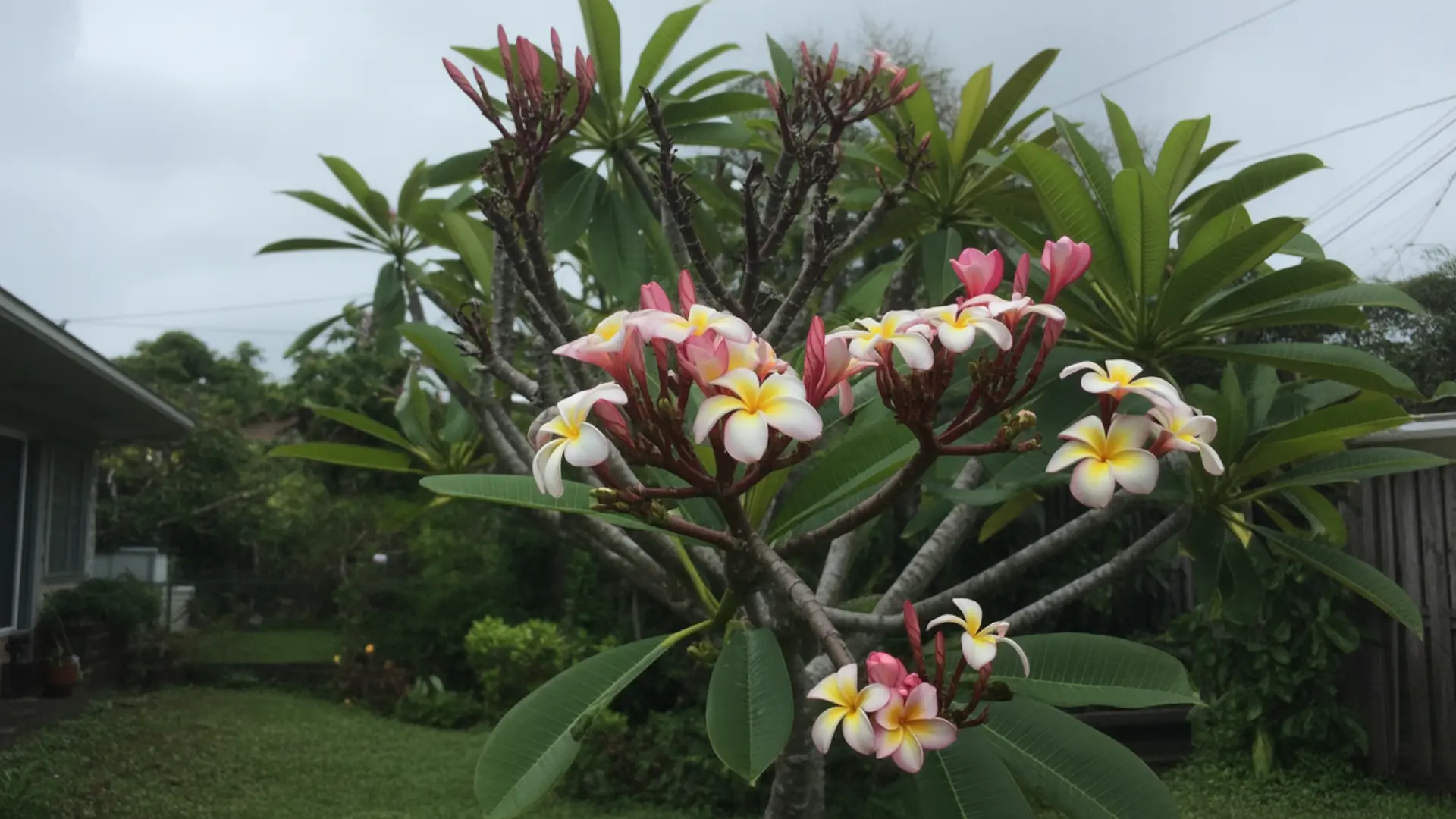
Plumeria, which is also called frangipani or, in some regions, the temple tree, is a tropical flowering shrub prized for its waxy, intensely fragrant blooms.
Just give it full sun, fast-draining soil, and a proper dry winter rest, and it will give you clusters of flowers every year, whether it’s planted in the ground or growing in a container on a balcony.
This guide covers everything you need for plumeria plant care: getting the light, water, and soil right, fertilizing and pruning for more blooms, spotting cold damage early, and keeping common pests away.
What is a Plumeria?
Plumeria is a genus in the Apocynaceae family, native to Central America, Mexico, and the Caribbean, and now grown across tropical and subtropical regions worldwide.
However, three species come up most often in home gardens:
- Plumeria rubra, which has classic fragrant flowers in vibrant hues
- Plumeria alba is a pure white bloom with yellow centers
- Plumeria obtusa has rounded leaves and a compact growth habit
These plants work as landscape focal points in warm climates, adapt well to container growing in cooler zones, and hold real cultural significance in Hawaii and parts of Southeast Asia.
Plumeria’s Native Growth Patterns
In their native tropical and subtropical habitats, plumerias thrive in warm, sunny environments with distinct wet and dry seasons.
These deciduous beauties develop thick, succulent branches with elongated leaves clustered at branch tips.
Climate requirements:
- USDA Hardiness Zones 9–11: Suitable for year-round outdoor growing.
- Zones 8 and below: Require container cultivation with winter protection.
Blooms typically appear from spring through fall, releasing their signature sweet fragrance that intensifies in the evening.
The scent varies by variety, ranging from jasmine-like to citrusy to coconut notes.
Ideal Growing Conditions for Plumeria

Plumeria thrives when its basic needs are met, and getting these four factors right sets the stage for healthy growth and reliable blooms.
1. Light Requirements
Plumeria needs full sun to put on its best show. Aim for at least six hours of direct sunlight each day, and more if you can manage it.
Plants grown in partial shade will survive, but they tend to produce fewer flowers and can develop leggy, weak stems as they stretch toward the light.
- Sun exposure: At least six hours of direct sunlight daily.
- Bloom trigger: Low light is the top reason plumeria won’t flower.
- Placement: South- or southwest-facing spots give the most consistent light.
2. Water Requirements
Plumeria roots are prone to rot, so less is often more. During the active growing season in spring and summer, water deeply but only once the top inch or two of soil has dried out.
Cut back significantly in fall and winter when the plant enters dormancy, watering just enough to keep the roots from drying out completely.
- Growing season: Water deeply once the topsoil dries out.
- Dormant season: Cut back watering drastically in fall and winter.
- Biggest risk: Overwatering causes root rot more than drought does.
Since plumeria’s watering rhythm is closer to a drought-tolerant plant than a typical tropical, seasonal watering for dry-loving plants is a useful comparison if you are used to watering by the calendar instead of by the soil.
3. Soil Requirements
A loose, fast-draining mix is non-negotiable for plumeria. Heavy, water-retentive soil is one of the most common reasons these plants struggle.
A blend of cactus or succulent potting mix combined with perlite or coarse sand works well for container plants.
If planting in the ground, amend dense clay soil with organic matter and grit to improve drainage.
- Mix type: Cactus or succulent soil with perlite added.
- Priority: Drainage matters more than soil fertility.
- pH range: Slightly acidic to neutral, around 6.0–7.0.
4. Temperature Requirements
Plumeria is a tropical plant through and through, and it does not tolerate cold.
It grows best in temperatures between 65 and 90 degrees Fahrenheit and starts to suffer once temperatures dip below 50. A light frost can damage leaves and stems, while a hard freeze can kill the plant outright.
- Ideal range: 65–90°F for healthy growth.
- Danger point: Damage starts below 50°F.
- Cold-climate fix: Grow in containers for easy indoor moves.
Correct Fertilizer Routine for Blooms
Plumeria is a hungry bloomer, and the right fertilizer routine makes the difference between a plant that just grows leaves and one that’s covered in flowers all season.
Choosing the correct nutrient balance and timing matters just as much as watering or sunlight.
- Best ratio: High-phosphorus formulas, such as 10-30-10, encourage flowers over foliage.
- What to avoid: Nitrogen-heavy fertilizers trade blooms for extra leaf growth.
- Form options: Granular, water-soluble, or slow-release formulas all work well.
- Growing season: Fertilize every two to three weeks from spring through summer.
- Dormant season: Stop feeding entirely once the plant drops its leaves in fall.
- Timing tip: Resume fertilizing only after new growth appears in spring.
Pruning and Shaping Your Plumeria
Strategic pruning transforms lanky, single-stemmed plumerias into full, multi-branched specimens that produce exponentially more blooms.
When and Why to Prune Plumeria?
The best pruning window opens in late winter or early spring before new growth emerges. Pruning during dormancy minimizes stress and allows wounds to heal as the growing season begins.
Remove damaged, diseased, or frost-bitten branches whenever you spot them, regardless of season.
Pruning encourages branching at cut sites, and each branch tip can produce flower clusters.
A well-pruned plumeria develops a bushier silhouette with multiple flowering points rather than a single tall stem.
Step-by-Step Shaping Techniques
Here’s how to shape your plumeria for maximum branching and bloom production:
- Step 1: Sterilize pruning shears with rubbing alcohol or bleach solution before making any cuts.
- Step 2: Cut main stems at a 45-degree angle, leaving at least 12 inches of growth from the base.
- Step 3: Make cuts just above a node or natural branch junction to promote healing and new growth.
- Step 4: Remove any leggy, weak, or crossing branches to improve air circulation and structure.
- Step 5: Allow cut ends to dry and callus for several days before watering to prevent rot.
Always wear gloves when pruning, as plumeria sap can irritate skin. Along with tha, clean tools between plants to avoid spreading potential diseases through your collection.
List of Plumeria Plant Care: Problems & Fixes
|
Problem |
Cause |
Fix |
|---|---|---|
|
Won’t bloom |
Insufficient sunlight |
Move to the brightest spot available, or add grow lights indoors |
|
Won’t bloom |
Low phosphorus |
Switch to a high-phosphorus fertilizer (e.g., 10-30-10) during the growing season |
|
Won’t bloom |
Skipped dormancy |
Allow at least two months of winter rest with reduced water and cool temperatures |
|
Buds dropping |
Temperature swings, inconsistent watering, transplant shock |
Keep conditions stable; avoid moving the plant once buds form |
|
Lush leaves, few flowers |
Too much nitrogen |
Cut back on fertilizer or switch to a bloom-specific, low-nitrogen formula |
How to Propagate Plumeria
Growing new plumerias from cuttings is remarkably straightforward and deeply satisfying.
This method produces genetically identical plants that will bloom with the same color and fragrance as the parent.
Step-by-Step Cutting Propagation
Follow these steps to successfully propagate plumeria from stem cuttings:
- Step 1: Cut a healthy branch 12 to 18 inches long at a 45-degree angle using sterilized shears.
- Step 2: Allow the cut end to dry and callus in a shaded, dry location for 5 to 7 days.
- Step 3: Dip the callused end in rooting hormone powder to encourage faster root development.
- Step 4: Plant the cutting two to three inches deep in well-draining cactus mix or perlite.
- Step 5: Water lightly and place in bright, indirect light until roots establish in 4 to 8 weeks.
Rooting Methods: Soil vs. Water
Both techniques work, though each has distinct advantages depending on your situation:
|
Method |
Pros |
Cons |
|---|---|---|
|
Soil |
Roots adapt immediately; less transplant shock |
Harder to monitor progress |
|
Water |
Visual root monitoring: faster initial growth |
Roots must adapt when transplanted |
Once roots reach two to three inches long, transition your cutting to regular care.
Water sparingly at first, gradually increasing as the root system establishes. Avoid fertilizing for the first two months. Provide bright light, but protect from intense afternoon sun at first.
Most cuttings bloom within two to three years when given proper care.
Common Pests & Diseases to Look Out For
Plumeria faces relatively few pest and disease problems, but staying vigilant helps you catch issues early.
- Spider Mites: Create fine webbing and stippled leaves. Treat with insecticidal soap or neem oil spray.
- Mealybugs: Appear as white, cottony masses at leaf joints. Remove with rubbing alcohol on cotton swabs.
- Aphids: Cluster on new growth and buds. Control with a strong water spray or horticultural oil; catching aphids early makes it easier to stop a cluster before it spreads to nearby plants.
- Scale Insects: Show up as brown bumps on stems. Require manual removal or systemic insecticides.
- Fungal Rust: Causes orange pustules on leaf undersides. Manage by removing affected foliage and improving air circulation.
- Black Tip Rot: Attacks branch ends in cool, wet conditions. Requires immediate pruning of infected tissue.
Prevention through proper spacing, adequate sunlight, and avoiding overhead watering beats treatment every time.
Seasonal Plumeria Care to Consider
|
Season |
Key Tasks |
Watering & Feeding |
|---|---|---|
|
Spring |
Resume care as leaves emerge; transition outdoors gradually |
Start light watering; begin biweekly fertilizing |
|
Summer |
Maintain consistent care; monitor pests |
Deep water when the top two inches are dry; fertilize every 2-3 weeks |
|
Fall |
Reduce frequency; prepare for dormancy |
Taper watering as leaves drop; stop fertilizing by late fall |
|
Winter |
Allow full dormancy; protect from cold |
Stop watering or use minimal monthly amounts; no feeding |
Decorative & Landscaping Uses of Plumeria
Plumeria brings instant tropical ambiance to outdoor spaces with its sculptural form and intoxicating blooms.
However, strategic placement maximizes both visual impact and plant health throughout your landscape.
- Tropical Garden Focal Points: Plant plumeria as specimen trees in prominent locations where their architectural branching and flower clusters command attention.
- Poolside Paradise Plantings: Position containers around pool decks where fallen flowers create a spa-like atmosphere, and fragrance enhances the resort experience.
- Patio Container Groupings: Cluster multiple plumerias in varying heights with complementary foliage plants for moveable tropical displays.
- Companion Plant Pairings: Underplant with hibiscus, bird of paradise, crotons, or ornamental grasses that share similar sun and water requirements.
- Entryway Statement Pieces: Flank doorways or gates with matching plumerias in decorative containers for a welcoming tropical greeting.
Potting vs Ground Planting
|
Factor |
Container Growing |
In-Ground Planting |
|---|---|---|
|
Best suited for |
Cooler climates need winter indoor moves |
Warm, frost-free climates |
|
Sizing |
10–12-inch pot to start, repot every 2–3 years |
Space for full mature height and spread |
|
Soil/drainage |
Cactus or succulent mix in a pot with drainage holes |
Fast-draining native soil, raised or mounded beds |
|
Flexibility |
Movable for frost protection |
Permanent, unrestricted growth |
Whichever route you choose, good drainage is the one thing plumeria will not forgive you for skipping, and watering from the base to avoid rot works just as well for a potted plumeria as it does for any other container plant.
Frequently Asked Questions
How Often Should I Water My Plumeria?
Water deeply once the top inch or two of soil dries out during the growing season, then cut back significantly in fall and winter when the plant goes dormant.
Why Is My Plumeria Not Blooming?
Insufficient sunlight is the most common cause. Plumeria needs at least six hours of direct sun daily to produce flowers reliably.
Can Plumeria Survive Winter Outdoors?
Only in USDA zones 9–11. In zones 8 and below, plumeria needs to be grown in a container and brought indoors before the first frost.
How Long Does Plumeria Take To Bloom?
Established plants typically bloom from spring through fall each year, while plants grown from cuttings can take one to three years to flower for the first time.
The Closing Note
Caring for plumeria doesn’t demand perfection, just a little attention and patience.
These plants reward you with beautiful blooms and a quiet sense of accomplishment that comes from watching something thrive under your care.
Adjust watering habits as seasons change, find that perfect sunny corner, or simply pause to enjoy their fragrance on a warm afternoon.
Plumeria plant care becomes part of life’s gentler rhythms.
Have questions or tips of your own? Drop a comment below. We’d love to hear how your plumerias are doing.



One Response
What is the best distance between to place multiple trees in a yard?