When you’re planning a renovation or building from scratch, the smallest misunderstandings can quietly snowball into the biggest headaches.
Story height is one of those terms that sounds straightforward until you’re mid-project and suddenly everyone in the room has a different number.
Is it measured to the ceiling?
Does it include the floor above?
The confusion is more common than you’d think, and the answer actually depends on who’s asking and why. So let’s clear it up together before it trips up your build.
What is “Story Height” in Construction?
When builders and architects talk about story height, they’re referring to the total vertical distance from one finished floor to the finished floor directly above it.
This measurement is used differently depending on whether you’re looking at it from a structural or architectural lens.
Structurally, it accounts for everything stacked between floors. Architecturally, it’s more about the experience of the space.
This is where the confusion creeps in, because story height, ceiling height, and clear height all sound interchangeable but aren’t.
Ceiling height is what you see; story height is what the building actually occupies, and that distinction becomes especially visible when looking at two-story house dimensions.
Does Story Height Include the Floor Structure?
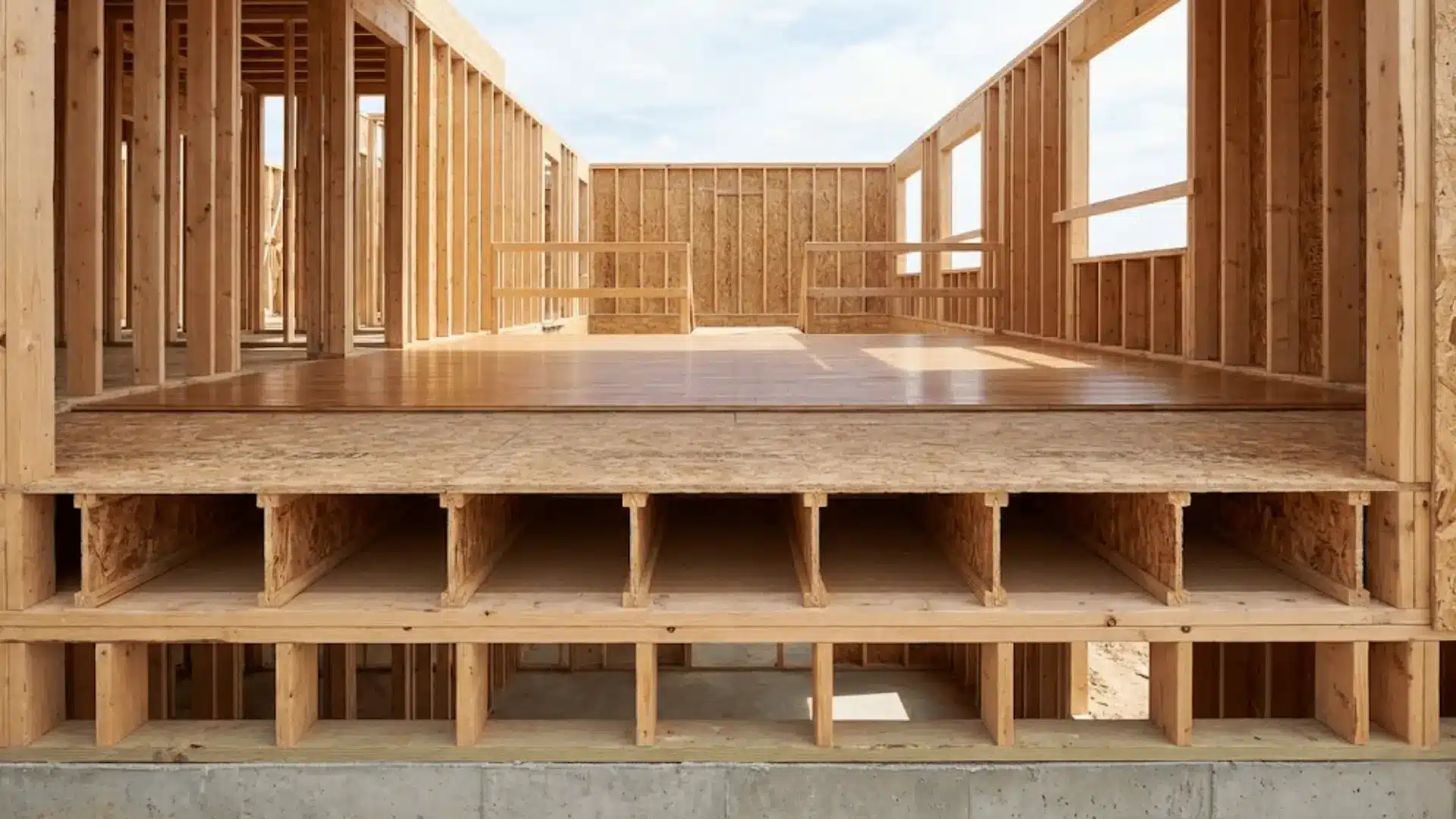
Story height isn’t just the air between your floor and ceiling. It’s a full measurement that accounts for everything in between, including the structure you’re standing on.
Standard Residential Construction
In most homes, story height includes the floor joists, subfloor, and finished flooring layered on top. These components sit between one level and the next, quietly adding inches to the overall measurement.
For slab-on-grade construction, the slab thickness itself factors in, which is why two homes with identical ceiling heights can have different story heights altogether.
These differences also ripple into outdoor elements like second story balcony height, where code minimums depend directly on how the story is measured.
Multi-Story Commercial Buildings
Commercial construction adds even more layers to the equation. Structural slabs, post-tension systems, and dedicated mechanical spaces for HVAC, plumbing, and electrical all live between floors.
This is why commercial floor-to-floor heights run noticeably taller than residential ones. Every system needs room, and that room is built directly into the story height measurement.
Why It’s Included?
Floor structure carries the load from everything above it, so excluding it from story height would create gaps in how vertical space is measured and built to code.
Consistent vertical measurement standards exist for a reason: safety, structural accuracy, and coordination between trades. The floor structure isn’t a footnote in the measurement; it’s a core part of it.
Building Code Definitions of Story Height
Building codes don’t all speak the same language when it comes to story height. Knowing which code applies to your project can change how every measurement gets interpreted.
International Residential Code (IRC)
The IRC defines a story as the portion of a structure between the upper surface of a floor and the upper surface of the floor or roof above. This means the floor structure is included by default.
Measurement reference points shift based on grade and ceiling height thresholds. For the full definition, refer to the IRC official documentation via the ICC.
International Building Code (IBC)
The IBC takes a broader approach, especially for commercial buildings, mezzanines, and mixed-use structures, where floor assemblies are thicker and more complex.
A mezzanine, for instance, may or may not count as a full story depending on its square footage relative to the floor below. The distinction matters for occupancy classification and height limits.
You can review the IBC directly through the ICC’s official IBC portal.
What is NOT Included in Story Height?
Not everything that adds to a building’s visual height actually counts toward story height. Here’s what typically gets left out of the measurement.
- Parapets sit above the roofline and serve as safety or aesthetic barriers; they don’t contribute to story height calculations.
- Roof structures like pitched roofs or decorative peaks are often excluded, particularly when they don’t enclose habitable space.
- Decorative architectural elements such as cornices, facades, or ornamental framing add visual height but hold no structural measurement value.
- Crawlspaces are generally not counted as a story unless the finished floor height clears a certain threshold defined by local code.
When in doubt, the rule of thumb is simple: if it isn’t habitable or structurally load-bearing in a vertical sense, it likely isn’t factoring into your story height.
Typical Story Heights in U.S. Construction
It’s also worth noting that overall house height and property value are more connected than they appear, particularly when appraisals come into the picture.
Here’s a general look at how floor-to-floor heights typically break down across construction categories in the U.S.
| Building Type | Typical Story Height (Floor-to-Floor) |
Typical Ceiling Height | Mechanical/Plenum Space |
|---|---|---|---|
| Residential (8 ft ceilings) | 9–10 ft | 8 ft | Minimal, 12–18 in |
| Residential (9 ft ceilings) | 10–11 ft | 9 ft | Minimal, 12–18 in |
| Luxury Homes | 11–12 ft | 10–11 ft | Minimal to moderate, 12–24 in |
| Commercial Office | 12–14 ft | 9–10 ft | Moderate, 2–3 ft |
| High-Rise Commercial | 14–16 ft | 10–11 ft | Significant, 3–4 ft |
How to Calculate Story Height Correctly?
Getting story height right comes down to measuring the full assembly, not just the open air of the room.
Follow these steps to make sure your numbers hold up.
- Step 1: Start your measurement from the top surface of the finished floor, not the subfloor or slab beneath it.
- Step 2: Extend your measurement up to the top surface of the finished floor on the level above, keeping it consistently floor-to-floor.
- Step 3: Factor in the full depth of the slab or joist assembly sitting between levels; this is what most people accidentally skip.
- Step 4: Cross-reference everything against your building plans or architectural drawings to catch any discrepancies before they become on-site problems.
A measurement that skips even one of these steps can throw off everything from ceiling clearances to mechanical rough-ins. When the numbers are right from the start, the rest of the build follows a lot more smoothly.
Wrapping Up
Story height might seem like a small detail on paper, but it quietly shapes every decision made on a build, from framing to finishes.
Understanding whether story height includes the floor structure isn’t just a technical checkbox; it’s the kind of clarity that saves time, budget, and a lot of back-and-forth on site.
Once you know how to read the measurement correctly, everything from code compliance to spatial planning starts making a lot more sense.
If this helped untangle things for you, drop your questions or project specifics in the comments below.