Somewhere between a wellness trend and a windowsill staple, air-purifying plants have earned themselves quite the reputation.
But do air-purifying plants really work, or has clever marketing turned a pretty leaf into a grand promise?
You’ve probably heard whispers of the NASA study, seen the Pinterest boards, the aesthetic shelfies, the “clean air” captions.
And honestly, the curiosity is valid!
Here’s what the indoor air quality science actually says, where the myths fall apart, and what your beloved pothos is genuinely capable of.
What the NASA Clean Air Study Really Was
Back in 1989, NASA partnered with the Associated Landscape Contractors of America to explore something genuinely fascinating.
The research tested plants’ ability to filter toxic compounds like formaldehyde, benzene, and trichloroethylene from the air.
The results were promising enough to spark decades of headlines, home gardening trends, and a whole lot of marketing copy. What got lost in translation, though, was context.
The study was conducted in small, sealed chamber environments, nothing remotely close to a ventilated, lived-in home.
Plants performed beautifully in controlled conditions, which is exactly why the findings traveled so far and why they need a little unpacking today.
How Plants Can Physically Interact with Air?
Plants are doing quiet, constant work just by existing. Through photosynthesis, they absorb carbon dioxide and release oxygen, making any indoor space feel a little more alive.
Beyond that, research has shown plants can absorb VOCs through tiny pores in their leaves called stomata, pulling certain airborne compounds into their tissue.
The more layered part of the story, though, is the soil.
The root and soil system, known as the rhizosphere, hosts microbial communities that actively break down pollutants at a surprisingly significant rate.
In controlled lab settings, this plant-plus-microbe relationship proved to be where a lot of the real filtration magic happened.
NASA’s Top Tested “Air-Purifying” Plants
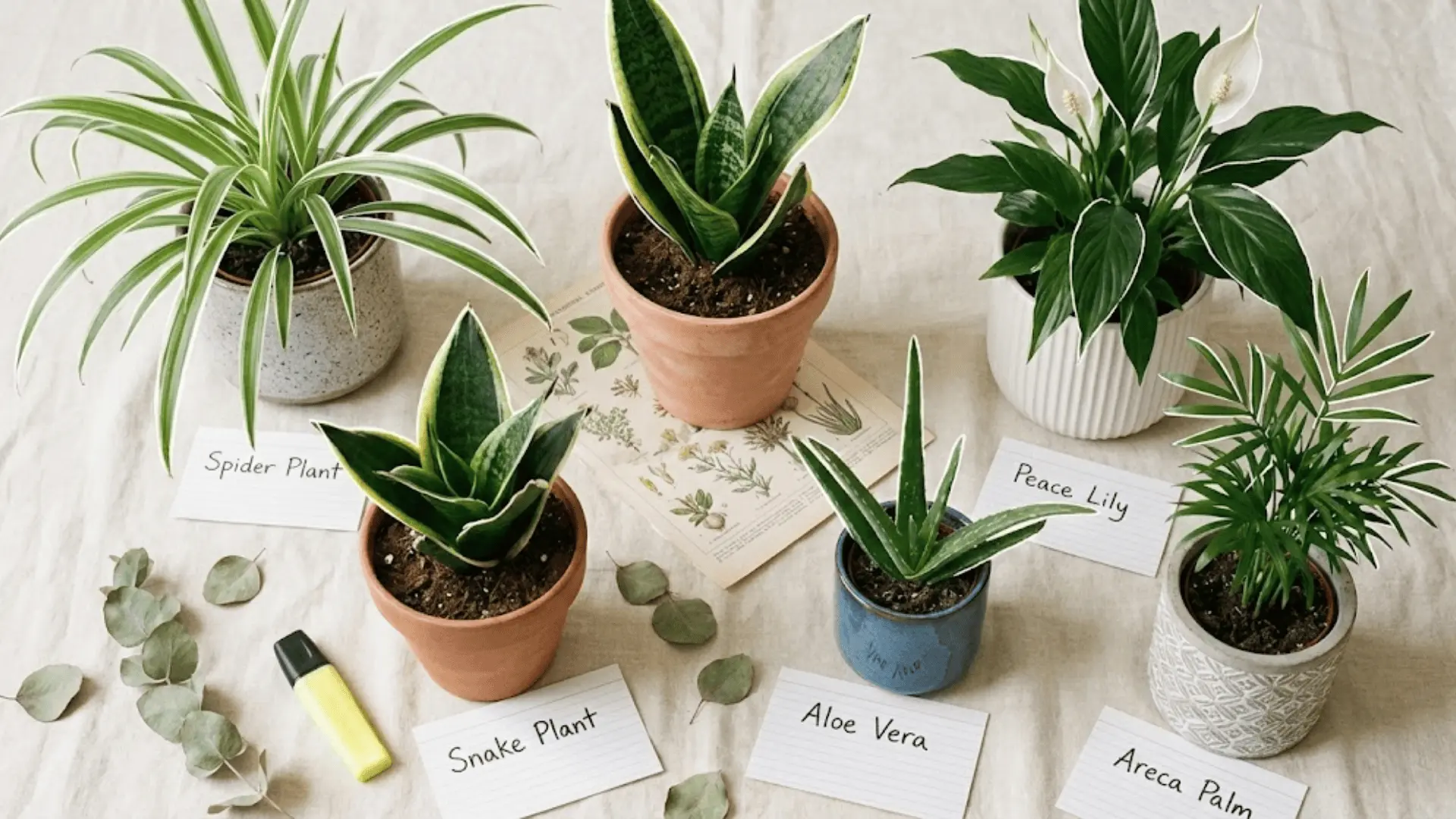
Certain plants repeatedly appeared in NASA’s findings, and their names have circulated online ever since. Among them are many of the most sought-after indoor plants that Gen Z has since turned into full-blown cultural moments.
Here are the most cited ones, along with what makes each worth keeping around.
1. Spider Plant
One of the most forgiving plants you can own, the spider plant showed strong results in removing formaldehyde, xylene, and toluene from sealed test environments.
It thrives in indirect light and needs watering only once the soil feels dry. Pet-friendly, fast-growing, and practically impossible to kill, it is a genuinely great starting point for anyone new to indoor plants.
2. Snake Plant
The snake plant earned its reputation quietly. NASA flagged it for absorbing formaldehyde, benzene, xylene, and nitrogen oxides, and it does this even through the night, releasing oxygen while most plants pause.
It prefers bright indirect light but tolerates low-light corners well. Water sparingly, as it is highly drought-tolerant and more likely to suffer from overwatering than neglect.
3. Peace Lily
The peace lily works across multiple VOCs and also adds a gentle humidity boost to dry indoor air. It is one of the few flowering plants on NASA’s list, making it as decorative as it is functional.
Keep it in low to medium indirect light and water it when the leaves just begin to droop slightly for best results.
4. Aloe Vera
Aloe vera absorbs formaldehyde and benzene from the air and is a great first-aid plant on your windowsill. It prefers bright, direct light and infrequent watering, perfect for sunny spots that are often overlooked.
The gel inside its leaves is a bonus, but its air-interacting qualities are what earned it a place in NASA’s research.
5. Areca Palm
The areca palm acts as a natural humidifier and targets airborne toxins. It prefers bright, indirect light and consistent moisture without sitting in waterlogged soil, making how often you water far more important
Its feathery, tropical fronds make it a statement piece in living rooms, and its size means more leaf surface area actively interacting with the surrounding air throughout the day.
A Few More Worth Mentioning
The conversation does not stop there. Several other plants have appeared across extended NASA-adjacent studies and are frequently cited by indoor air quality researchers.
- Pothos – Exceptionally adaptable in low-light spaces, pothos has shown capacity for formaldehyde and benzene absorption. It trails beautifully, grows fast, and needs minimal attention beyond occasional watering.
- Rubber Plant – Bold in both appearance and function, the rubber plant targets formaldehyde particularly well and thrives in bright indirect light with infrequent watering.
- Bamboo Palm – One of the higher-rated plants across multiple studies, it filters several VOCs while naturally adding humidity. It prefers indirect light and consistently moist but well-drained soil.
The Science vs. Reality: Do They Actually Improve Air Quality at Home?
The NASA Clean Air Study is often cited as proof that plants clean indoor air, but the findings tell a more nuanced story. Even within sealed chambers, the impact was modest.
In real homes with natural airflow, the numbers shift further.
Independent reviews have since found that plants remove VOCs at a pace too slow to matter meaningfully, and achieving noticeable results would require an unrealistic density of plants per square meter.
Simply opening a window outperforms any arrangement of houseplants when it comes to actual air quality improvement.
Ventilation and air purifiers remain significantly more effective solutions.
Practical Indoor Air Quality Tips
Plants are lovely, but they work best as a supporting act. For air quality that actually moves the needle, these are the habits worth building.
- Open windows daily to flush out stale air and VOCs faster than any plant ever could.
- Invest in a HEPA or activated carbon air purifier for genuinely measurable pollutant reduction indoors.
- Reduce VOC sources at the root by choosing low-VOC paints, cleaners, and furniture where possible.
- Improve natural ventilation by keeping air circulating through fans or exhaust systems, especially in kitchens and bathrooms.
- Let plants do what they do best by enjoying them as mood-lifting, aesthetic additions rather than air-cleaning workhorses.
Small, consistent habits make a far bigger difference than any single plant ever will, and honestly, that does not make your green corner any less worth having.
Expert Opinions & Research Summaries
The scientific community has been fairly consistent on this.
A 2019 study by Cummings and Waring in the Journal of Exposure Science and Environmental Epidemiology found that natural air exchange in average rooms exceeds what plants can filter.
Researchers at Drexel University echoed this, noting the gap between controlled lab results and real-world conditions.
A broader 2025 review on ScienceDirect further confirmed that the real-world effectiveness of indoor plants remains insufficiently studied.
The science is fairly settled: plants have genuine value, just not as air purifiers.
Wrapping Up
So, do air-purifying plants really work? Not quite in the way the marketing would have you believe.
But that does not make them any less worth having. They bring calm to a corner, life to a shelf, and a quiet kind of joy that no air purifier ever could.
Think of them as companions, not cleaners. Let your windows do the heavy lifting, and let your plants simply be beautiful.
We would love to know which plant has your heart right now? Drop it in the comments below.