Energy costs in California commercial buildings are not going down. With PG&E rates climbing and Title 24 compliance becoming harder to sidestep, the insulation decision is now a financial one, not just a building code checkbox. Contractors and facility managers across the Bay Area are consistently finding that commercial insulation upgrades deliver measurable payback within two to five years – especially when paired with roofing work already planned for the budget cycle.
What Drives the Insulation Decision in the Bay Area
The Bay Area climate is deceptively demanding. Coastal fog, marine layer temperature swings, and radiant heat from inland valleys create a mixed load on commercial HVAC systems. A building in Oakland or San Jose can see a 30-degree temperature swing within a single day. Inadequate insulation forces HVAC systems to cycle more often, shortening equipment life and inflating utility bills.
The most vulnerable points in most commercial structures:
- Roof decks – the single largest surface area exposed to temperature extremes
- Metal panel walls, which conduct heat directly inside without a thermal break
- Penetrations around HVAC curbs, skylights, and mechanical equipment
- Older warehouse buildings with single-layer roofing and no interior liner
Spray Foam Roofing: What It Costs and Why It Makes Sense in California
A full spray foam roofing cost analysis needs to account for more than the installed price. The system eliminates the seams that fail in TPO and modified bitumen roofs, bonds directly to the substrate without fasteners, and adds measurable insulation value at the same time. That combination is why California commercial property owners are moving toward it steadily.
Installed Cost Ranges – Bay Area Market
| Roof size | Spray foam system | TPO replacement | Modified bitumen |
|---|---|---|---|
| Under 5,000 sq ft | $18,000 – $30,000 | $15,000 – $25,000 | $12,000 – $20,000 |
| 5,000 – 15,000 sq ft | $30,000 – $75,000 | $30,000 – $65,000 | $25,000 – $55,000 |
| Over 15,000 sq ft | $4.50 – $7.00/sq ft | $4.00 – $6.50/sq ft | $3.50 – $5.50/sq ft |
The spray foam premium is real, but it closes fast. Energy savings of 20 to 30 percent on cooling loads are common in California climates, and the roofing membrane itself rarely needs replacement – only a recoat of the protective elastomeric topcoat every 10 to 15 years at a fraction of a full reroof cost.
Spray Foam vs. Traditional Insulation: A Direct Comparison
| Factor | Spray foam | Fiberglass batts | Rigid board |
|---|---|---|---|
| Air sealing | Yes – complete | No | Partial |
| R-value per inch | 6.0 to 7.0 | 2.2 to 2.7 | 3.8 to 6.5 |
| Moisture barrier | Closed-cell: yes | No | Varies |
| Labor disruption | Low | Medium | Medium-high |
| Lifespan | 20-30+ years | 10-25 years | 20+ years |
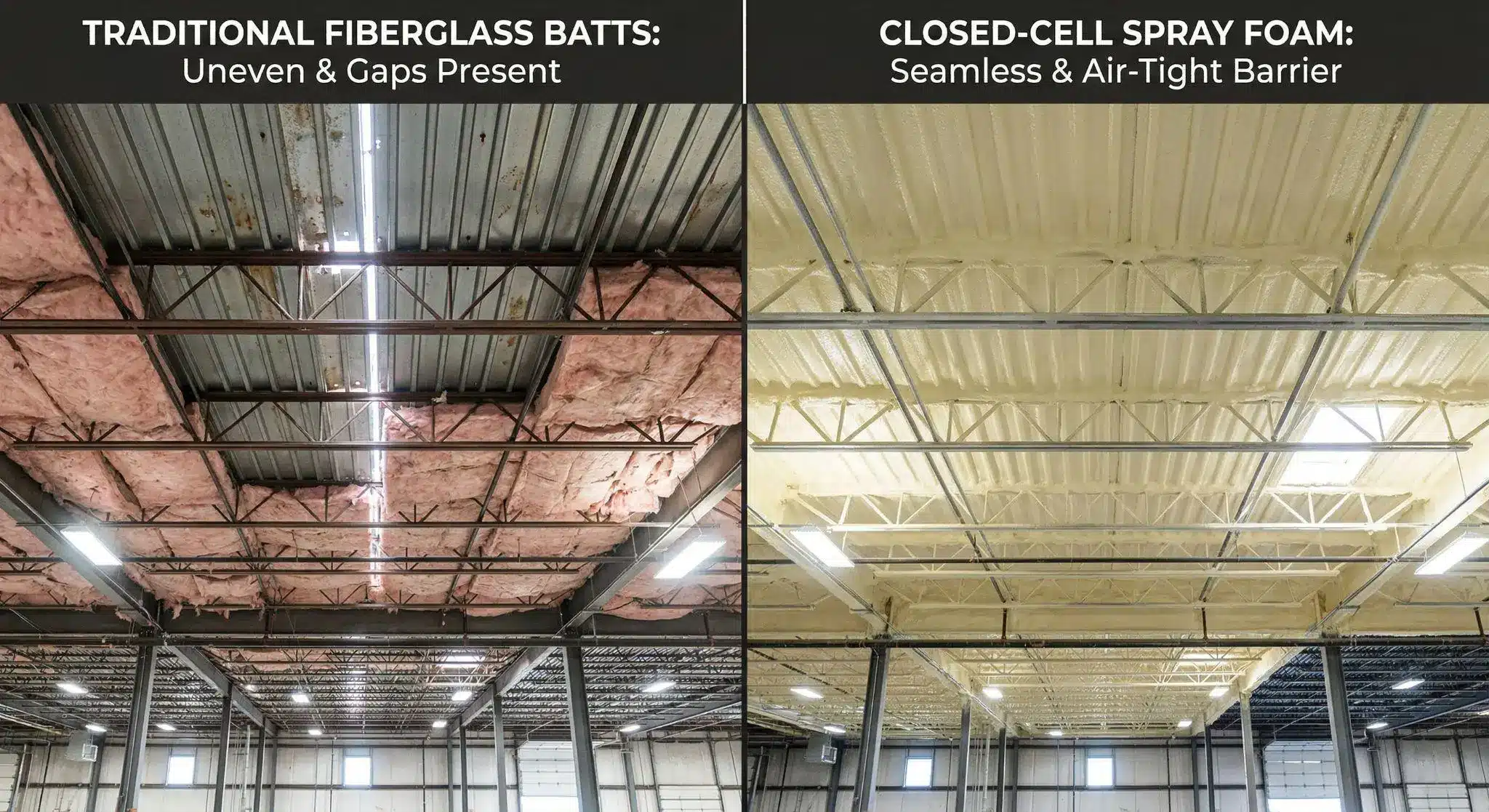
The R-value advantage compounds over the roofline. A 3-inch layer of closed-cell spray foam on a roof deck delivers an R-value of around 21, with no gaps, no compression, and no air movement through the assembly. Fiberglass at the same thickness tops out at R-9, with performance losses from any air infiltration.
Seasonal Timing: When to Schedule the Work
Best Window: Late Spring Through Early Fall
Spray foam requires ambient temperatures above 50 degrees and low humidity for proper adhesion and off-gassing. In the Bay Area, the May through October window is ideal. Summer heat accelerates cure times and allows topcoat application within the same day on most projects.
Avoid: Rainy Season and Marine Layer Mornings
Foam sprayed onto a damp substrate will not bond correctly. Coastal sites in San Francisco, Daly City, and Half Moon Bay need morning fog to clear before crews can start. This typically means afternoon-only scheduling from November through March, which extends project duration and raises labor costs.
Title 24 Compliance and What the Code Actually Requires
California’s Title 24 energy code sets minimum R-values based on climate zone. The Bay Area falls primarily across climate zones 3 (coastal), 4 (San Francisco Bay inland), and 12 (Sacramento Valley fringe). Key commercial requirements:
- Roofs: R-20 to R-30 depending on zone and occupancy type
- Walls: R-13 to R-19 for above-grade assemblies
- Existing buildings adding conditioned space must meet current minimums
Spray foam closed-cell systems typically achieve code compliance in a thinner assembly than competing options, which matters on buildings with tight parapet heights or interior clearance constraints.
Questions to Ask Before Signing a Contract
- Is the contractor ABAA (Air Barrier Association of America) certified or trained by the foam manufacturer?
- What is the density spec – 2 lb closed-cell or 0.5 lb open-cell? Each has different applications.
- What topcoat system is included, and what is the recoat schedule?
- Is the bid based on installed thickness, not just gallons, so you can verify R-value compliance?
USA Spray Me serves commercial clients across the Bay Area and Central Valley, handling both insulation and roofing scopes with crews that understand California code requirements and local conditions firsthand.