My pumpkin vine bloomed for three straight weeks before a single fruit showed up. Dozens of yellow flowers, day after day, and nothing to show for it.
Turns out that is completely normal. A pumpkin vine grows two different flowers, not one. Male flowers show up first and produce pollen. Female flowers come later and grow the actual fruit.
I did not know that in my first season, so I assumed I was doing something wrong.
Once you know what to check at the base of the stem, telling male and female flowers apart takes about two seconds.
Why Pumpkin Plants Produce Both Male and Female Flowers?
Pumpkin plants are monoecious, meaning one plant produces both male and female flowers.
Separate male and female flowers give pumpkins more control over reproduction.
A single vine can still self-pollinate, since both flower types share the same genetics. But keeping the sexes apart within one plant lowers the risk of a flower accidentally self-fertilizing before pollinators arrive.
This structure also lets the plant manage resources efficiently.
Producing fruit requires more energy than pollen, enabling the vine to adjust its male-to-female bloom ratio.
That flexibility helps the plant conserve energy and stay reproductive during most of the growing season.
How Do Male and Female Flowers Pollinate?
Male flowers produce pollen in structures called stamens, while female flowers hold the ovary and stigma.
Pollination happens when pollen moves from the stamen of a male flower to the stigma of a female flower.
Bees, butterflies, wind, and other insects carry this pollen from bloom to bloom.
Once pollen lands on the stigma, it travels down a tube into the ovary, where it fertilizes the egg cells.
This process creates seeds and allows the plant to reproduce. Some plants hold both male and female parts on one flower, while others grow separate male and female blooms on the same or different plants entirely.
Flower Anatomy: Male vs. Female Pumpkin Flowers
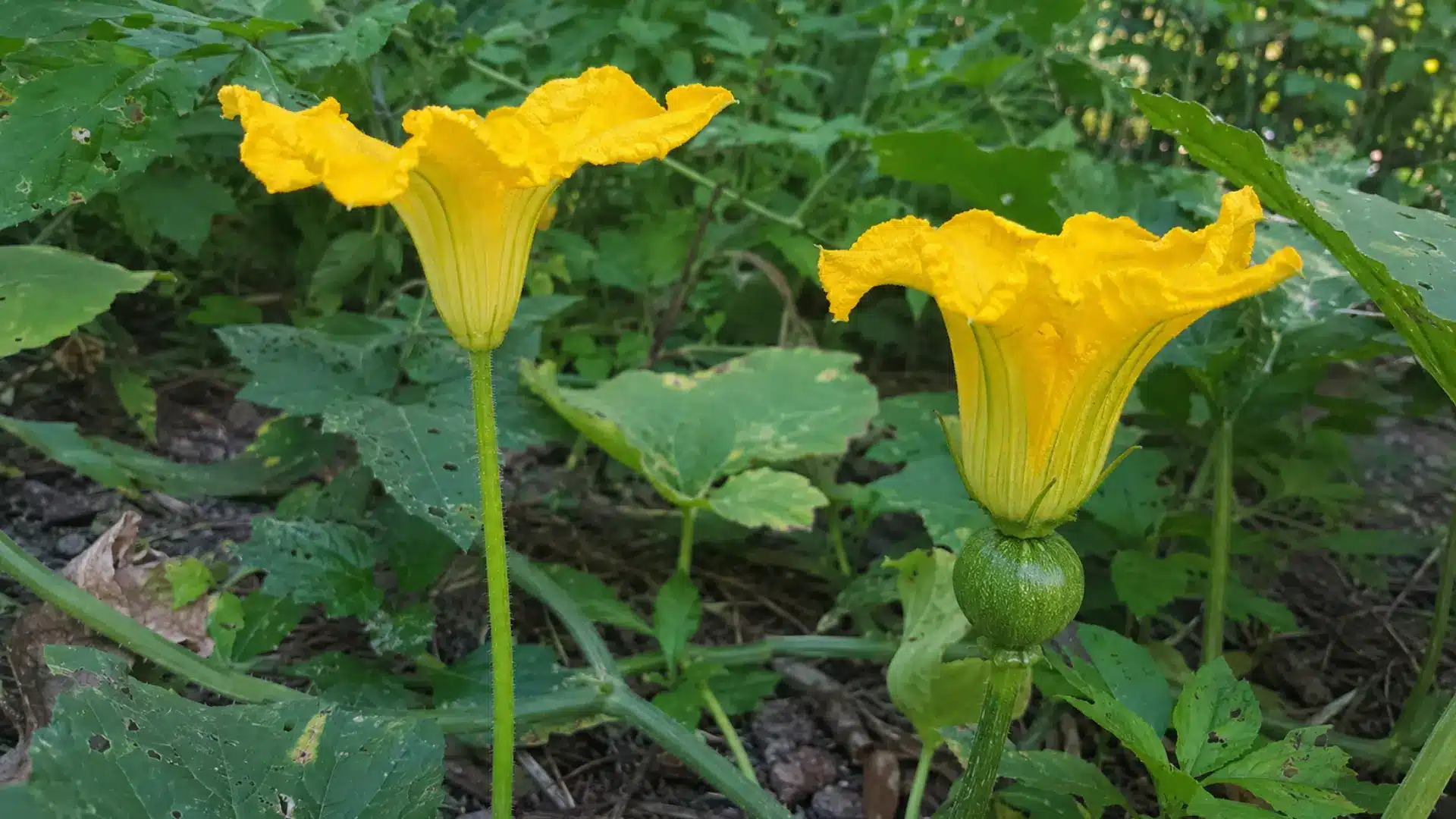
Male pumpkin flowers develop on a long, slender stem without any structure beneath the petals, while female flowers appear on a short, thick stem with a small round swelling at the base.
How to Identify Male Pumpkin Flowers?
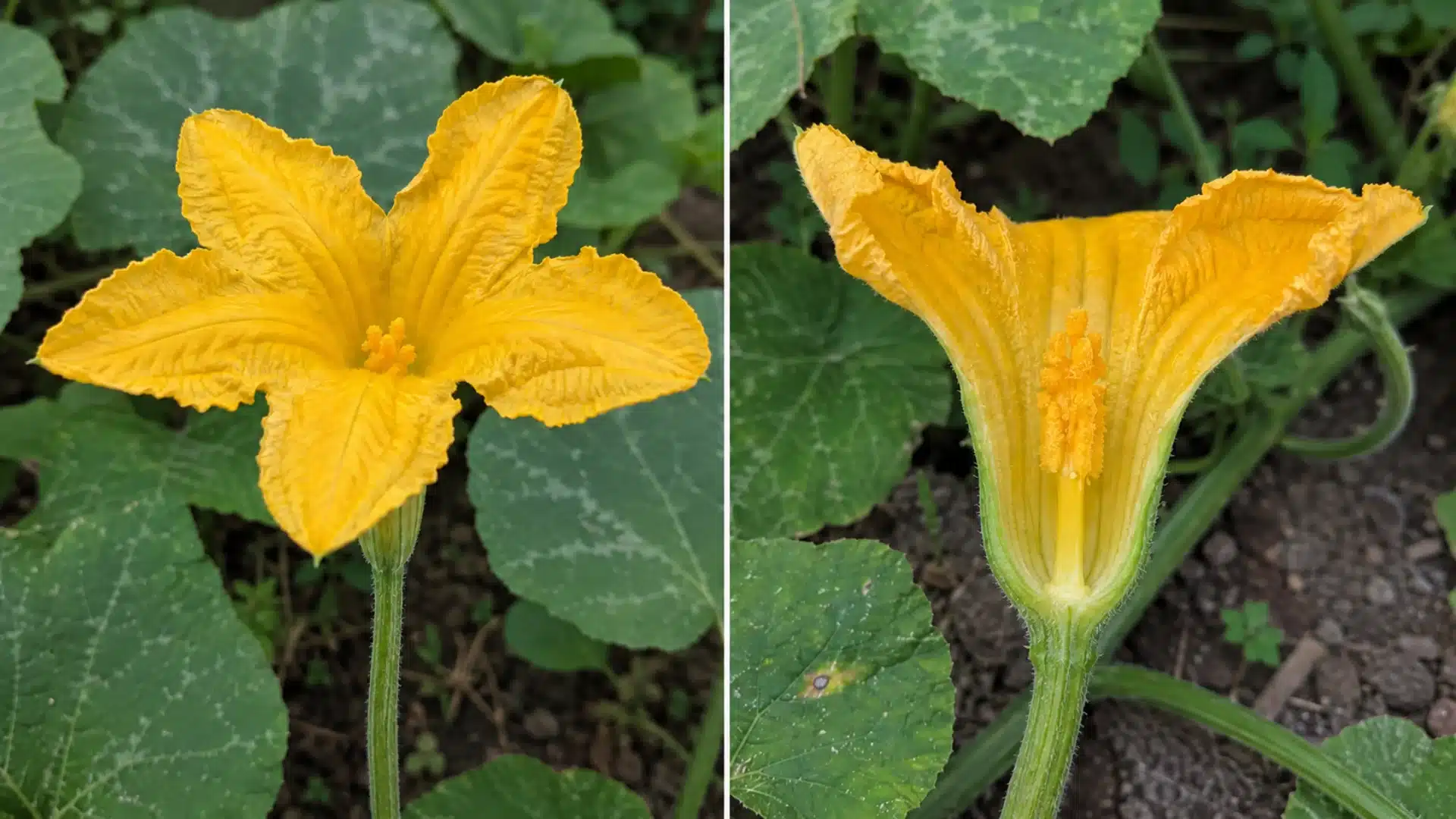
Male pumpkin flowers are usually the first to bloom on young vines, appearing a week or two before female flowers. They outnumber females all season, ensuring pollen is available when females are ready to receive it.
What a Male Flower Looks Like
Check the stem first. It is long, thin, and straight, rising well above the leaves.
No bulge forms underneath the petals. The bloom is bright yellow with five petals, and the petals feel thin and papery. Inside, the structure stays simple. Open it up, and you’ll find a single central stamen.
That stamen is covered in fine, sticky pollen.
Producing that pollen is the male flower’s entire purpose. Nothing else grows inside.
What It Means If You Only See Male Flowers
No bulge under any flower means they’re all male. That’s completely normal early in the season.
Your plant is not unhealthy, and pollination hasn’t failed. Female flowers usually form within 1 to 2 weeks.
Patience is all you need right now. Keep up regular watering and care in the meantime. Each bloom opens in the early morning and closes by midday.
Once females appear, pollination can start, and fruit follows soon after.
Parts of a Male Pumpkin Flower
Male pumpkin flowers possess a specific set of parts primarily for pollen production rather than fruit development.
Here are the key parts and their roles.
- Petals: Five bright yellow petals fused at the base into a bell shape.
- Stem (peduncle): Long, thin, and straight, with no bulge underneath.
- Stamen: Single central structure coated in pollen.
- Sepals: Small green leaf-like parts at the base of the bloom.
- Ovary: Not present, since male flowers do not develop into fruit.
These components work together to produce and release pollen, which is then received by the female flowers.
How to Identify Female Pumpkin Flowers?
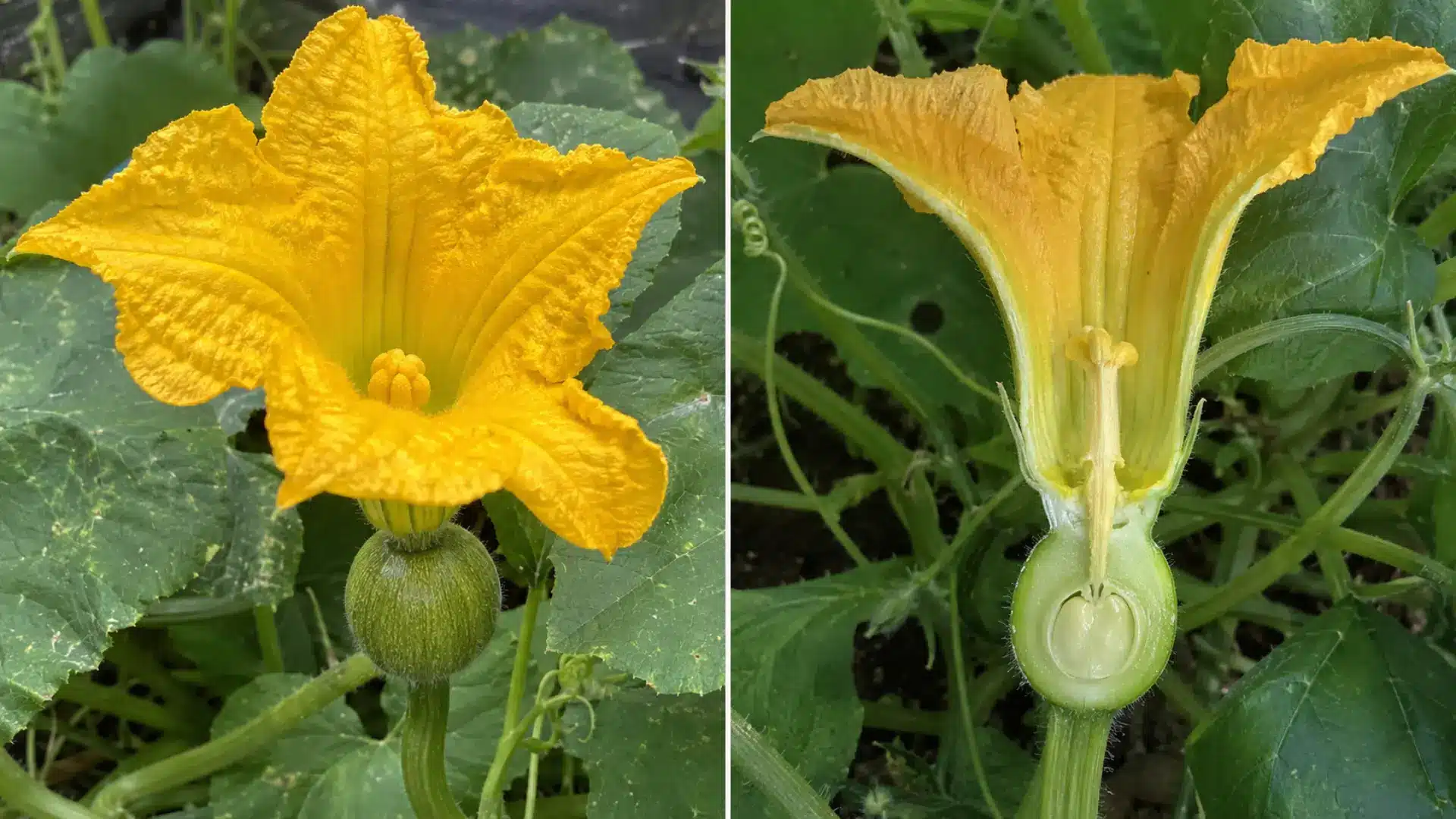
Female pumpkin flowers emerge 1-2 weeks after male flowers, once the vine can support fruit. The exact timing depends on weather conditions, the pumpkin variety, and the plant’s maturity.
What a Female Flower Looks Like
Check the stem first. Unlike the long, thin male stem, the female’s stem is short and thick.
It is built to support a growing pumpkin. Right beneath the petals, look for a small round bulge. That bulge is the immature fruit. It waits there until pollination triggers its growth.
No pollination means no growth. The bulge stays small and eventually falls off.
Spotting that bulge early is the fastest way to confirm that a flower is female.
What Happens If the Flower is Not Pollinated
If that bulge isn’t pollinated within a day or two, it stops developing.
It turns yellow, softens, then shrivels and drops off within about a week. This is normal. Nothing is wrong with the plant. It simply redirects energy toward the next round of blooms.
Open the flower, and you’ll find a multi-lobed stigma inside, not a single stamen like males.
That stigma receives pollen and starts fertilization. Without it, the flower’s job ends there.
Parts of a Female Pumpkin Flower
Female pumpkin flowers have parts that receive pollen and develop into fruit. Here are their key roles.
| Part | Description |
|---|---|
| Petals | Five yellow petals, similar in color and shape to the male bloom |
| Stem (peduncle) | Short and thick, built to support developing fruit |
| Ovary | A small, round bulge beneath the petals that becomes the pumpkin |
| Stigma | Multi-lobed structure inside the flower that receives pollen |
| Sepals | Green base structures, same as in the male flower |
The ovary clearly indicates that the flower is female, as it is the point where the pumpkin will develop.
How to Hand Pollinate Pumpkin Flowers Correctly?
Sometimes bees do not show up in enough numbers to get the job done, whether it is due to poor weather, nearby pesticide use, or simply growing in a small home garden with limited pollinator traffic.
In such cases, hand-pollination is an easy, dependable backup.
- Step 1: Identify a freshly opened male and female flower on the same morning.
- Step 2: Remove the male flower’s petals to expose the pollen-covered stamen.
- Step 3: Gently rub the stamen directly onto the female flower’s stigma.
- Step 4: Loosely cover the pollinated female flower to prevent competing pollination (optional).
- Step 5: Check back over the next few days to see the fruit begin to swell.
Early morning is the best time to do this, right after the flowers open and before they close by midday.
What Happens After Successful Pollination?
A bee or other pollinator moves pollen from a male flower to a female flower’s stigma.
The pollen grain travels down the style. It reaches the ovules inside the ovary.
Fertilization happens once pollen joins an ovule. This triggers the small bulge at the base of the flower. It starts swelling into a young pumpkin. The flower itself wilts within a day or two. Its job ends once fertilization succeeds.
The tiny fruit left behind turns a deeper green. It grows larger each day. Inside, fertilized ovules develop into seeds.
The surrounding tissue thickens into flesh. Over the following weeks, the fruit continues to expand. It changes color as it matures, ready for harvest.
When Pumpkin Flowers Open and Why Timing Matters?
Pumpkin flowers open early, usually around sunrise. They close by early afternoon the same day.
This narrow window means pollination has to happen fast, before the bloom shuts for good. Bees stay most active in these cooler morning hours. That timing lines up well with when pollinators search for food.
If a male flower has not shed its pollen, or a female flower closes before a bee visits, that chance is lost.
Hot afternoons speed up closing time even further.
This reduces the timeframe and emphasizes that early-morning visits are critical for fruit set.
Factors that Affect Male and Female Flower Production
Environmental factors influence whether a vine produces male or female flowers.
| Factor | Effect on Flowers |
|---|---|
| Plant Age | Young vines skew male; mature vines produce more females. |
| Temperature | Extreme heat or cold delays female blooms and favors males. |
| Daylight Hours | Shorter days favor females; longer days favor males. |
| Nitrogen Levels | Excess nitrogen favors vine growth and male flowers over females. |
| Watering Consistency | Irregular watering stresses the plant and lowers female counts. |
| Pruning Practices | Removing excess vine growth redirects energy to more females. |
| Plant Stress | Disease, pests, or poor soil lowers female production first. |
| Variety Differences | Some varieties produce females earlier or in greater numbers |
How to Encourage More Female Flowers Naturally?
Cut nitrogen-heavy fertilizer. It pushes leaves over flowers.
Switch to one higher in phosphorus and potassium once the vine spreads.
Pinch the main vine’s tip at six to eight feet. This redirects energy toward flowers. Water deeply and consistently, since drought stress lowers female counts. Give the plant six or more hours of full sun.
Space vines to avoid nutrient competition.
Companion plants that draw in pollinators help keep bee traffic steady once female flowers open.
Why Female Flowers Fall Off Without Producing Fruit?
Female pumpkin flowers often drop off without fruiting. Poor pollination is the usual cause.
Bees may skip the short bloom window. Cool or windy weather can keep pollinators away. Too few male flowers nearby means the stigma never gets enough pollen. Weak or aged pollen also fails to fertilize properly.
Stressed or overcrowded plants sometimes abort young fruit to save energy.
The small yellow bulge withers and falls before it ever becomes a pumpkin.
Pumpkin Flower Look-Alikes that Confuse Gardeners
A few plants in the squash family share pumpkin’s yellow, trumpet-shaped blooms, and telling them apart comes down to small details in the flowers and leaves.
- Zucchini Flower: Smaller bloom with narrower, more pointed petals.
- Butternut Squash Flower: Nearly identical shape, but the vine has softer, velvety leaves.
- Cucumber Flower: Much smaller bloom with smoother, less lobed leaves.
- Gourd Flower: Similar shape, sometimes white instead of yellow, and often opens in the evening.
- Luffa Flower: Comparable yellow color, but grows on a climbing vine with star-shaped leaves.
Common Problems with Pumpkin Flower Pollination
Pollination issues in pumpkin vines typically stem from timing, weather conditions, or how the plants are cared for.
Here is a quick breakdown of common issues, causes, and fixes.
| Problem | Cause | Fix |
|---|---|---|
| Only male flowers | Timing; females lag 1–2 weeks. | Wait it out. |
| No fruit set | Poor bee activity, bad weather, pesticide use. | Hand-pollinate; skip pesticides during bloom. |
| Flowers drop early | Stress, uneven watering, low nutrients. | Water on schedule; check soil. |
| Blossom-end rot | Calcium gap or uneven watering. | Water steadily; add calcium if needed. |
| Too few females | Excess nitrogen, stress, heat. | Balance fertilizer; pinch tips; manage heat |
Wrapping It Up
Male vs female pumpkin flowers aren’t hard to tell apart once you know this one detail.
If bees are scarce in your garden, you can pollinate by hand with a small paintbrush, moving pollen from a male flower straight onto a female’s center. It takes under a minute per flower.
Try it this week, and let me know in the comments how your pumpkins turn out.
Frequently Asked Questions (FAQs)
Do Pumpkin Plants Need Male and Female Flowers to Produce Fruit?
Yes, male flowers provide pollen while female flowers develop into the fruit itself.
Why Does My Pumpkin Plant Only Have Male Flowers?
Male flowers bloom first; females typically follow within one to two weeks naturally.
Can You Eat Male Pumpkin Flowers?
Yes, male flowers are edible and don’t affect fruit production once removed.
How Do I Know if a Pumpkin Flower Was Pollinated?
The bulge beneath the female flower swells and turns green within days.
Will Zucchini Cross-Pollinate with My Pumpkins?
It can, since both are often the same species, but the fruit stays unaffected.