I used to think succulents thrived on neglect, that their plump leaves meant they barely needed water at all.
But here’s what I’ve learned: that’s the myth that kills more succulents than anything else. Yes, overwatering is their biggest enemy, but underwatering them into crispy oblivion isn’t the answer either.
The truth is more nuanced than most people realize, and it shifts with where you’re growing them, what season you’re in, and even the pot they call home.
I’m here to walk you through exactly how to find that sweet spot, so your succulents can truly thrive, not just survive.
Understanding How Succulents Store Water
Succulents are living water reservoirs. Their thick, fleshy leaves and stems act like tiny storage tanks, holding moisture for those inevitable dry spells. This is why they can go longer between drinks than your average houseplant.
But here’s where it gets interesting: their roots are designed for deep, infrequent soaks, not constant sips. Shallow, frequent watering keeps the soil surface moist, which invites rot and never encourages roots to grow deeper.
Desert succulents like echeveria crave that dry-then-drench cycle, while tropical varieties like haworthia prefer slightly more consistent moisture.
Understanding your succulent’s origin helps you water with intention, not guesswork.
How Often to Water Indoor Succulents?
Indoor succulents live in a controlled world, but that doesn’t mean their watering needs stay the same. Let me break down what actually influences how often you’ll reach for that watering can.
1. Average Indoor Watering Schedule
Most indoor succulents thrive with water every ten to fourteen days, but I need you to hear this: schedules are just starting points, not rules. Your home’s unique conditions will always have the final say.
| Condition | Watering Frequency |
|---|---|
| Standard indoor environment | Every 10-14 days |
| High humidity or low light | Every 14-21 days |
| Dry air or bright light | Every 7-10 days |
2. Factors That Affect Indoor Watering Frequency
Your succulent’s thirst depends on so many little details. Here’s what actually matters:
- Humidity levels slow down how quickly the soil dries.
- Terracotta pots breathe and dry faster than plastic or glazed ceramic pots.
- Drainage holes are essential for preventing water from pooling at the roots.
- Bright indirect light increases water needs, while low light slows them down.
- Warmer temperatures and good airflow help soil dry more quickly.
3. Signs Your Indoor Succulent Needs Water
Watch for these telltale signals that your plant is ready for a drink:
- Leaves look wrinkled or feel softer than usual, like they’ve deflated slightly.
- The plant appears dull or slightly deflated, losing that plump, vibrant look.
- Soil is pulling away from the edges of the pot, creating visible gaps.
4. Signs of Overwatering Indoors
Overwatering shows up in ways you can’t ignore:
- Leaves turning yellow or translucent, especially at the base.
- Stems feel mushy or look dark and waterlogged.
- Soil smells sour or shows signs of mold on the surface.
How Often to Water Outdoor Succulents?
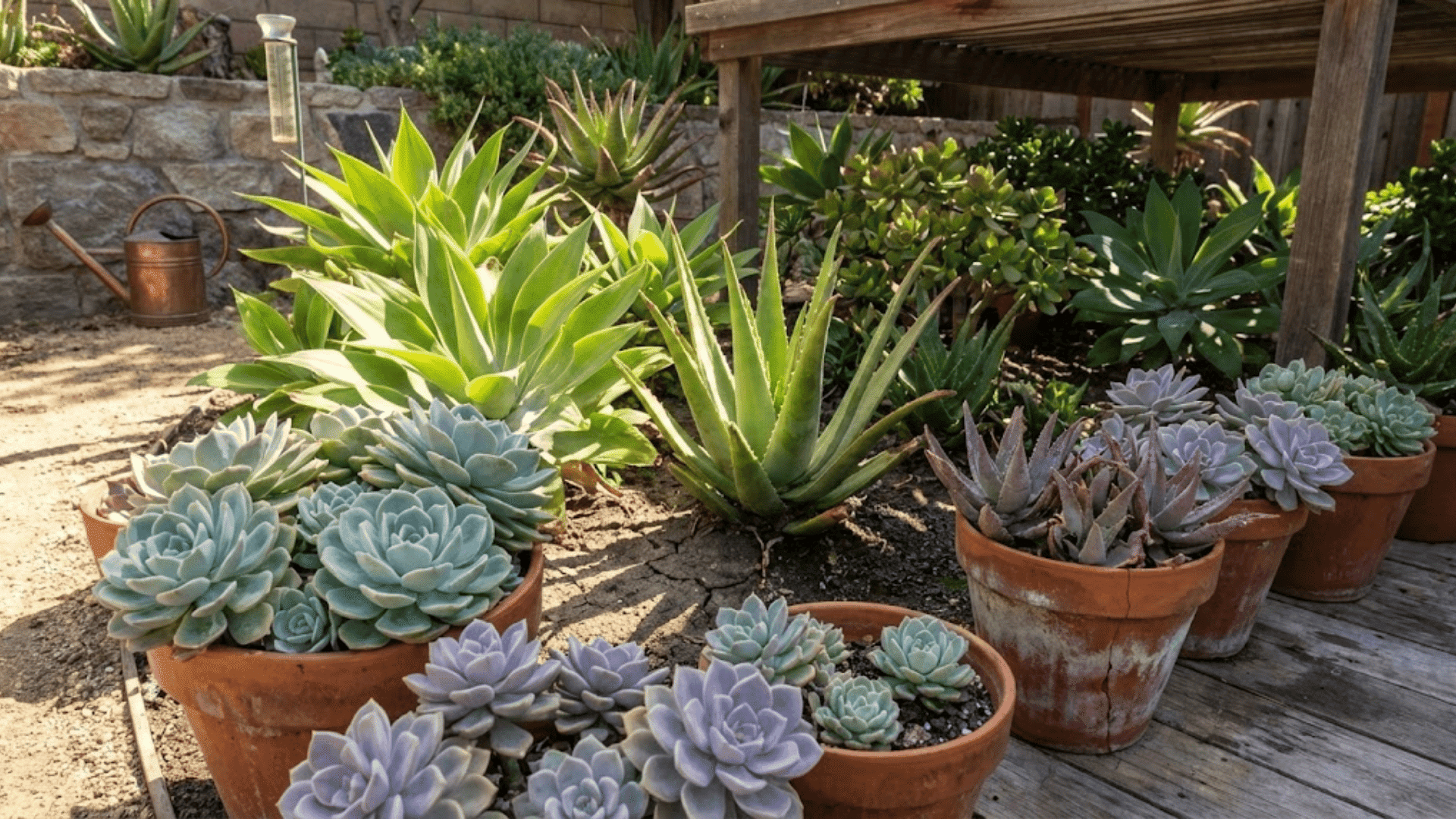
Outdoor succulents answer to nature first, and nature doesn’t follow a schedule. Let me show you how to work with the seasons and your specific climate instead of against them.
1. Watering Succulents Outdoors in Summer
Summer transforms your succulents into sun-soaked beauties, but it also accelerates their thirst in ways you might not expect.
Here’s what changes:
- Evaporation happens fast. That morning watering you gave? It could be halfway gone by noon in peak heat, especially in unglazed pots or shallow containers.
- Heat and sun exposure intensify needs. Full sun succulents in ninety-degree weather may need water twice as often as their shaded cousins, sometimes every five to seven days instead of two weeks.
- Timing matters more than you think. Morning watering gives roots time to drink before the heat hits. Evening watering in summer can leave the soil too damp overnight, inviting pests and rot.
2. Watering Succulents Outdoors in Winter
Winter is when your succulents whisper, “let me rest,” and you need to listen. Here’s how dormancy changes everything:
- Dormancy is real. Most outdoor succulents slow or stop growing when temperatures drop, meaning their water needs plummet right along with the thermometer.
- Frost and water don’t mix. Watering before a freeze can cause cells to burst as water expands into ice. In frost-prone areas, cut back to once a month or stop entirely.
- Know when to quit. If temperatures consistently stay below forty degrees, your succulents likely don’t need any water until spring wakes them up again.
3. Watering Succulents by Climate
Your zip code dictates more than you realize. Different climates create completely different watering rules, and what works in Arizona will drown a succulent in Florida.
| Climate Type | Summer Watering | Winter Watering | Notes |
|---|---|---|---|
| Hot, dry | Every 7-10 days | Every 2-3 weeks | Fast evaporation |
| Humid, tropical | Every 2-3 weeks | Every 3-4 weeks | Air moisture slows drying |
| Temperate, coastal | Every 10-14 days | Every 2-3 weeks | Adjust for weather changes |
| Rain-heavy | As needed | Minimal to none | Prioritize drainage |
How Pot Size, Soil & Drainage Affect Watering Frequency?
The vessel matters just as much as the plant. Small pots dry out faster than large ones because there’s less soil to hold moisture.
Shallow bowls need more frequent attention than deep containers, where roots have room to spread, and soil stays damp longer.
Your soil mix should be gritty and fast-draining, think cactus mix with added perlite or pumice, never dense potting soil that holds water like a sponge.
And drainage holes? Absolutely non-negotiable. Without them, you’re not growing succulents, you’re creating a swamp in a pretty pot.
How to Water a Succulent the Right Way?
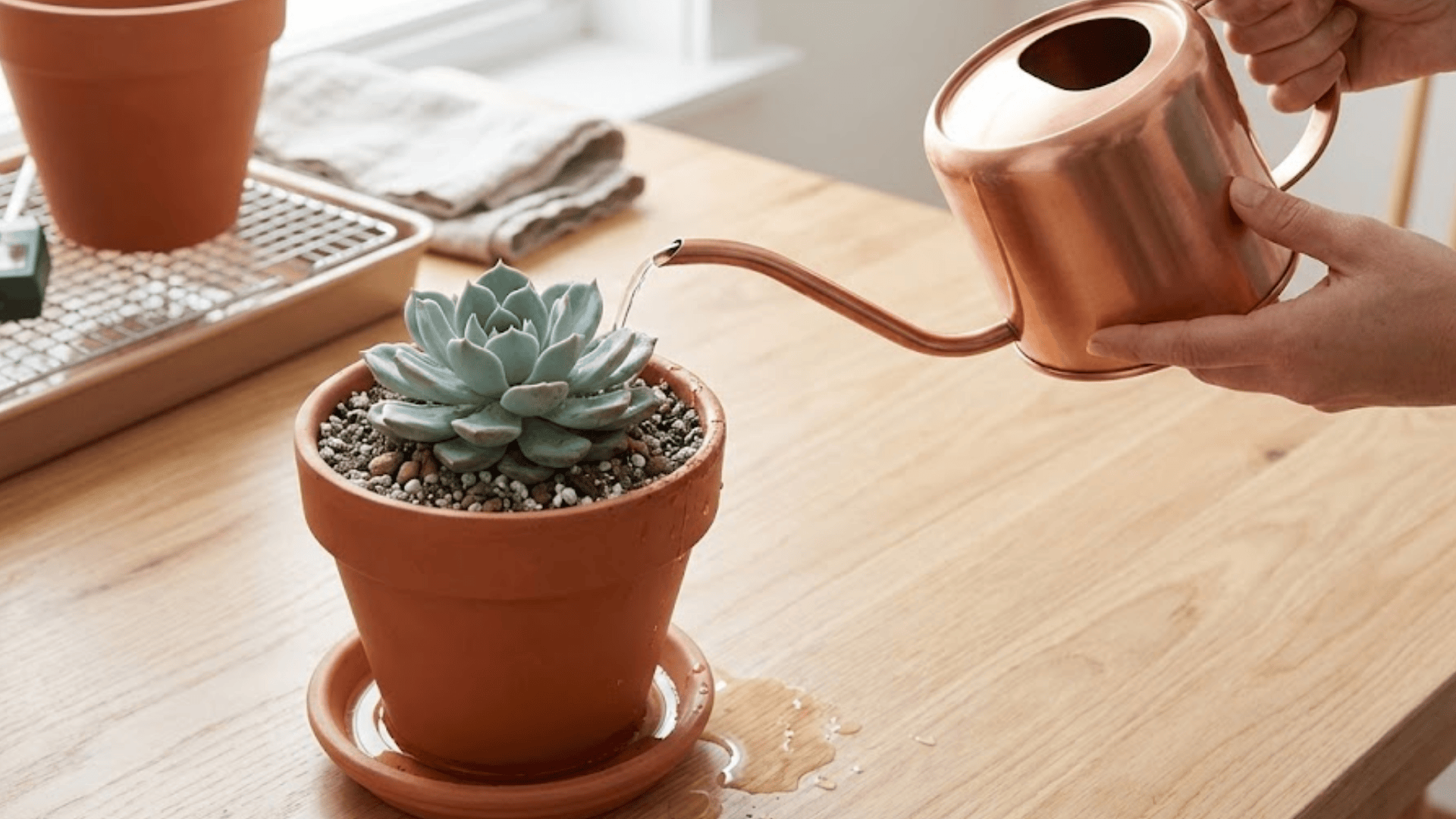
Watering succulents isn’t about sprinkling a little water on top and calling it done. It’s about mimicking a rainstorm: thorough, intentional, and followed by a long dry spell.
Step-by-Step Proper Watering Method
The key to watering success is following a consistent process that encourages deep root growth while preventing moisture buildup. Here’s exactly how to do it:
- Step 1: Check soil dryness first. Stick your finger two inches into the soil. If it feels even slightly damp, wait another few days.
- Step 2: Water thoroughly until it drains. Pour water slowly across the entire soil surface until you see it flowing freely from the drainage holes at the bottom.
- Step 3: Let it drain completely. Allow the pot to sit for several minutes so excess water escapes, ensuring roots aren’t sitting in moisture.
- Step 4: Empty all saucers and trays. Never let your succulent sit in standing water, even for an hour. This invites root rot faster than anything else.
- Step 5: Wait until the soil is bone dry before watering again. This waiting period is where the magic happens, encouraging strong root growth and preventing rot.
Bottom Watering vs. Top Watering
Bottom watering works beautifully when you need even moisture distribution or want to avoid disturbing delicate leaves.
Set your pot in a shallow tray of water and let the soil absorb moisture from below for ten to fifteen minutes.
But here’s the catch: bottom watering can leave mineral buildup at the soil surface and doesn’t flush out salts the way top watering does.
For most succulents, alternating between both methods gives you the best of both worlds.
Seasonal Succulent Watering Guide
Succulents live by the rhythm of the seasons, and your watering schedule should dance along with them. As the year shifts, so do their needs, moving from active growth to restful dormancy and back again.
| Season | Growth Phase | Watering Frequency | What’s Happening |
|---|---|---|---|
| Spring | Active growth begins | Every 7-10 days | Roots wake up, new growth emerges, and plants need consistent moisture |
| Summer | Peak growth period | Every 5-10 days | Maximum thirst, faster evaporation, roots are working overtime |
| Fall | Growth slows down | Every 10-14 days | Plants prepare for rest, and water needs gradually decrease |
| Winter | Dormancy | Every 2-4 weeks or none | Growth stops, roots barely drink, and the risk of overwatering is highest |
Tip: Follow temperature changes, not calendar dates. A warm autumn means continuing summer watering longer, while an early cold snap signals it’s time to pull back sooner.
Common Succulent Watering Mistakes to Avoid & Final Tips
Even the most well-meaning plant parents fall into watering traps that sabotage their succulents. Here’s what to avoid and what to adopt instead:
- Never mist your succulents. Light sprays wet the leaves without reaching the roots, inviting rot on the surface while starving the plant below.
- Ditch the fixed schedule. Your succulent doesn’t know it’s Wednesday. Water based on soil dryness and plant signals, not arbitrary timing.
- Don’t rely solely on moisture meters. They can give false readings in gritty soil. Your finger is often the most accurate tool you have.
- Watch your plant, not just the calendar. Wrinkled leaves and pulled-back soil tell you more than any watering chart ever could.
- When in doubt, wait it out. Succulents recover from underwatering far more easily than from overwatering. An extra day or two of dryness won’t hurt them.
The secret to thriving succulents isn’t perfection; it’s paying attention. Once you learn to read your plants, watering becomes second nature.
The Bottom Line
So there you have it. How often to water succulents comes down to reading the room, literally.
Check the soil, watch the leaves, respect the seasons, and give your plants time to dry out between drinks. It’s simpler than it sounds once you stop overthinking it.
The more you practice, the more natural it becomes to tell when your succulents are thirsty versus when they’re perfectly content.
You’ll start noticing the subtle shifts, the way they plump up after a good soak or how they slow down when winter arrives.
If you’ve got questions or a watering win to celebrate, leave a comment below. I’m always here to help troubleshoot or cheer you on.