Small flies buzzing near your fruit bowl or houseplants are easy to dismiss as one generic pest – until treatment fails and they keep coming back.
That’s usually a sign you’re mixing up fruit flies vs fungus gnats, two insects that look alike at a glance but breed in different places, multiply on different timelines, and need different fixes.
One breeds in fermenting food and drains; the other lives in moist potting soil.
Below, you’ll find how to spot each pest correctly, why infestations return, and exactly what gets rid of them for good.
Two Tiny Pests, Two Completely Different Problems
It’s easy to see why these two get lumped together- both are small, both show up uninvited, and both seem to multiply overnight. But treating them as the same problem is where most people go wrong.
A spray or trap built for one pest does nothing against the other, so the population you didn’t target just keeps growing while you assume the issue is solved.
That mismatch- time and money spent treating the wrong bug- is the real cost of confusing fruit flies vs fungus gnats.
The rest of the blog breaks down exactly how to avoid that mistake- starting with the fastest way to tell them apart.
How to Tell Them Apart at a Glance

Before treating anything, confirm which pest you’re dealing with. A few quick visual and behavioral cues make the difference between gnats and fruit flies obvious.
Eye Color, Body Shape, and Size
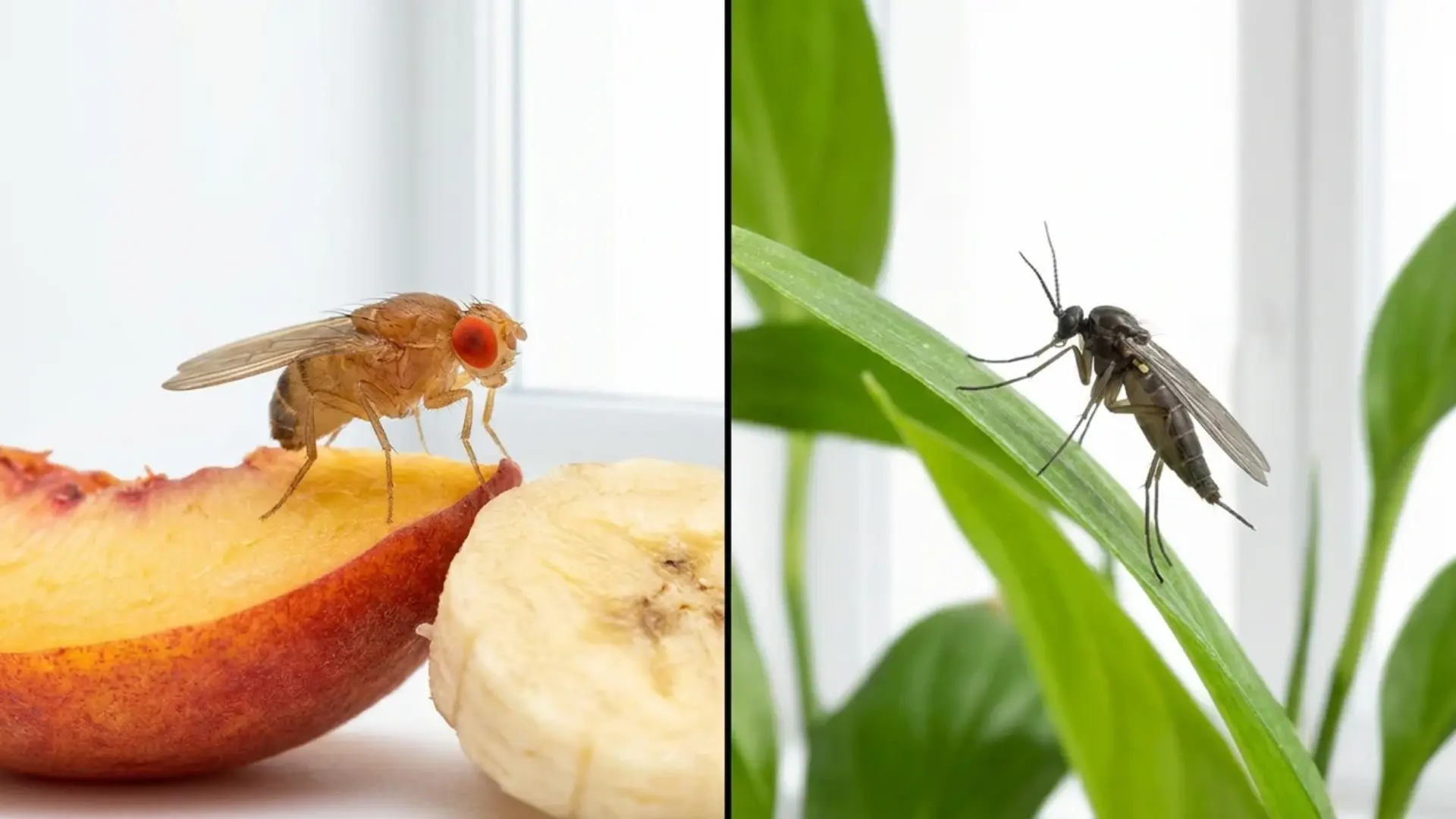
Eye color is the fastest tell. Fruit flies have large, bright red eyes that stand out immediately, while fungus gnat eyes are small and dark, easy to miss at a glance.
Body shape backs this up:
- Fruit flies: tan to brown, round, compact- similar to a miniature house fly
- Fungus gnats: dark gray to black, slender, with long legs and thin antennae, closer to a tiny mosquito
Both measure around 1/8 inch, so size alone won’t help you tell them apart.
Flight Pattern and Behavior
How they move tells you almost as much as how they look.
- Fruit flies fly fast and directly, often in small clusters over food or fruit bowls
- Fungus gnats fly weakly and erratically, staying low near soil or plant leaves rather than swarming
Fruit flies are also more active during the day, while fungus gnats show up steadily year-round if the soil stays damp.
This same mix-up happens with a third look-alike, so if your flies are hanging out near a sink or shower drain instead of soil or fruit, it’s worth ruling out drain flies before you treat anything.
Here’s a side-by-side summary to confirm what you’re seeing in seconds.
|
Trait |
Fruit Flies |
Fungus Gnats |
|
Eyes |
Large, red |
Small, dark |
|
Body |
Round, tan/brown |
Slender, black/gray |
|
Legs |
Short |
Long, spindly |
|
Flight |
Fast, direct |
Weak, erratic |
|
Common Location |
Kitchens, drains, and fruit |
Houseplants and damp soil |
Life Cycle Breakdown- Egg to Adult
Both pests multiply fast, but their timelines and breeding grounds differ completely- which is exactly why early identification matters.
Fruit flies move quickest: eggs hatch within a day, larvae feed on fermenting fruit or drain slime for a few days, then pupate and emerge as adults- a full cycle in about 8-10 days.
Fungus gnats take a similar path but through soil:
- Eggs are laid on the moist potting soil surface
- Larvae feed on organic matter and fungal growth for 1-2 weeks
- Adults emerge and begin laying again almost immediately
A single female of either species can produce hundreds of eggs, so a small problem becomes a full infestation within one to two weeks.
That speed is the real argument for catching the difference between gnats and fruit flies early – a few days’ delay in treatment can mean the gap between a minor nuisance and a recurring, house-wide infestation.
Can You Have Both at the Same Time?
Yes- and it happens more often than people expect.
A kitchen near potted plants can host both pests simultaneously, each breeding in its own spot while you assume it’s just one problem.
Signs of a Mixed Infestation
If you’re spotting flies near both your fruit bowl and your houseplant soil, or noticing two distinct flight patterns- fast darting near the counter, weak fluttering near the pots-you likely have both pests at once, not one confusing species.
Why Treating Only One Pest Backfires
This is where the difference between gnats and fruit flies matters most- not just for identification, but for treatment.
Each pest breeds in a completely separate location, so treating only one spot leaves the other population untouched.
Drain gel and fruit fly traps won’t reach larvae living in houseplant soil, letting gnats keep breeding undisturbed.
Likewise, soil drenches won’t stop fermenting fruit or dirty drains from attracting new fruit flies.
The result is an infestation that looks cleared for a few days, then returns once the untreated source produces its next generation.
What Happens If You Misidentify the Pest

Getting the identification wrong isn’t just a minor mix-up- it directly shapes how much time, money, and plant health you lose.
Misjudging fruit flies vs fungus gnats means reaching for the wrong product entirely, and the consequences show up in two distinct ways.
Wasted treatments and recurring infestations:
- Sprays and traps designed for fruit flies do nothing against soil-dwelling gnat larvae
- Soil treatments meant for gnats won’t touch drain- or fruit-breeding flies
- Each wrong attempt buys a few quiet days before the untreated population rebounds
Plant root damage vs. food contamination risk: Fungus gnat larvae feed on plant roots, stressing or stunting houseplants over time if left untreated.
Fruit flies, by contrast, pose a food safety concern- contact with contaminated produce or surfaces can trigger irritation for some people.
Treating the wrong pest means the actual risk in your home goes unaddressed.
Are They Harmful to Humans?
Neither pest bites nor poses a serious health threat, but each carries a different, minor risk worth knowing.
- Fruit flies: Can pick up bacteria from rotting food or unclean surfaces and transfer it to fruit, dishes, or countertops, which may cause mild irritation or stomach upset in rare cases.
- Fungus gnats: Generally harmless to people; their main damage is to plants, not humans, since larvae feed on roots and organic matter in soil rather than skin or food.
In short, fungus gnats are more of a plant problem, while fruit flies are more of a kitchen hygiene concern- neither is dangerous, but both are worth addressing quickly.
How to Get Rid of Each Pest

Once you’ve confirmed which pest- or pests- you’re dealing with, treatment becomes straightforward.
Fruit flies and fungus gnats respond to different methods entirely, so match the fix to the source rather than reaching for a generic spray.
Fruit Fly Control Methods (Traps, Drain Treatment, Sanitation)
Fruit flies breed around food and drains, so control starts with removing their food source:
- Sanitation first: Discard overripe produce, empty trash daily, and clean sticky spills or fermenting residue.
- Drain treatment: Use a bio-enzyme drain gel weekly to break down the slime larvae feed on.
- Traps: Set apple cider vinegar or store-bought traps near counters to catch remaining adults.
Consistency across all three steps clears an infestation within one to two weeks.
Fungus Gnat Control Methods (Soil Treatment, BTI, Sticky Traps)
Fungus gnats breed in moist soil, so control focuses on the growing medium itself:
|
Control Method |
How It Helps |
|---|---|
|
Let Soil Dry Out |
Allow the top 1–2 inches of soil to dry between waterings to disrupt egg-laying. |
|
BTI Treatment |
Apply a BTI-based soil drench or granules to eliminate larvae without harming plants. |
|
Yellow Sticky Traps |
Place traps near pots to capture adult gnats before they lay more eggs. |
Repeat treatment for two to three weeks to break the full breeding cycle.
Prevention Tips for Both Pests
Stopping an infestation before it starts is far easier than clearing one that’s already spread. A few consistent habits keep both pests from finding a way in.
- Store food properly: Keep ripe fruit in the refrigerator or sealed containers instead of open bowls on the counter.
- Check soil moisture before watering: Let the top inch of soil dry out between waterings, and make sure pots drain well so water doesn’t sit in saucers.
- Clean regularly: Wipe down counters, empty trash daily, and rinse drains weekly to remove buildup before it attracts fruit flies.
- Quarantine new plants: Keep new houseplants separate from the rest of your collection for about a week, since gnats can already be breeding unnoticed in the soil before you ever spot an adult flying around.
Build these habits into your regular routine, and neither fruit flies nor fungus gnats will find much reason to stick around.
When to Call a Pest Professional
DIY methods handle most infestations, but some situations call for outside help. Knowing when to stop troubleshooting on your own saves time and prevents a small problem from spreading further.
Consider calling a professional if:
- Infestation continues past three to four weeks despite consistent treatment
- You’re dealing with a mixed infestation and can’t pinpoint all breeding sites
- Gnats or flies are spreading across multiple rooms or plants
- Houseplant roots show visible damage or stunted growth
- You’ve tried sanitation, traps, and soil treatment without any drop in numbers
- A sudden burst of activity indoors, after weeks of seeing nothing, is also worth a second look, since something breeding out of sight suddenly matured all at once.
A professional can inspect drains, soil, and hidden moisture sources you might miss, and apply targeted treatment that clears the root cause rather than just the visible adults.
Quick Identification Checklist
Still unsure which pest is buzzing around your home? Run through this quick self-check before choosing a treatment.
|
Question |
Fruit Flies |
Fungus Gnats |
|
Where are they found? |
Near fruit bowls, trash, drains, or other food sources |
Around potted plants and moist soil |
|
What do the eyes look like? |
Large, bright red |
Small, dark, and less noticeable |
|
How do they fly? |
Fast, direct flight in small groups |
Weak, erratic flight close to the soil |
|
What is the body shape? |
Round and compact |
Slender with long legs |
|
When are they most common? |
More active during warmer months |
Can appear year-round if soil remains moist |
Answer these five questions honestly, and you’ll know exactly which pest you’re facing- no more guessing between fruit flies vs. fungus gnats before you treat the problem.
Final Thoughts!
Two tiny flies shouldn’t cost you weeks of frustration. Once you know the tells, eye color, flight pattern, and where they gather, the right treatment applied to the right source breaks the cycle fast.
Skip that first step, and you’re stuck spraying blind while the real problem keeps breeding untouched.
Identification comes first, treatment second, and a professional is worth calling if the numbers won’t budge after a few weeks of consistent effort.
Have you dealt with fruit flies, fungus gnats, or both at once in your own home? Share what finally worked for you in the comments; it might save someone else a few wasted weeks.
Frequently Asked Questions(FAQ’s)
Do Fruit Flies Turn into Fungus Gnats?
No. They’re entirely separate species with different biology, breeding grounds, and life cycles.
Can Fungus Gnats Bite?
No, fungus gnats don’t bite humans or pets. They’re harmless to people directly, though their larvae can damage houseplant roots over time.
How Long Does It Take to Get Rid of an Infestation?
Most infestations clear within one to two weeks with consistent sanitation, drain or soil treatment, and trapping. Severe or mixed infestations may take three to four weeks.