
Your cabinets do more than hold your dishes. They shape the entire personality of your kitchen. And tucked inside that one design decision is a quiet but meaningful choice: framed or frameless?
Each has its own character, its own strengths, and honestly, its own kind of beauty.
If you’re drawn to the warmth of a classic kitchen or the clean pull of something more modern, understanding how these two are built changes everything.
Let’s walk through it together so you can choose the one that actually fits your life.
What are Framed Cabinets?
Framed cabinets are built with a solid face frame attached to the front of the cabinet box.
That frame is what you see running along the edges of each door, giving the cabinet its structure and its signature look.
The doors and drawers attach directly to this frame, which makes the whole unit feel incredibly sturdy.
Because of how they’re constructed, framed cabinets naturally lend themselves to traditional, farmhouse, and classic kitchen styles where that visible border adds to the charm rather than taking anything away from it.
What are Frameless Cabinets?
Frameless cabinets skip the face frame entirely, so the doors and drawers attach directly to the cabinet box itself.
This opens up the full width of the cabinet, giving you more accessible storage and a much cleaner look from the outside.
There are no visible borders interrupting the surface, just a smooth, continuous front that feels intentional and refined.
Often called European-style cabinets, they’re a natural fit for modern and contemporary kitchens where that sleek, seamless appearance is exactly the point.
Framed vs. Frameless Cabinets: Side-by-Side Comparison
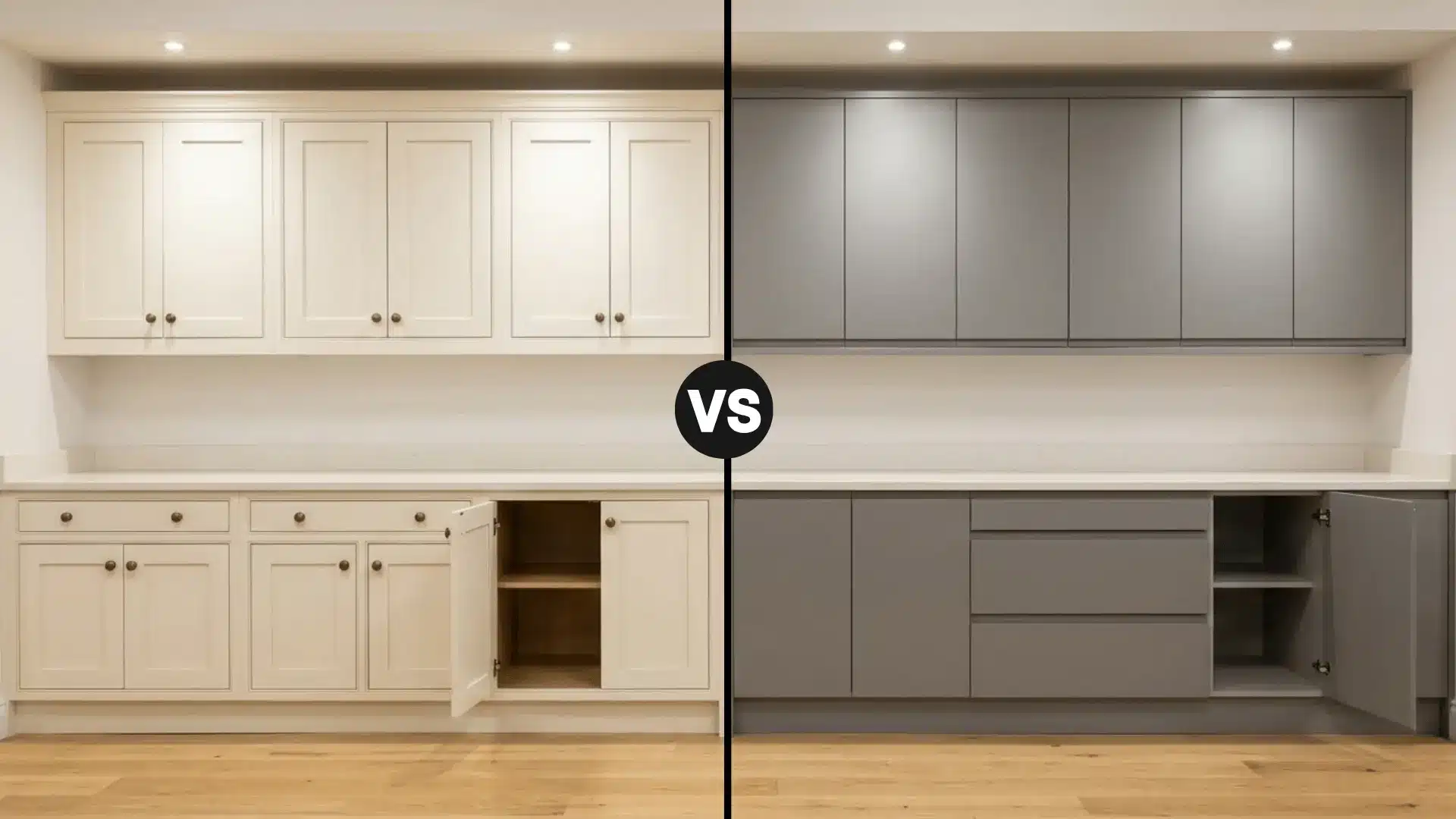
Looking at both styles side by side makes the decision a whole lot clearer.
Here’s how they stack up across the details that actually matter.
1. Construction
Framed cabinets are built around a solid face frame that gets attached to the front of the box, adding structure and rigidity. Frameless cabinets strip that away completely, relying on the box itself for support.
The result is a thicker, sturdier panel construction in frameless builds, while framed ones lean on the frame to do that structural heavy lifting.
2. Appearance
Framed cabinets carry a warm, familiar look with visible borders framing each door. Frameless cabinets offer a clean, uninterrupted front that feels sleek and intentional.
One feels collected and cozy, the other feels sharp and curated. It really comes down to whether your kitchen leans classic or contemporary in its overall personality.
3. Storage Space
Because the face frame slightly eats into the opening, framed cabinets offer marginally less accessible space inside. Frameless cabinets open fully, so you can actually reach everything stored inside without awkward angles.
For anyone who cooks often and needs maximum usable cabinet space, that difference adds up faster than you’d expect.
4. Accessibility
Framed cabinets have a narrower opening since the frame sits in front of the box. Frameless cabinets give you the full opening width, making it easier to pull things in and out.
This is especially noticeable in base cabinets and corner units where reach and visibility make a real difference in everyday use.
5. Cost
Framed cabinets tend to sit in the mid-range price bracket, making them a practical choice for a variety of budgets.
Frameless cabinets, with their precise construction and hardware requirements, often come in at a higher price point, though the investment tends to reflect in the longevity and finish quality you get in return.
Pros and Cons of Framed Cabinets
Framed cabinets have been a kitchen staple for a long time, and for good reason. But like any design choice, they come with their own set of trade-offs worth knowing before you commit.
Where Framed Cabinets Shine
There’s a lot to love about how framed cabinets are built and what they bring to a kitchen visually.
- Their solid face frame adds a layer of structural strength that holds up really well over time.
- The classic, bordered look fits naturally into traditional, farmhouse, and cottage-style kitchens.
- They offer more flexibility with hinge types, making hardware choices easier to customize.
- Door alignment is more forgiving, which means installation tends to go smoother overall.
Where They Fall Short
A few limitations are worth keeping in mind, especially if storage and space are priorities for you.
- The face frame slightly reduces the usable opening, making access a little more restricted.
- Interior storage space is marginally less compared to frameless builds, which adds up across an entire kitchen.
- The visible frame can feel visually heavy in smaller kitchens where a lighter, seamless look would serve the space better.
Framed cabinets are a solid, dependable choice that ages gracefully in the right kitchen. If your space leans warm and traditional, they’re likely to feel right at home.
Pros and Cons of Frameless Cabinets
Frameless cabinets have a lot going for them, especially in kitchens that lean modern and minimal. That said, they do ask a little more of you, both in budget and in installation precision.
Where Frameless Cabinets Shine
If clean design and smart storage are at the top of your list, frameless cabinets deliver on both fronts.
- Without a face frame in the way, you get full access to every inch of storage inside.
- The sleek, uninterrupted front gives kitchens that polished, contemporary finish that photographs beautifully.
- Reaching into base cabinets and deep shelves feels noticeably easier and more intuitive in everyday use.
- The absence of visible borders creates cleaner lines that make even smaller kitchens feel more open.
Where They Fall Short
Frameless cabinets are worth the investment, but a few considerations deserve an honest look before deciding.
- The construction and hardware requirements mean they often come at a higher price point than framed alternatives.
- Because there is no frame to compensate, installation needs to be precise and level from the start.
- Door and drawer alignment leaves less room for error, making adjustments trickier down the line.
Frameless cabinets reward careful planning and a skilled installer. Get those two things right, and you’re looking at a kitchen that feels effortlessly put together for years to come.
You’re right, it’s not needed. Here’s the cleaned-up version:
Cost Comparison: Framed vs. Frameless Cabinets
Understanding where your money goes makes it easier to plan your kitchen budget without any surprises along the way.
Here is a straightforward breakdown of how both styles compare in cost.
| Cost Factor | Framed Cabinets | Frameless Cabinets |
|---|---|---|
| Base Price | $100 to $300 per linear foot | $150 to $400 per linear foot |
| Installation Complexity | Lower complexity, $50 to $100 per hour | Higher precision, $75 to $150 per hour |
| Hardware Requirements | Standard hinges, $2 to $10 per hinge | Specialized hinges, $10 to $30 per hinge |
| Material Usage | Moderate, face frame adds $20 to $50 per cabinet | Higher, thicker panels add $30 to $70 per cabinet |
| Overall Value | Budget-friendly for traditional kitchens | Higher upfront, stronger return in modern builds |
Which Cabinets Offer More Storage Space?
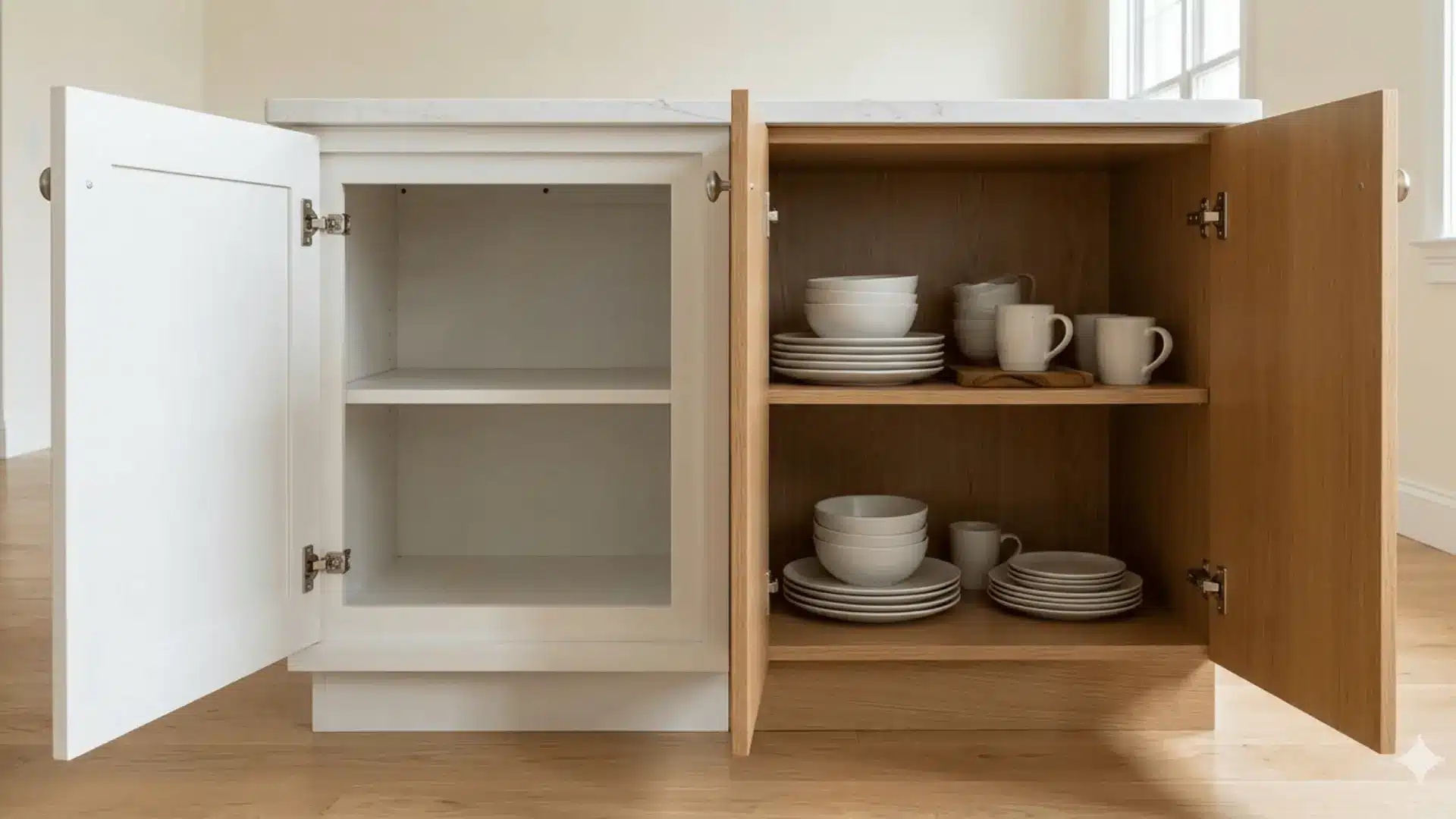
When it comes to storage, the difference comes down to what’s sitting in front of the box.
Framed cabinets lose a small amount of accessible space because the face frame narrows the opening, making it slightly harder to reach everything inside.
Frameless cabinets open fully, giving you complete, unobstructed access to the entire interior.
That difference feels small on paper but becomes very noticeable across a full kitchen, especially in tighter layouts where every inch of usable storage counts.
Which Style is More Durable?
Durability in cabinets is less about which style wins and more about how well each is built.
Framed cabinets carry a natural structural advantage because the face frame adds an extra layer of rigidity to the whole unit, making them particularly resilient in high-traffic kitchens.
Frameless cabinets can absolutely match that durability, but they rely entirely on the quality of the box construction and materials used.
With the right build, they hold up beautifully. With a rushed or budget build, the absence of a frame leaves little room for compromise.
Which Cabinet Style is More Popular?
Popularity here is genuinely split, and it largely depends on where you live and how your kitchen is styled. In the United States, framed cabinets have historically dominated the market, rooted in American homebuilding.
Europe has long favored frameless construction, hence the name European-style cabinets. As modern kitchens grow worldwide, frameless cabinets are gaining popularity.
According to the KCMA’s glossary of cabinet construction, frameless construction is increasingly being specified in new builds and renovations as architects and designers prioritize cleaner sight lines and full-access interiors.
Both styles hold strong in their respective spaces, but the overall design conversation is clearly leaning toward sleeker, frameless aesthetics in newer builds and renovations.
Can You Mix Framed and Frameless Cabinets?
Mixing the two is possible, but it requires a deliberate hand.
Because each style carries a distinct visual weight, combining them without a clear plan can make a kitchen feel inconsistent rather than layered.
The key is to let one style lead while the other plays a supporting role.
Keeping finishes consistent across both ensures the eye reads the space as a cohesive whole rather than two competing decisions sharing the same room.
Final Thoughts
At the end of the day, the framed vs. frameless cabinets conversation really comes down to what your kitchen needs and what feels right to you.
Both styles are well-built, beautiful in their own way, and capable of converting a space completely.
The best choice is simply the one that fits your lifestyle, your layout, and the kind of kitchen you actually want to cook and live in.
Already made your pick or still weighing your options? Drop your thoughts in the comments below. Would love to hear which direction you’re leaning.