There are times when we want someone to know they matter, without saying too much. A quick message won’t do it. A gift feels closer, but even gifts can miss the point.
That’s where the forget-me-not flower steps in. Small, blue, and easy to overlook at first glance, this flower carries a message far bigger than its size suggests.
It’s been passed between lovers, placed at graves, worn by knights, and planted in memory of the lost.
I’ve grown these in shaded corners of my own garden for years, and the flower still surprises new gardeners with how much history rides on something so small.
This piece breaks down where the forget-me-not flower’s meaning comes from, what it means today, and why it still holds weight.
What Does the Forget-Me-Not Flower Really Mean?
The forget-me-not means love, remembrance, and loyalty – a direct plea, built right into its name, not to be forgotten.
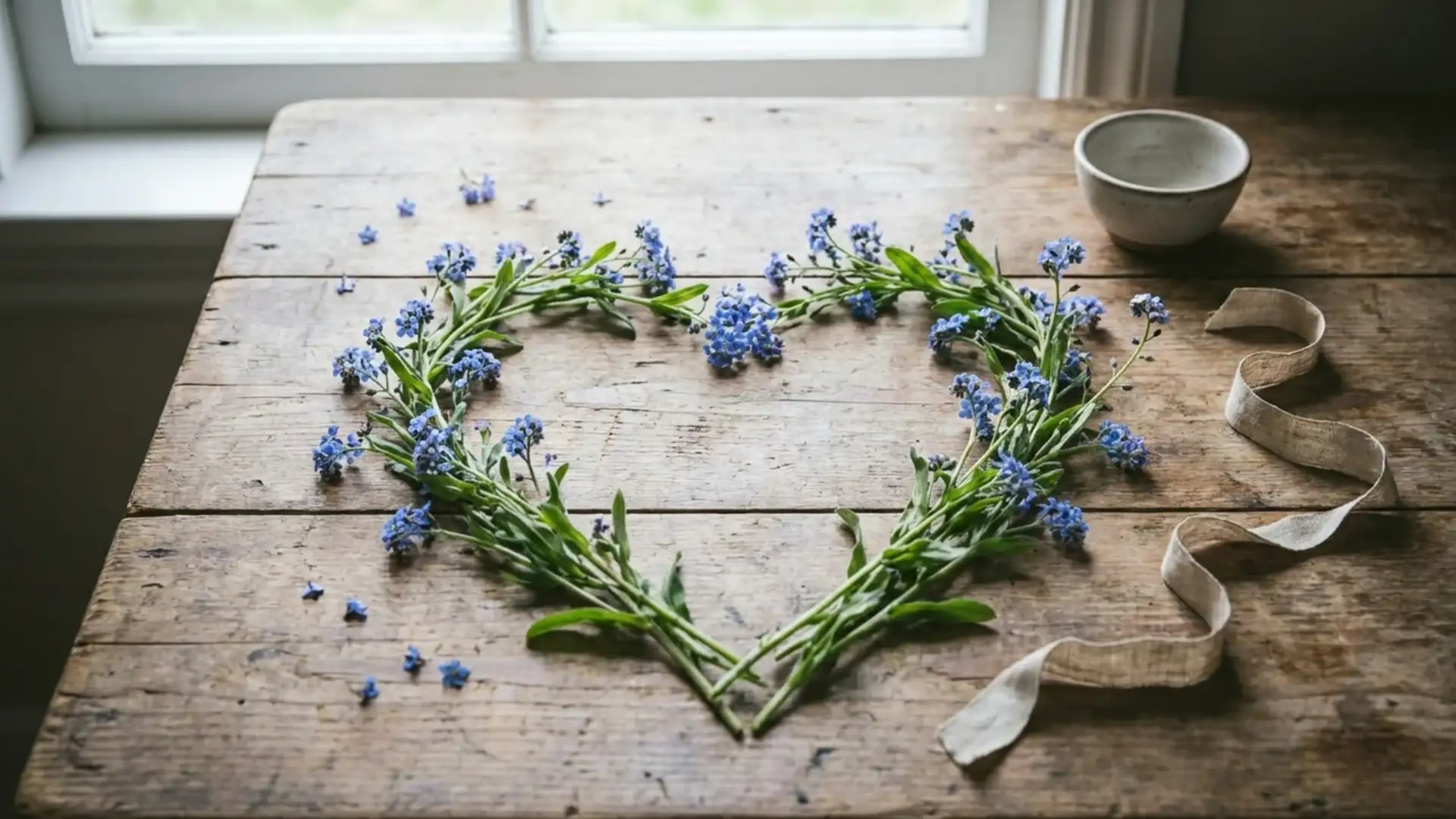
Its small blue petals and bright yellow center belong to the genus Myosotis, which is found growing wild across Europe, Asia, and North America.
What makes this flower stand out isn’t rarity or size- it’s how consistently that one meaning has held across centuries, cultures, and contexts, from medieval Europe to modern memorials.
Quick Facts About the Forget-Me-Not Flower

Not every claim about the forget-me-not holds up under scrutiny.
Some come from verified botanical records; others get repeated so often online that they start to sound like fact even without a solid source.
This section separates the two.
It covers what the plant actually is: its scientific name, native range, and classification, and clarifies its loose ties to birth months and zodiac signs.
Knowing the difference matters if you’re using this flower’s meaning accurately.
Botanical Name and Origin (Myosotis)
The forget-me-not belongs to the genus Myosotis, from Greek words meaning “mouse” and “ear,” a reference to the plant’s small, textured leaves.
Around 150 species are currently recognized within the genus. Native to Europe, Asia, and New Zealand, the plant has also naturalized across North America.
It commonly grows in damp, shaded areas near streams and woodland edges, which is part of why riverbank folklore attached to it so easily.
Is It a Birth Flower or a Zodiac Symbol?
Yes, but with a caveat. The forget-me-not is widely listed as a September birth flower, and it appears in some birth-flower-zodiac charts tied to Virgo.
Neither association comes from an official body- they’re rooted in floral folklore that’s been repeated across gardening and gift sites for decades.
Here’s how it breaks down:
|
Category |
Association |
|
Birth Month |
September |
|
Shared Birth Flowers |
Aster, Morning Glory |
|
Loosely Linked Zodiac Sign |
Virgo |
|
Official Status |
Folk Tradition, Not Formally Standardized |
These associations come from floral folklore rather than any governing horticultural body, so you’ll find some variation between sources.
Treat them as a layer of cultural meaning to draw from, not a fixed rule.
The Core Symbolism of the Forget-Me-Not
The forget-me-not carries four connected meanings, each shaped by centuries of use in poetry, folklore, and personal keepsakes.
Together, they explain why this small flower still shows up at weddings, funerals, and farewells today.
Here’s what each one represents:
- True Love and Devotion: Given between partners, the flower signals a love meant to outlast distance or time apart.
- Remembrance of Lost Loved Ones: Often placed at graves or memorials, it marks a person who is gone but still held in mind.
- Loyalty and Faithfulness: Historically exchanged as a pledge of constancy, especially before long separations like war or travel.
- A Promise Not to Forget: At its simplest, the flower is a direct message: this bond won’t fade from memory.
These four meanings overlap more than they differ, which is part of why the flower works for so many occasions. Whether it’s romantic, platonic, or memorial, the underlying message stays the same
The Legend Behind the Name
The forget-me-not’s name traces back to a medieval story that recurs, with only minor variations, across German, French, and Slavic folklore.
The Riverside Legend and Its Regional Variations
The most widely repeated version involves a medieval knight walking beside a river with his beloved.
Spotting blue flowers on the far bank, he waded in to pick them, was swept away by the current, and threw the bouquet to her while calling out “Vergiss mein nicht”- forget me not.
Variations of this story appear across German-speaking Europe, with similar riverside or drowning motifs showing up in French and Slavic folklore, suggesting a shared oral tradition rather than a single verified event.
The Christian Legend and What History Actually Confirms
A separate folk tale claims that when God finished naming every flower, this one called out “forget me not,” having been overlooked.
It’s a charming story with no historical or textual source behind it. What is documented: the name “vergissmeinnicht” appeared in German texts by the 14th and 15th centuries and crossed into English as “forget-me-not” by the 1530s.
The romantic legends explain why the name caught on, not where it started.
Forget-Me-Not Color Meanings

The forget-me-not is best known for its blue blooms, but pink, white, and purple varieties occur in nature and in cultivated gardens, each carrying a slightly different meaning. Yellow versions are rare and mostly appear in color symbolism traditions rather than common natural varieties.
Here’s how the meanings break down by color:
|
Color |
Symbolic Meaning |
|
Blue |
Loyalty and peace; the most common and historically significant shade |
|
White |
Purity and new beginnings |
|
Pink |
Gentle affection, often associated with quiet or early-stage love |
|
Purple |
Mystery and transition, linked to change or uncertainty |
|
Yellow |
Security and stability, though rare in natural specimens |
These color meanings come from the floral symbolism tradition rather than any botanical or horticultural standard, so treat them as cultural color, not a fixed fact.
Cultural and Historical Significance
Beyond personal sentiment, the forget-me-not has attached itself to nations, movements, and institutions over the centuries.
Each use draws on the same core idea- remembrance- but applies it to a different kind of loss or loyalty:
- King Henry IV and the Royal Emblem: Exiled in 1398 after a dispute with the Duke of Norfolk, Henry Bolingbroke adopted the forget-me-not as his personal emblem. He kept it after returning to England and taking the throne as Henry IV in 1399.
- Alaska’s State Flower: Officially designated in 1949, the forget-me-not represents the state’s cold-loving resilience and its early pioneers’ resolve not to be forgotten.
- Alzheimer’s and Dementia Awareness Symbol: Adopted by several Alzheimer’s and dementia organizations worldwide, the flower reflects the tension between memory loss and the wish to still be remembered.
- Masonic and Wartime Remembrance: German Freemasons used the flower as a covert identifying symbol during the Nazi era, when Masonic emblems were banned, quietly signaling membership without detection.
- Newfoundland, Armenian Genocide, and Other National Memorials: Newfoundland has historically used the forget-me-not to commemorate its war dead, and the flower served as the official symbol of the Armenian Genocide centennial in 2015, marking loss on a national scale.
From royal survival to wartime secrecy to public health advocacy, the forget-me-not keeps returning to one function: holding a place for something, or someone, that might otherwise be lost to time.
Spiritual and Emotional Meaning

Beyond its use in gifts and history, the forget-me-not holds a quieter, more personal role in how people process loss and connection.
It shows up in grief work, dream interpretation, and memorial practices, offering a way to sit with someone’s absence without forcing the memory away.
What the Flower Symbolizes in Grief and Healing
In contexts of grief, the forget-me-not represents a middle ground between forgetting and being consumed by loss.
It suggests that remembering someone doesn’t have to be painful- it can be a quiet, ongoing act of honoring them.
Many grief counselors and memorial services use the flower’s imagery for exactly this reason.
Forget-Me-Not in Dreams
In folk dream interpretation, seeing forget-me-nots is often read as a sign of unresolved memories or a person the dreamer hasn’t fully let go of.
Some interpret it as reassurance that a loved one is remembered fondly. These readings come from cultural and symbolic tradition, not clinical psychology, so treat them as prompts for reflection rather than diagnosis.
Using It in Meditation or Memorial Rituals
Some memorial services and quiet reflection practices incorporate forget-me-nots that are physically pressed into keepsakes, planted at grave sites, or held during moments of remembrance.
The flower’s small size makes it easy to include without overwhelming the moment, letting the ritual stay simple and personal.
When to Give (or Plant) Forget-Me-Nots
Meaning only carries weight if it’s applied at the right moment. The forget-me-not works across a surprising range of occasions, from celebration to loss, because its core message, remembrance and enduring connection, flexes to fit the context.
Here’s how it applies across common situations:
|
Occasion |
Why It Fits |
|
Weddings and Anniversaries |
Symbolizes lasting love and an enduring bond. |
|
Funerals and Memorial Gardens |
Represents remembrance of someone who is gone but not forgotten. |
|
Supporting Someone with Alzheimer’s or Dementia |
Expresses the hope of being remembered despite memory loss. |
|
Friendship and Long-Distance Relationships |
Reflects loyalty and connection across time or distance. |
However, it’s given, the forget-me-not carries the same underlying request: don’t let this bond fade. That consistency is what makes it fit so many different moments without losing its meaning.
Where to Buy Forget-Me-Not Seeds and Plants
Once the meaning and history are clear, the next natural step for many readers is bringing the flower into their own space- whether for a garden, a memorial planting, or a wedding favor.
Below are established, verifiable seed retailers, so you’re buying from sources with a proven track record rather than from unverified marketplace listings.
Trusted Online Seed Retailers
Each of these sources has an established retail history, which matters if you’re buying seeds meant for something meaningful, like a memorial garden or a wedding giveaway, rather than a casual purchase.
Final Words
The forget-me-not flower meaning has survived kings, wars, and centuries of retelling because it answers something people still need: a way to say a bond matters without needing more words.
It doesn’t demand grand gestures. A few small blue petals do the job.
That’s likely why it still shows up in gardens, keepsakes, and quiet memorials today, long after the legends that named it have faded into folklore.
In a culture full of loud gestures, this flower stays modest. And that restraint is exactly why it still means something.
Have you planted forget-me-nots for someone in particular, or grown them just because you liked the story? Tell us about it in the comments below.
Frequently Asked Questions(FAQ’s)
What Does It Mean When Someone Gives You Forget-Me-Nots?
It signals lasting love, loyalty, or remembrance- a wish for the bond between you to remain, regardless of distance or time.
Is the Forget-Me-Not a Symbol of Death?
Not death itself, but remembrance after loss. It’s used at funerals and memorials to honor someone gone, not to represent death.
What Flower is Opposite in Meaning to Forget-Me-Not?
No single flower is officially “opposite.” Yellow carnations (disdain) or petunias (resentment) are sometimes cited as thematic contrasts in floriography.
Can You Press and Preserve Forget-Me-Nots?
Yes. Their small, flat petals press and dry well, making them popular for keepsakes, bookmarks, and memorial jewelry.