
Dates are the kind of snack you grab without thinking.
You toss them into smoothies, add them to energy bars, or eat a few straight from the box.
They’re sweet, sticky, and hard to stop eating. Dates have been around for ages, but they don’t grow quite the way you might picture. They take time, a bit of help, and the right conditions to grow. How do dates grow?
In this blog, we will walk through it step by step, from flower to fruit, and examine what it takes to grow a palm tree yourself.
How Do Dates Grow?
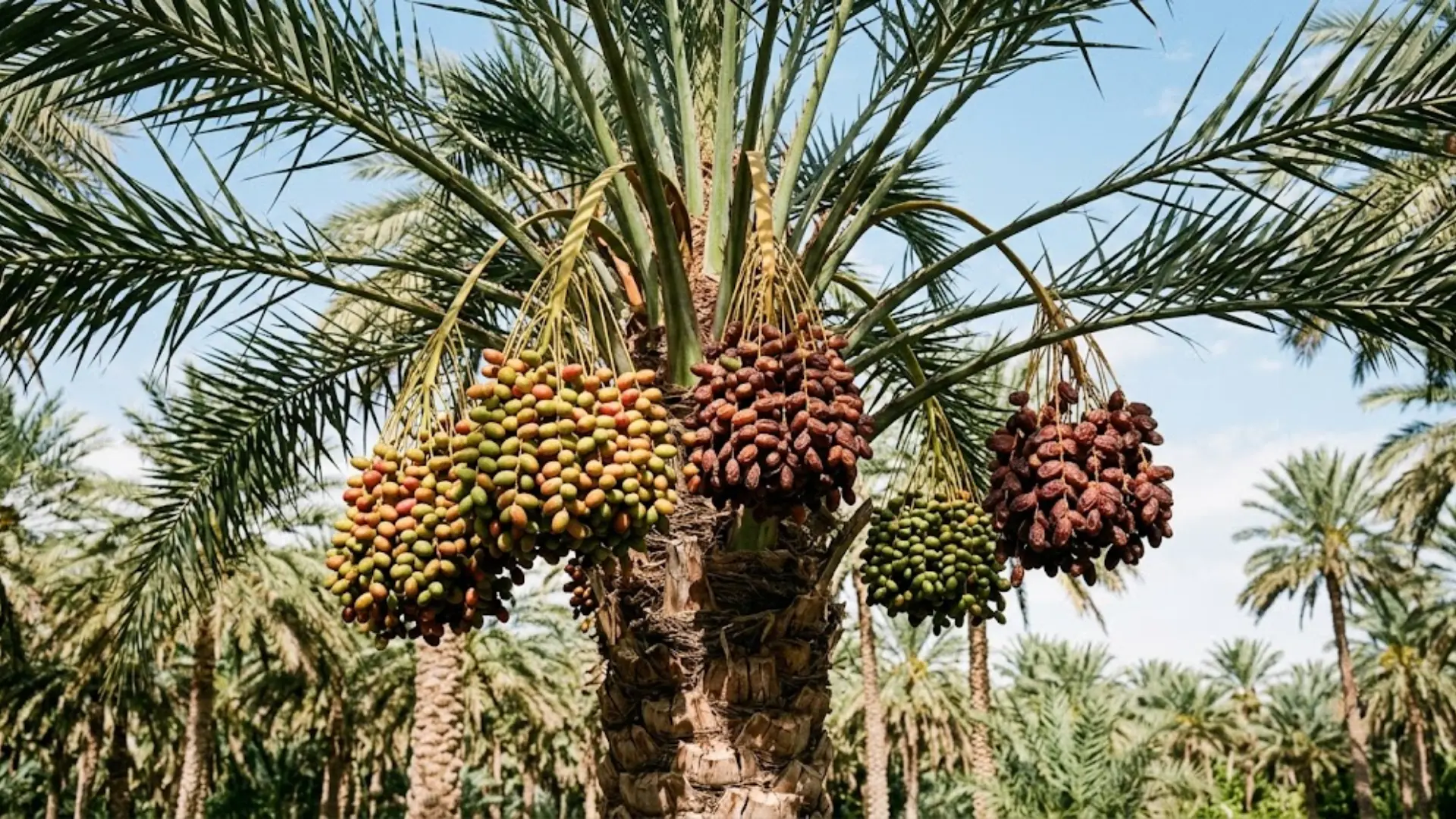
Dates grow on the date palm (Phoenix dactylifera), and only female palms produce fruit.
In spring, pollen from a male palm reaches the female flowers.
In the wild, the wind carries the pollen, while on farms, people apply it by hand.
Each pollinated flower becomes a single date. The dates grow in heavy clusters below the fronds. Over five to seven months, the fruit changes from hard and green to soft, brown, and sweet. Growers harvest them from late summer into fall.
Do dates grow on trees? In everyday language, yes. But botanically, a palm is not a true tree.
The date palm is a monocot, and its trunk never forms the woody growth rings an oak does.
Still, it’s a tall, single-trunked plant, so dates count as tree fruit, not shrub or vine fruit.
Date Palm Life Cycle and Production
Dates aren’t like apples or peaches. They all come from just one kind of palm tree. Date palms grow slowly and steadily.
If you take good care of them, they can live for more than 100 years and reach about 80 feet tall. But most are cut down much earlier, usually at 50 to 65 feet, when they produce less fruit and the top becomes too hard to reach.
Either way, that’s much taller than what most people can fit in their backyard.
Date palms are either male or female, and only the female trees produce fruit.
But female palms need a male tree nearby for pollination.
So if you have just one female palm in your yard, it’s really just for looks when it comes to fruit.
The Full Process Behind How Dates Grow
A date takes a few steps to go from flower to fruit. The timeframes are typical, but they vary by variety and climate.
Step 1: The Palm Sends Up Flower Stalks
A date palm takes several years to grow before it flowers.
When it finally does, small pale flowers grow at the top of the tree, right where the leaves start. The female flowers are creamy white and a bit waxy, packed closely together on strands inside the spathe.
The male flowers are looser and hold the pollen. Both types are actually easy to overlook.
The first time I saw them, I walked right past, even though I was standing directly underneath.
Step 2: Pollen Reaches the Female Flowers
Date palms need pollen from a male tree because they can’t pollinate themselves.
If you rely only on the wind, the clusters often turn out patchy and uneven. Hand pollination leads to a bigger and more consistent crop. Timing matters a lot. Pollen is most effective within two to four days after a spathe opens.
Growers usually go back three to four days later and keep returning as new stalks appear.
From my own experience: I once helped with hand-pollination in a small grove. Honestly, I wasn’t sure a little human effort would make much difference, but it did. The clusters on the trees we worked on looked fuller and more uniform right away.
Step 3: Tiny Fruits Set in the Hababouk Phase
After pollination, you’ll notice tiny green fruits on the strands, each about the size of a grain of rice.
Growers call this first phase Hababouk, and it lasts for about five weeks.
Growth is very slow during this time; I often wondered if anything was happening at all. But the changes are real, just subtle.
By the end of this phase, each fruit reaches the size of a pea and weighs about a gram. The major growth spurt comes later.
Step 4: Growers Thin the Bunches
When the fruit reaches the size of a pea, growers start thinning.
They might remove entire bunches, take out strands from the middle, or pick some fruit off each strand.
Although this might seem wasteful, it actually helps. The remaining dates grow larger and ripen sooner. The palm also stays healthy and can produce a good crop the following year, instead of taking a break.
Even after thinning, a single cluster can still have hundreds of dates.
Note: Timing shifts with variety and climate, and these ranges come from MDPI.
So what drives all that change? Moisture is a major factor. At the Kimri stage, dates are mostly water, but by the time they reach the fully dried Tamar stage, moisture can drop to about 20–22%.
Step 5: Hard Green Stage (kimri)
Kimri lasts from about week 6 to week 16 after pollination.
It’s the first of four ripening stages, each with a traditional Arabic name still used by growers and sellers in the Middle East and North Africa. At this point, the fruit is hard, apple green, and mostly water. It isn’t sweet, so people don’t eat it yet.
This stage is the longest. Dates gain weight quickly at first, then slow down as they approach full size.
Step 6: Crunchy Color Stage (khalal)
Between weeks 17 and 20, the green color changes to yellow or red, depending on the variety.
This stage is called Khalal. The fruit becomes crisp, juicy, and moderately sweet.
It reaches its full size and weight now, and most of its sugar is stored at this point. Some varieties are eaten fresh at this stage or added to salads. However, Khalal dates only last a few days without refrigeration, so they need to be eaten quickly.
Step 7: Soft Stage (rutab)
Rutab appears around weeks 21 to 24, and its name means wet. Ripening begins at the tip, which turns brown and soft first, then spreads to the rest of the date. Moisture drops to about 30 to 45 percent.
The sour, astringent taste fades, and the sweetness increases. The fibers soften, and the flesh becomes tender and sticky.
Rutab dates are perishable and do not last long at room temperature.
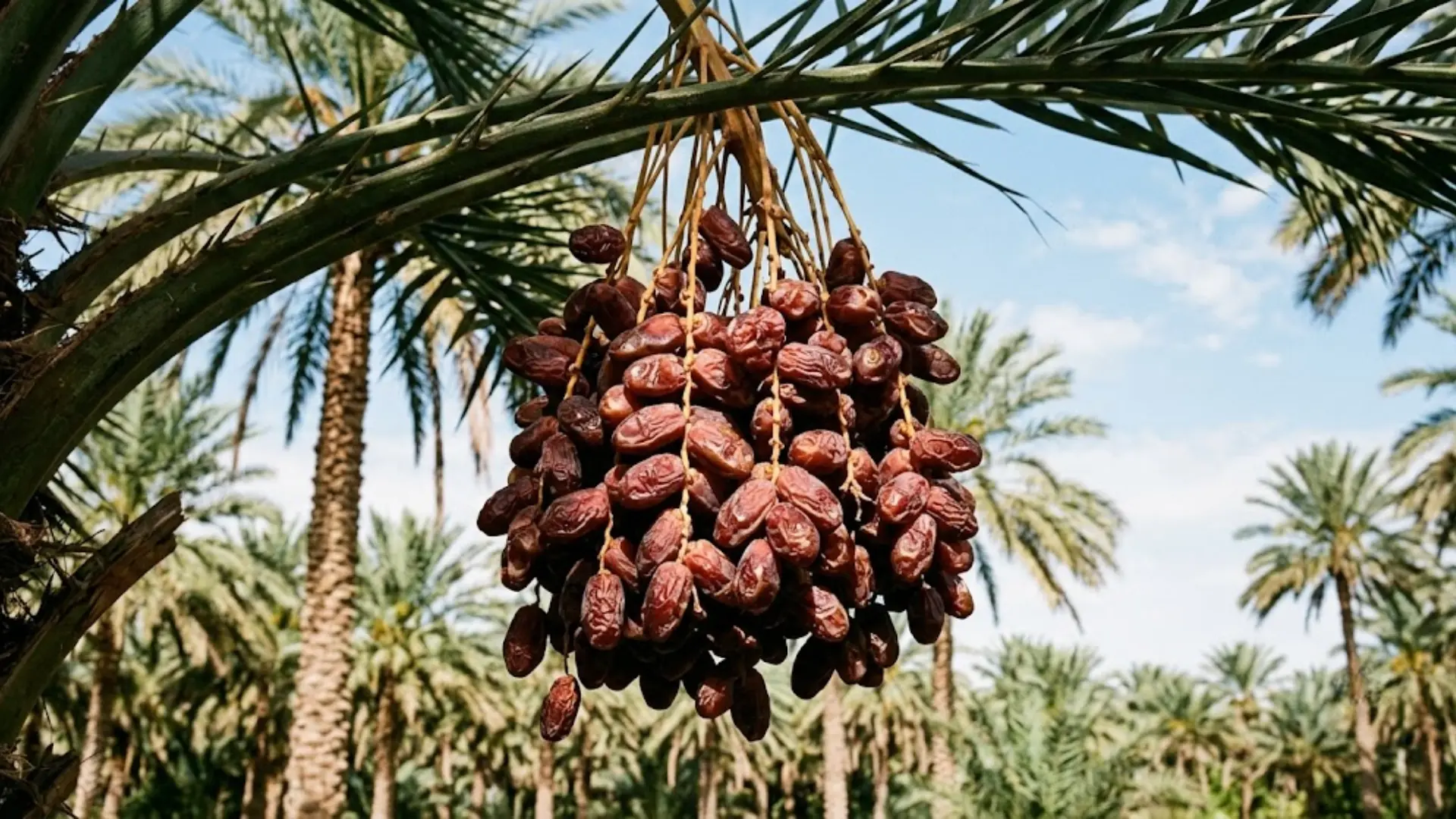
Step 8: Fully Ripe Stage (tamar)
Tamar is the final stage, arriving around weeks 25 to 27.
The skin turns dark brown, becomes wrinkled, and sticks to the flesh. Moisture drops below 25 percent, and in the driest dates, it can go down to 10 percent or less. This loss of water concentrates the sugars, creating the deep sweetness.
It also makes dates shelf-stable.
With so much sugar and so little water, they don’t ferment. That is why Tamar dates are good for storage and baking.
How Long Does It Take Dates to Grow?
Date palms need several years before they start producing fruit. The first harvest is just the beginning, and it takes much longer to reach the best yields. After that first small crop, the harvests keep getting bigger for more than ten years.
Most commercial growers use offshoots, small shoots that grow at the base of a mature palm, to start new date palms.
These offshoots are exact copies of the mother palm and bear fruit two to three years earlier than palms grown from seed.
On farms where growers pollinate by hand, they pay close attention to this timeline.
It helps them know when a tree begins to cover its own costs.
-
Germination takes 1 to 3 months, but this only applies to palms grown from seed.
-
Flowering usually happens in years 3 to 5 for offshoots in commercial groves, but it often takes longer for seedlings and home garden palms.
-
Fruit develops over five to seven months after pollination.
-
The harvest season runs from late summer through fall.
-
Date palms reach full production between years 15 and 20.
If you plant a date palm hoping for a quick reward, it’s important to be patient and adjust your expectations.
When a date palm matures, it follows a steady annual cycle. It flowers every spring and bears fruit until harvest, without repeating the early growth stages. In the Southwest, this cycle begins with pollination in late winter or early spring.
Growers thin the fruit in May and June. Starting in July, they bag the clusters to protect them from birds as the dates ripen.
The first harvests usually happen in September.
Where Do Date Palms Grow Best?
Date palms fruit well only in hot, dry places. Elsewhere, a palm may grow, but it rarely carries heavy clusters.
Heat and Dry Air
Summers need to be long and hot, with temperatures regularly past 90°F. Winters should stay mild, well above freezing.
The fruit needs months of steady warmth to ripen fully. Dry air at ripening matters just as much. Rain or humidity can split, sour, or rot the fruit. Deglet Noor is one of the most rain-sensitive. Khadrawy copes far better.
That’s why commercial groves are located in deserts, including southern California and Arizona.
Sandy, Salt-Tolerant Soil
Date palms do best in loose, sandy, well-draining soil.
Standing water rots the roots. They tolerate salty ground that many fruit trees can’t, and they need little compost.
Are Dates PickedFresh or Dried?
Many folks assume dates come pre-dried, straight out of a package.
In reality, they dry naturally right on the tree, and how long they stay up there decides what you end up with.
Some I pick at the Rutab stage, when they’re soft and best eaten fresh, and my Barhi never make it that far because I eat them straight off the strand at the crisp Khalal stage.
I leave most on the palm until they reach Tamar, when sun and time slowly pull the moisture out.
That’s all a store-bought “dried date” really is: fruit that stayed on the tree a little longer.
Harvest still means reaching the crown. Growers send up experienced climbers, fix ladders to the trunk, or use machines that lift pickers into the palm. Dates on one bunch ripen over almost a month, so pickers usually make three or four passes.
Growing Date Palms at Home
Can a home gardener grow one outside the desert? Yes, you can. However, actually getting fruit is another challenge.
You’ll need the right climate, a good setup, and plenty of patience.
Date palms do best in USDA hardiness zones 9 to 11, where winters are mild.
-
Buy a rooted female offshoot: Pick a named variety, already potted. Skip pygmy date palms, and treat a pit you germinate like any other seed as a gamble.
-
Plan your pollen: Keep a male palm nearby, or save last season’s dried pollen.
-
Choose a sunny, open spot: Give it full sun all day and room to spread, since groves space palms about 26 to 33 feet apart.
-
Plant in the morning, at the right depth: Set the widest part of the base level with the soil, because too deep rots the heart and too shallow dries the roots. Then shape a shallow basin around it.
-
Water deeply: Soak young palms often to push roots down, and keep watering through flowering and fruiting so clusters don’t shrink.
-
Move pots up as it grows: Repot it into a larger container as needed, then plant it in the ground once you want fruit.
-
Hand-pollinate each spring: When a female spathe splits, dust dried pollen onto a walnut-sized piece of cotton and tuck it between the flower strands.
-
Remove offshoots from the base: It helps the parent palm fruit better, and you can pot them up as new palms.
Once your palm outgrows its container, spacing matters as much as sunlight. Commercial growers plant palms about 26 to 33 feet apart, so try to give your backyard palm a similar amount of open space, away from your house
The best way to start is with a nursery-grown offshoot from a female palm.
You can also try sprouting a seed from a fresh store-bought date, but it’s a gamble since you can’t be sure of the sex or variety.
Tip: Spacing date palms is similar to planning the layout of vegetable garden beds.
Common Date Varieties and Their Differences
You will spot several varieties in the grocery aisle, each with its own texture, flavor, and best use in the kitchen.
|
Variety |
Texture |
Flavor |
Best Uses |
|---|---|---|---|
|
Medjool |
Large, soft, chewy |
Rich, caramel-like |
Snacking, stuffing, baking |
|
Deglet Noor |
Firm, semi-dry |
Mild, nutty |
Baking, chopping into dishes |
|
Barhi |
Soft, almost creamy when ripe |
Buttery, honeyed |
Eating fresh at the Khalal or Rutab stage |
|
Zahidi |
Firm, drier |
Mild, subtly sweet |
Cooking, savory dishes |
|
Halawy |
Soft, tender |
Sweet, syrupy |
Snacking, desserts |
|
Khadrawy |
Soft, moist |
Rich, smooth |
Fresh eating |
|
Ajwa |
Soft, dense |
Deep, slightly smoky |
Snacking, traditional and religious use |
Comparing Different Propagation Methods
Date palms can be started three ways, and each suits a different grower.
-
Seeds are cheap and easy to try, but fewer than 10% of seedlings bear good fruit.
-
Seeds mostly suit breeders hunting for new varieties.
-
Offshoots are pups you separate and root from a female palm, with no lab needed.
-
Each palm makes only 20 to 30 offshoots, so supply is limited.
-
Offshoots can carry pests, so pick healthy, pest-free ones.
-
Tissue culture grows clones in a lab, giving disease-free, uniform plants year-round.
-
Lab plants need hardening off before planting, so they mostly suit large commercial groves.
How Date Palms Adapt to Different Environments
Date palms handle extremes better than most fruit trees. The palm has a single growing point at the top of the trunk.
Old frond bases insulate it, so new growth toughens up before facing the sun. Temperature still sets limits.
A palm flowers only once shade temperatures pass 64°F, and sets fruit above 77°F. Growth stops below 50°F. At about 21°F, leaflet edges yellow and dry. Below 16°F, the outer fronds die back, and a long freeze can leave the palm looking burnt.
Wind rarely hurts it. Date palms shrug off hot, dusty gusts and often shelter other crops.
Where are Most Dates Grown Around the World?
Dates are grown commercially in more than 30 countries, but output is concentrated in a handful of hot, arid places.
|
Country |
Known For |
Approx. Annual Production (2024) |
|---|---|---|
|
Saudi Arabia |
Largest global producer, premium dates |
1.93 million tonnes |
|
Egypt |
Second-largest producer |
1.75 million tonnes |
|
Algeria |
Export production, Deglet Noor |
1.34 million tonnes |
Note:Totals move a little each year with weather and water supply, so treat these numbers as a recent snapshot. They are FAOSTAT figures for 2024, and the ranking can shift from year to year.
Wrapping It Up!
Before you go, a fun fact. The date palm’s scientific name comes with its own little story. “Phoenix” is named after the legendary bird that rose from its ashes, because these palms can grow back even after a fire.
“Dactylifera” simply means “finger-bearing,” since the fruit looks a bit like little fingers. Pretty fitting, right?
Next time you grab a date, think about the tough palm it came from.
What’s your favorite way to eat dates? Tell us in the comments!
Frequently Asked Questions (FAQs)
How Many Dates Does One Tree Produce?
It varies a lot by variety and care. Growers chasing large Medjool fruit aim for about 175 to 265 pounds per palm a year, and a heavy cropper like Barhi averages around 440 pounds. Output also depends on the tree’s age and how consistently it’s watered during fruit development.
Do Dates Keep Ripening After They’re Picked?
Partly. Growers often cut bunches early, between the Khalal and Rutab stages, to dodge rain. Much of that fruit finishes ripening in airy containers or sheds, though fully tree-ripened Tamar dates still store best.
Can You Tell Male and Female Date Seeds Apart?
No, a seed shows no sign of its sex. A seedling reveals its sex only when it first flowers, years later, and about half turn out male.


3 Responses
I was wondering how to identify male and female seeds
Thanks for the information , I have already soaked the seeds patiently waiting for the results.
Planted a couple of seeds, two sprouts have emerged, the first one has now curled up into a stem? The second one is still a flat leaf. We will see what happens next.