Bat Bugs vs Bed Bugs: What’s the Difference?

Something’s eating the leaves. Something’s leaving spots. These notes help you figure out what’s going on.

They show what to look for, what it means, and what to do. Easy signs. Straight answers. Steps that make and work.

Last Updated: September 17, 2026

bat-bugs-vs-bed-bugs

Table of Contents

Corn seems like one crop until you stand in front of a seed catalog.

Sweet corn, flint corn, dent corn, and popcorn barely behave the same way. They don’t cook the same either, once they hit the soil or a skillet. Each variety carries its own sugar level, kernel hardness, and job to do.

Mix them up in the garden or the kitchen, and the harvest disappoints.

This blog covers the different types of corn grown. It shows what separates their kernels on a genetic level, and which variety belongs in your garden bed, your cornbread, or your popcorn bowl this season.

How Different Types of Corn are Classified

Corn is grouped by kernel structure, starch type, and endosperm, not just color or taste.

These traits decide why a kernel pops, grinds, or stays tender enough to eat fresh.

Classification Basis Category Example Types Key Trait
Endosperm Type Soft (Floury) Flour Corn Soft interior, grinds easily
Hard (Flinty) Flint Corn, Popcorn Glassy shell resists cracking
Mixed Dent Corn (Field Corn) Soft center, hard sides, forms a dent
Sugar Content High Sugar Sweet Corn Mutation blocks sugar-to-starch conversion
Starch Composition Waxy Starch Waxy Corn Nearly pure amylopectin, sticky texture
Kernel Structure Husk-Enclosed Pod Corn Each kernel wrapped in its own husk
Harvest Timing Immature Harvest Baby Corn Picked before starch fully forms
Genetic Grouping Species All types (Zea mays) One species, shaped by selective breeding

Every corn type traces back to one species. Genetics, starch, and harvest timing set them apart.

Corn categories have developed over centuries of selective breeding, each tailored for a specific purpose.

Some varieties are used as livestock feed, others for human consumption, and some look very different from the corn on your dinner plate.

1. Sweet Corn

fresh yellow sweet corn with partially peeled green husks growing in a healthy garden under sunlight

Sweet corn is bred to hold sugar instead of converting it to starch. Kernels stay tender and juicy.

Flavor ranges from mild and milky to candy-sweet, depending on the cultivar.

People cook it, grill it, boil it, roast it, or shave it raw into salads. Silver Queen, Peaches and Cream, Honey Select, and Bodacious are popular picks, each with its own sugar level and kernel color.

Higher-sugar hybrids stay sweet longer after picking, but home gardeners usually cook them the same day.

2. Field Corn (Dent Corn)

mature field corn with dry husks and dented yellow kernels ready for harvest in a farm field

Field corn earns the name dent corn from the small dimple each kernel forms as it dries. The kernels are tough, low in sugar, and unpleasant raw, so growers leave them in the field to mature and dry fully.

Once dried, this corn becomes livestock feed, ethanol, cornstarch, and syrup.

It is the most widely planted corn crop by a wide margin. Combine harvesters strip entire fields in a single pass.

Most of this crop never makes it to a produce aisle.

3. Flint Corn

colorful flint corn ears with glossy hard kernels arranged naturally on a rustic wooden table

Flint corn gets its name from a hard, glassy shell that resists cracking and moisture better than most types.

Kernels come in deep reds, blues, purples, and golds, which makes the ears popular for fall displays and wreaths.

Beyond decoration, flint corn holds up in long-simmered dishes like polenta and hominy without turning mushy, and it grinds into a coarse, hearty cornmeal.

The name comes from its resemblance to flint stone. Growers ensure ears are completely dried before storing.

4. Flour Corn

white flour corn beside freshly ground corn flour in a rustic kitchen with natural daylight

Flour corn is almost entirely soft starch, with little hard shell protecting the kernel. That softness grinds into a fine meal without heavy machinery.

For centuries, communities across the Americas turned it into tortillas, breads, and porridges.

Today it still appears in blue corn pancakes and atole, valued for its nutty, delicate flavor, and some heirloom varieties show streaks of red or purple beneath the husk.

It is closely tied to Native American agriculture. Kernels crush easily between two fingers once dry

5. Popcorn

popcorn kernels beside an ear of popcorn corn and a bowl of freshly popped popcorn on a table

Popcorn kernels trap a small amount of moisture inside a hard shell.

Heat turns moisture to steam, building pressure that causes the kernel to burst and expand. Butterfly kernels pop irregularly and gently, while mushroom kernels stay round and sturdy, ideal for caramel or cheese coating.

Ground into flour, popcorn also works well in gluten-free baking.

Only certain hybrids pop reliably at home. A single acre can yield thousands of pounds of kernels.

6. Pod Corn

rare pod corn ear with each kernel enclosed in leafy husks displayed in natural outdoor light

Pod corn is a genetic oddity: each kernel grows wrapped in its own small husk, giving the ear a shaggy, layered look unlike any other corn type.

It yields little and offers no culinary advantage, so farmers rarely plant it commercially.

Its value is mainly historical, helping researchers trace corn’s evolution from wild teosinte, its ancient ancestor.

Seed banks keep small samples alive for study. It rarely appears outside university research plots.

7. Waxy Corn

fresh waxy corn ears beside cooked waxy corn kernels arranged on a rustic wooden tabletop

Waxy corn’s starch is almost pure amylopectin, giving cut kernels a glossy, waxy look instead of the usual sheen.

That structure creates a thicker, more stable texture when cooked, which is why manufacturers use waxy starch in sauces, gravies, and frozen meals.

Industrially, it also appears in adhesives, paper coatings, and other products where steady thickening matters.

Breeders first identified the waxy trait in China in the early 1900s.

8. Baby Corn

freshly harvested baby corn with peeled husks and sliced pieces on a wooden cutting board

Baby corn is harvested just days after the silk appears, before kernels have time to form.

Farmers hand-pick the tiny ears whole, then peel and trim them for sale fresh, canned, or pickled. It’s a common addition to stir-fries and salads for its crunch, especially in Southeast Asian cooking.

Nutritionally, it is low in calories but offers fiber, folate, and vitamin C.

Some baby corn comes from dwarf varieties bred just for this purpose. It cooks in minutes, unlike mature ears.

Colored Corn Varieties and What Their Colors Mean

Corn color comes down to pigments in the pericarp and aleurone layers, controlled by genetics passed down through generations of cross-pollination and selective planting.

9. Yellow Corn

bright yellow corn on the cob with fresh green husks growing on a healthy corn stalk

Yellow corn’s color comes from carotenoid pigments like lutein and zeaxanthin, found in both sweet and field corn.

It is the shade most home gardens and commercial fields grow by default, the one you’d picture on the cob or in a can.

Compared with white varieties, yellow corn carries a slightly deeper, more classic corn flavor.

These are the most commercial hybrids grown in yellow. It’s also the standard base for corn syrup production.

10. White Corn

fresh white corn with creamy kernels and green husks partially peeled back in natural daylight

White corn lacks the carotenoid pigments responsible for yellow color, giving it a pale, creamy kernel instead.

Varieties like Silver Queen and Country Gentleman are prized for their tender texture and mild, delicate sweetness, often considered smoother than yellow corn.

White corn shows up frequently in Southern cooking, grits, and hominy production.

Its subtle flavor makes it a popular choice for people who find yellow corn’s taste slightly too strong or grassy.

11. Bi-Color Corn

fresh bi-color corn with white and yellow kernels resting on a rustic wooden surface

Bi-color corn comes from planting a yellow variety and a white variety close enough to cross-pollinate naturally in the same field.

Each ear ends up with kernels of both colors scattered unevenly across the cob rather than in a set pattern.

Butter and Sugar is a popular pick, blending the deeper flavor of yellow corn with the tenderness of white.

Isolation distance between the parent varieties still matters. It’s a common pick at roadside stands.

12. Blue Corn

deep blue corn ears with loose blue kernels arranged naturally on a wooden tabletop

Blue corn’s slate-blue to indigo color stems from anthocyanins, the same antioxidant pigments as in blueberries.

Ground into flour, it goes into tortillas, chips, and pancakes, giving baked goods a distinct grayish-blue tint once cooked.

Its flavor is mildly nutty and earthy, with a texture ideal for rustic baking.

Traditional recipes often pair it with red or green chile. Its color can fade slightly with prolonged cooking.

13. Red Corn

deep red corn with dried husks displayed on a rustic wooden table in natural daylight

Red corn varies from brick to bright cherry red, with pigment in the outer layer rather than the kernel’s interior.

Usually a flint variety, it is grown more for appearance than eating and often used in fall wreaths and dried arrangements.

Ground red corn yields a reddish-tinted cornmeal occasionally used in specialty baking or regional dishes.

Its kernels resist pests better than sweeter varieties. Growers plant it mainly for autumn markets.

14. Purple Corn

fresh purple corn with glossy dark purple kernels and green husks in bright outdoor light

Purple corn has high anthocyanins, turning kernels deep violet-black and coloring water or dough purple when cooked.

Peru has long used it in chicha morada, a spiced beverage, and mazamorra morada, a fruit-based pudding.

Its pigment is being studied for antioxidant properties.

The purple corn is increasingly sold as a natural food dye. Boiling the kernels releases most of the color into the water.

15. Black Corn

black corn with dark glossy kernels displayed naturally on a rustic wooden tabletop

Black corn appears nearly black or deep purple-black, with anthocyanin levels higher than typical purple varieties.

Mostly a flint type, it’s prized for dramatic dried arrangements and fall décor, not for fresh eating.

Some varieties are ground into dark, richly colored cornmeal for specialty dishes, and gardeners grow it for its striking appearance.

Seed catalogs often list it under heirloom collections. It germinates and grows much like standard flint corn

16. Multicolored Corn

colorful indian corn with mixed kernels in a harvest basket on a rustic wooden surface

Multicolored corn, often called Indian corn, shows a random patchwork of yellow, red, purple, blue, and white kernels on one cob, a result of genetic variation within flint varieties.

It is mostly grown today for autumn decorating and wreaths rather than eating.

Technically edible, its hard kernels work far better ground into cornmeal than eaten straight off the cob.

No two ears look exactly alike. Farmers often bundle it into fall gift baskets.

Corn Varieties Worth Growing

Corn’s journey from a wild grass in Mesoamerica to a global staple means different regions developed their own signature varieties over thousands of years.

Here is a look at some of the most notable regional varieties.

17. American Sweet Corn

fresh american sweet corn with golden kernels and green husks arranged on a rustic wooden table

American sweet corn evolved through breeding for fresh eating, prioritizing sugar over starch.

It became a summer staple nationwide, appearing at cookouts, farmers’ markets, and gardens coast to coast.

Modern hybrids, developed over decades for tenderness and sweetness, are among the most cultivated corn varieties globally.

Breeding programs release new hybrids most years. Farmers’ markets often sell it within hours of picking

18. Mexican Maize

colorful heirloom mexican maize with blue, white, yellow, and red kernels on a wooden table

Mexican maize includes some of the oldest, most genetically diverse corn varieties still grown, with landraces suited to specific regions and altitudes.

Colors range from white and yellow to deep blue and black, each suited to dishes like tortillas, tamales, or pozole.

Nixtamalization, soaking corn in an alkaline solution, originated here and still shapes Mexican cooking today.

Many landraces carry names tied to their home village. Seed saving keeps these varieties from disappearing.

19. Peruvian Giant Corn

peruvian giant corn with oversized white kernels displayed beside loose kernels on wood

Peruvian giant corn, known locally as choclo or cuzco corn, produces kernels far larger than typical varieties, some reaching the size of a thumbnail.

Grown high in the Andes, it has a starchy, mild flavor and firm bite unlike sweeter corn types found elsewhere.

Peruvians serve it boiled or roasted as a street food snack, often paired with cheese, and it appears in traditional dishes like ceviche and choclo con queso across the country.

20. Blue Corn of the Southwest

blue corn ears with deep navy kernels arranged naturally on a rustic wooden tabletop

Blue corn holds deep cultural weight for Indigenous communities in the Southwest, particularly the Hopi and Pueblo peoples, who have grown it for centuries as part of traditional agriculture.

It remains central to foods like piki bread, and its popularity has grown commercially in recent decades for chips, pancakes, and specialty baked goods sold nationwide.

Ceremonial use still shapes how and when it is planted.

Specialty mills now sell blue cornmeal well beyond the region.

21. European Flint Corn

european flint corn with glossy orange kernels displayed beside loose flint corn kernels

European flint corn adapted well to cooler climates after arriving from the Americas, where other varieties struggled to mature in a shorter season.

Its hard shell resisted pests and moisture during storage, a useful trait for regions with unpredictable harvests.

Italy and parts of Eastern Europe still rely on it for polenta and traditional cornmeal dishes today.

Growing Different Types of Corn in Your Garden

Corn’s needs shift by type, but the basics hold for sweet, popcorn, and flint corn alike.

Corn is wind-pollinated, not insect-pollinated, so a single row rarely fills every ear.

A block of four rows by four plants improves pollination. Sweet corn, popcorn, and field corn cross-pollinate if planted close, leaving sweet corn starchy. Keep varieties 250 feet apart, or stagger planting by two weeks.

A raised bed sized for a corn block works best on the north side of the garden.

Grouping crops by size and water needs – tall corn back, shorter vegetables front – simplifies the season.

Space seeds 8 to 12 inches apart in rows 2 to 3 feet apart, with rich, moist soil through tasseling.

Which Corn Type Should You Grow?

The right corn to grow depends on the goal.

Home gardeners after fresh summer eating should stick with sweet corn. It’s produced for tenderness and a quick harvest.

Anyone grinding their own meal or tortillas gets more use from flint corn, since they store well once dried.

Popcorn lovers can grow their own popping variety with little extra care.

Those drawn to fall displays might plant ornamental flint or multicolored corn purely for color.

Small yards suit compact or early-maturing varieties, while larger plots can accommodate full block plantings like sweet corn and popcorn.

Climate and available space matter too, so check maturity times before planting.

Harvest Timing for Every Type of Corn

Picking corn at the wrong time can ruin the whole crop, leading to mushy popcorn that won’t pop or sweet corn that becomes starchy on the stalk.

Each type has its own window for peak quality, tied closely to moisture content and kernel maturity.

  • Sweet Corn: Harvested at the milk stage, 60 to 90 days after planting, when kernels run milky if pierced.
  • Baby Corn: Picked just 2 to 3 days after silk emerges, before kernels fill out.
  • Field Corn (Dent Corn): Left on the stalk 100 to 120 days, until moisture drops below 20 percent.
  • Flint Corn: Harvested late season, once kernels harden fully for long-term storage.
  • Flour Corn: Left to fully mature and dry on the stalk, then harvested for grinding.
  • Popcorn: Dried on the stalk until kernel moisture hits 13 to 14 percent, the ideal popping range.
  • Pod Corn: Harvested at full maturity, though rarely grown commercially due to low yield.
  • Waxy Corn: Harvested at full maturity, once starch and moisture meet industrial processing standards.

Which Types of Corn are Best for Cooking?

Different corn varieties behave differently in the kitchen; using the wrong type can result in grits or fragile tortillas.

Method Best Corn Type Why It Works
Boiling Sweet Corn High sugar and tender kernels stay juicy without turning starchy
Grilling Sugars caramelize over heat while kernels hold their bite
Roasting Dry heat concentrates natural sweetness and adds light char
Cornbread Flour Corn/ Field Corn Soft starch grinds into a fine meal that bakes up tender
Tortillas Flour Corn or Flint Corn Nixtamalized meal creates the pliable dough masa requires
Polenta Flint Corn Hard, glassy kernels grind into coarse grits that hold texture during long simmering
Grits Dense kernel structure breaks down slowly for a creamy, thick consistency
Popcorn Popcorn Hard shell and trapped moisture are what allow kernels to pop at all
Corn Flour Flour Corn Naturally soft, low-starch kernels grind finer than any other type

Choosing the right corn type is crucial for recipes and affects dish quality. Using sweet corn for fresh dishes and flint, flour, and field corn for grinding and baking maintains each type’s traditional qualities.

How to Store Different Types of Corn?

Corn doesn’t stay fresh evenly; improper storage can quickly ruin its flavor or texture.

  • Fresh Sweet Corn: Refrigerate unhusked ears and use within one to two days for peak sweetness.
  • Dried Corn: Keep in an airtight container in a cool, dry spot for up to a year.
  • Popcorn Kernels: Store sealed at room temperature to protect the moisture needed for popping.
  • Cornmeal and Flour: Store in an airtight container and refrigerate or freeze for longer shelf life.
  • Frozen Corn: Blanch before freezing and use within eight to twelve months for best quality.

Common Mistakes When Choosing Corn Varieties

Many growers plant sweet corn too close to field corn. Cross-pollination turns sweet corn starchy instead of tender.

Some assume all corn is edible fresh. Flint, flour, and field corn are bred for grinding, not for eating raw.

Others cook popcorn kernels like sweet corn, but popcorn’s hard shell needs popping, not boiling. Skipping maturity times causes trouble in short growing seasons.

Poor spacing weakens pollination and leaves ears with missing kernels.

Buying ornamental corn for flavor also disappoints, since those varieties are bred for color, not taste.

Wrap Up!

Sweet corn gets bred for a quick, tender harvest, popcorn gets bred for a hard shell that bursts under heat, and flint, flour, dent, and waxy corn stock feed troughs, tortilla presses, and factory floors.

Centuries of breeding shaped every kernel toward one job.

Know the different types of corn, and know what each one is built for.

Choosing seed packets, planning garden beds, or grabbing the right bag at the store stops feeling like guesswork.

Grow one type this season, or grow three, and taste the difference yourself.

Frequently Asked Questions (FAQ’s)

What are the Four Main Types of Corn?

The four main types are dent corn, flint corn, sweet corn, and popcorn.

Which Type of Corn is the Sweetest?

Sweet corn is the sweetest, bred specifically for high sugar content and fresh eating.

What Type of Corn is Used for Popcorn?

Popcorn kernels, a distinct variety with a hard shell that traps moisture and allows the kernel to pop.

Is Field Corn Edible?

Yes, but only after processing or drying, since it’s too starchy and tough to eat fresh off the cob.

What is Blue Corn Used for?

Blue corn is ground into flour for tortillas, chips, pancakes, and traditional dishes like piki bread.

A bug near the bed is enough to make one check the sheets twice.

When they are small, flat, and reddish-brown, bed bugs seem like the obvious answer. But that is not always the case.

Bat bugs can look so similar that telling them apart without a closer look can be difficult.

For me, the key to understanding bat bugs vs bed bugs is knowing that a nearly identical appearance does not mean the insects behave the same way.

Where the bug came from and what it feeds on can reveal much more than its color or size.

What are Bat Bugs?

Bat bugs are small, blood-feeding insects that mainly live around bats and their roosting areas.

These pests live alongside bat colonies and depend on them as a primary food source.

They get lumped in with other tiny bugs found indoors often enough that location, not looks, ends up doing most of the identification work.

Key traits worth noting:

  • Feed almost exclusively on bat blood
  • Travel indoors by hitching onto roosting bats
  • Remain near roosting sites rather than living rooms or bedrooms
  • Start seeking new hosts once bats leave or are excluded

What are Bed Bugs?

These insects rely on human blood to survive and reproduce, which shapes almost every part of their behavior.

They stay close to sleeping areas since that’s where a steady host is available night after night.

Common habits include:

  • Feeding while people sleep, usually undetected
  • Hiding in mattress seams, headboards, and bed frame cracks
  • Staying within a short distance of their feeding spot
  • Spreading through luggage, furniture, or clothing rather than the flight

Because their survival depends entirely on repeated access to a human host, bed bugs rarely wander far from bedrooms or upholstered furniture.

Bat Bugs vs Bed Bugs: Side-by-Side Differences
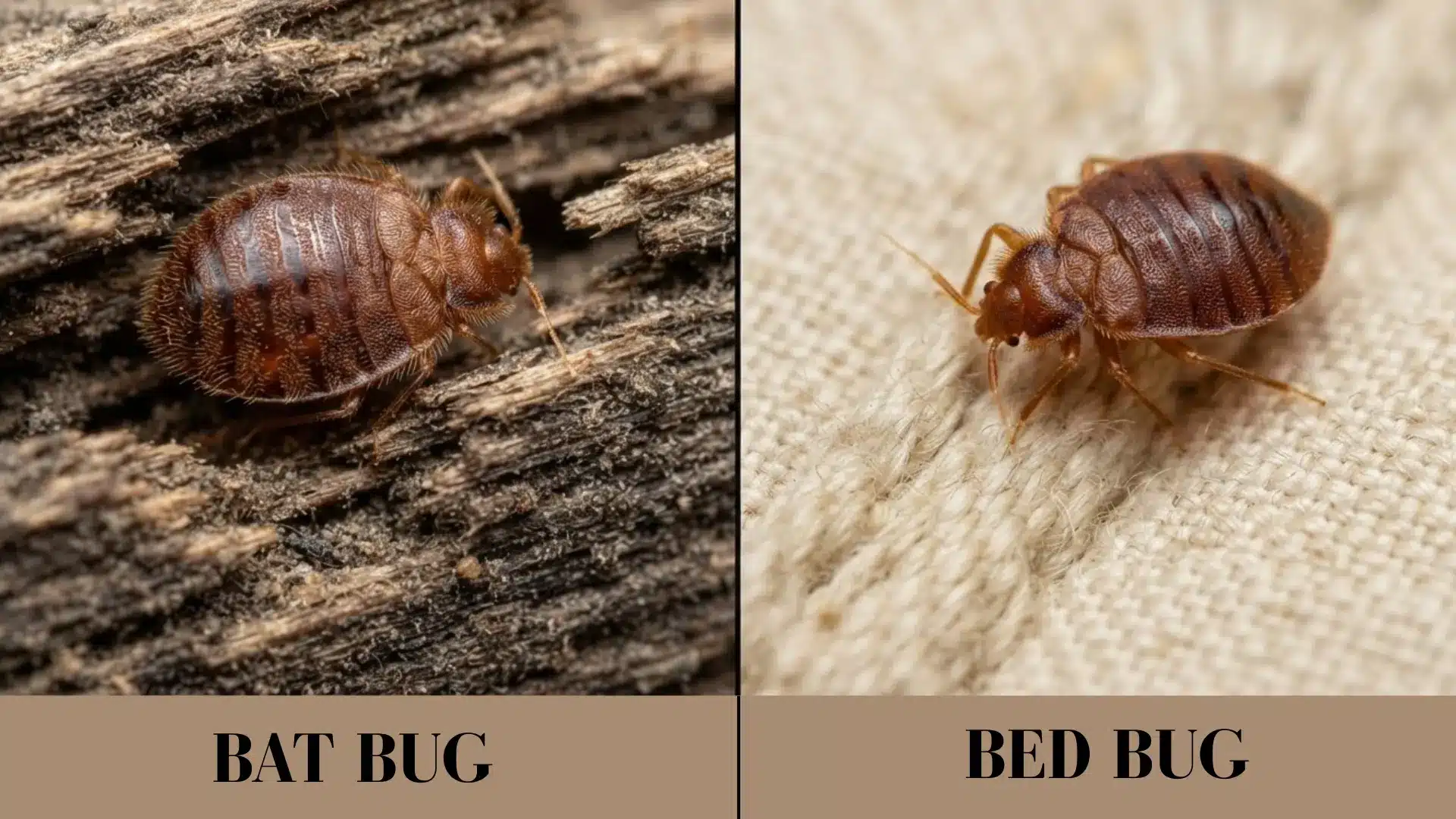
side by side comparison of a bat bug on wood and a bed bug on fabric showing their similar appearance

Spotting the difference between bat bugs vs bed bugs comes down to a few small, specific physical details.

1. Differences in Appearance

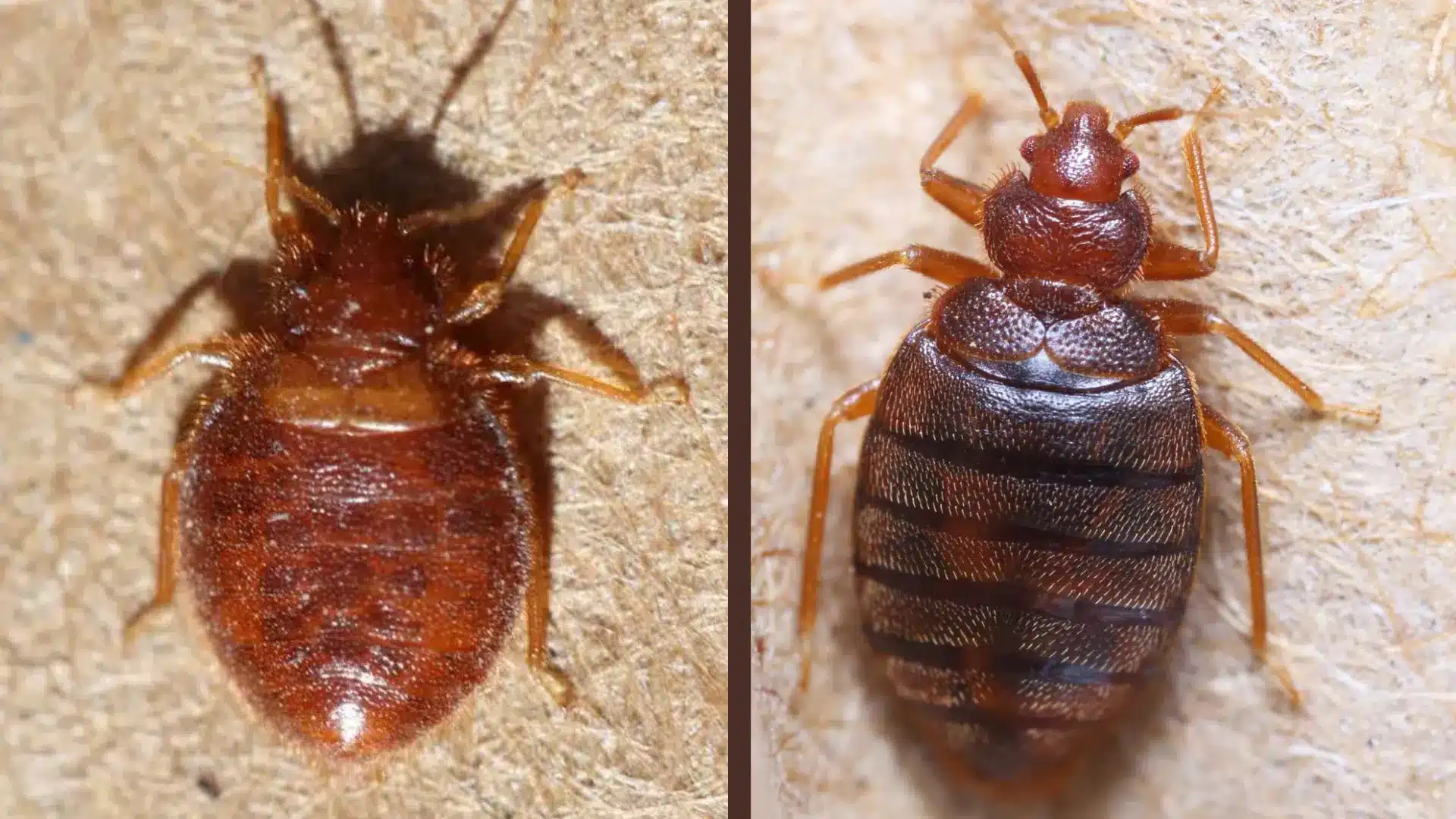
Bat bugs and bed bugs are both small, flat, oval-shaped insects with reddish-brown bodies.

Adults are generally similar in size, so identifying them by size or color alone can be difficult. Their appearance may also change slightly after feeding as their bodies become fuller and darker.

That reddish-brown coloring shows up in other bugs too.

Because the differences are so subtle, you may need a magnifying glass or microscope to examine their finer physical features.

2. Differences in Body Hair

Bat bugs have noticeably longer hairs around the pronotum, the area directly behind the head.

These hairs can extend beyond the width of the insect’s eye. Bed bugs have much shorter hairs in the same area.

Since these hairs are extremely small, magnification is usually needed to see the difference clearly and identify the insect correctly.

3. Differences in Their Preferred Hosts

Bat bugs primarily feed on bats and usually stay close to places where bats roost. When bats are present, humans are not their preferred source of blood.

Bed bugs are different because they commonly feed on humans.

They usually settle near beds, couches, and other places where people remain still long enough for them to feed.

4. Differences in Infestation Patterns

Bat Bugs may start moving into rooms after bats leave or are removed because they begin searching for another host.

Bed bug infestations usually develop around areas where people sleep or rest.

Over time, bed bugs can spread from mattresses and bed frames into furniture, baseboards, cracks, and nearby rooms.

Spotting Bat Bugs vs Bed Bugs by Where They Hide

When comparing bat bugs vs bed bugs, where you find the insect often reveals more than its color or shape ever could.

Signs pointing to bat bugs:

  • Found near attics, chimneys, or upper wall gaps
  • Appear after bats roost nearby or get excluded
  • Rarely seen in bedding or furniture

Signs pointing to bed bugs:

  • Found in mattress seams, headboards, or couch cushions
  • Appear alongside itchy bite marks after sleep
  • Accompanied by dark fecal spots on sheets

Matching the location to these patterns narrows down the culprit long before any closer inspection is needed.

Attics and wall voids are not exclusive to bats either. Pseudoscorpions tucked into the wall voids turn up in those exact gaps, so location alone still benefits from a closer look.

Do Bat Bugs Bite Humans?

Yes, bat bugs will bite people, but only when their preferred host disappears.

Once bats leave a roost or get excluded from a home, bat bugs search for another blood source and will feed on humans if nothing else is available.

The bite itself often goes unnoticed at first, since their mouthparts are small, though some people develop mild swelling or itching afterward.

Compared to bed bug bites, which tend to appear in noticeable clusters or lines, bat bug bites are usually isolated, milder, and easy to mistake for something else entirely.

Other insects that appear from nowhere often show up around the same entry points once a preferred host is gone, which is another reason a location check settles the question fast.

Neither bug is known to spread disease, but persistent bites from either one are worth checking with a professional rather than ignoring.

DIY Removal Steps for Bat Bugs vs Bed Bugs

Handling either pest starts with a different first step, so knowing the right order of action for each one makes the whole process far less stressful.

Since one insect depends on bats and the other depends on people, treating them the same way rarely works.

The table below breaks down the practical steps for each:

Step Bat Bugs Bed Bugs
First Priority Address the bat infestation, not just the bugs. Locate and treat all hiding spots directly.
Source Control Arrange proper bat exclusion through appropriate channels. Wash all bedding and fabrics in hot water.
Seal Entry Points Caulk gaps in attics, chimneys, and wall voids. Seal cracks in bed frames, baseboards, and furniture.
Cleaning Vacuum roosting areas after the bats are gone. Vacuum mattress seams, carpets, and upholstery thoroughly.
Follow-Up Monitor for lingering bugs seeking new hosts. Use interceptor traps and recheck after a few weeks.
When DIY Isn’t Enough Bat activity continues, or bugs remain indoors. Bites or signs continue despite repeated cleaning.

When to Bring in a Pest Control Professional

Some situations call for expert confirmation rather than continued guesswork at home.

Lab-level identification becomes worthwhile when color and hair-length checks aren’t conclusive, or when bites keep appearing despite no clear source found.

A typical inspection usually includes:

  • A physical sample collected for closer examination
  • A check of attics, wall voids, and roosting areas
  • An inspection of mattress seams, furniture, and bedding
  • A tailored treatment plan based on which pest is confirmed

Getting a confirmed identification early saves time and money and prevents treating the wrong pest altogether.

Conclusion

Finding a bug in your home can leave you unsure about what to do next, especially when bat bugs and bed bugs look so much alike.

Instead of relying only on what you can see, pay attention to where the bugs appear and if bats are living, or recently lived, around your home.

A closer inspection can save you from using the wrong treatment and dealing with the same problem again.

Have you ever confused a bed bug with a bat bug? Share your experience in the comments below.

Frequently Asked Questions

Can I Still Sleep in My Bed If I Have Bed Bugs?

Yes, you can sleep there, but use protective measures and begin treatment promptly to prevent bed bugs from spreading to other areas of your home.

How Long Can Bat Bugs Live?

Bat bugs can survive for several months without feeding, especially under favorable conditions, allowing them to remain after bats have left or been removed from buildings.

Are Bat Bugs Attracted to Light?

Bat bugs are not strongly attracted to light. They generally remain hidden during daylight and become more active when searching for a suitable host.

Can Bat Bugs Survive Cold Weather?

Bat bugs can tolerate cool conditions and survive for extended periods in protected areas, although temperature and access to hosts can affect their survival.

Mask group

About Author

Marcus Chen has been dealing with garden pests since 2015, like aphids, beetles, and whatever's chewing holes in your tomatoes. A certified integrated pest management specialist, he teaches workshops and writes for gardening publications, helping people manage pest problems. Marcus shares practical solutions that work, helping growers protect their plants and actually enjoy the process.

Drop a comment

Leave a Reply

Your email address will not be published. Required fields are marked *

Mask group

About Author

Marcus Chen has been dealing with garden pests since 2015, like aphids, beetles, and whatever's chewing holes in your tomatoes. A certified integrated pest management specialist, he teaches workshops and writes for gardening publications, helping people manage pest problems. Marcus shares practical solutions that work, helping growers protect their plants and actually enjoy the process.

Table of Contents

related posts

How to Get Rid of Spider Mites Before They Spread?

Spider mites are one of those pests that seem to appear out of nowhere and

13 Essential Oils to Repel Bugs & 5 Natural Bug Spray Recipes

How many summer evenings have been spoiled by a persistent mosquito? Most of us grab

13 Ways on How to Prevent and Get Rid of Tomato Hornworms

A hornworm can hide on a tomato plant for days without being noticed. Its green