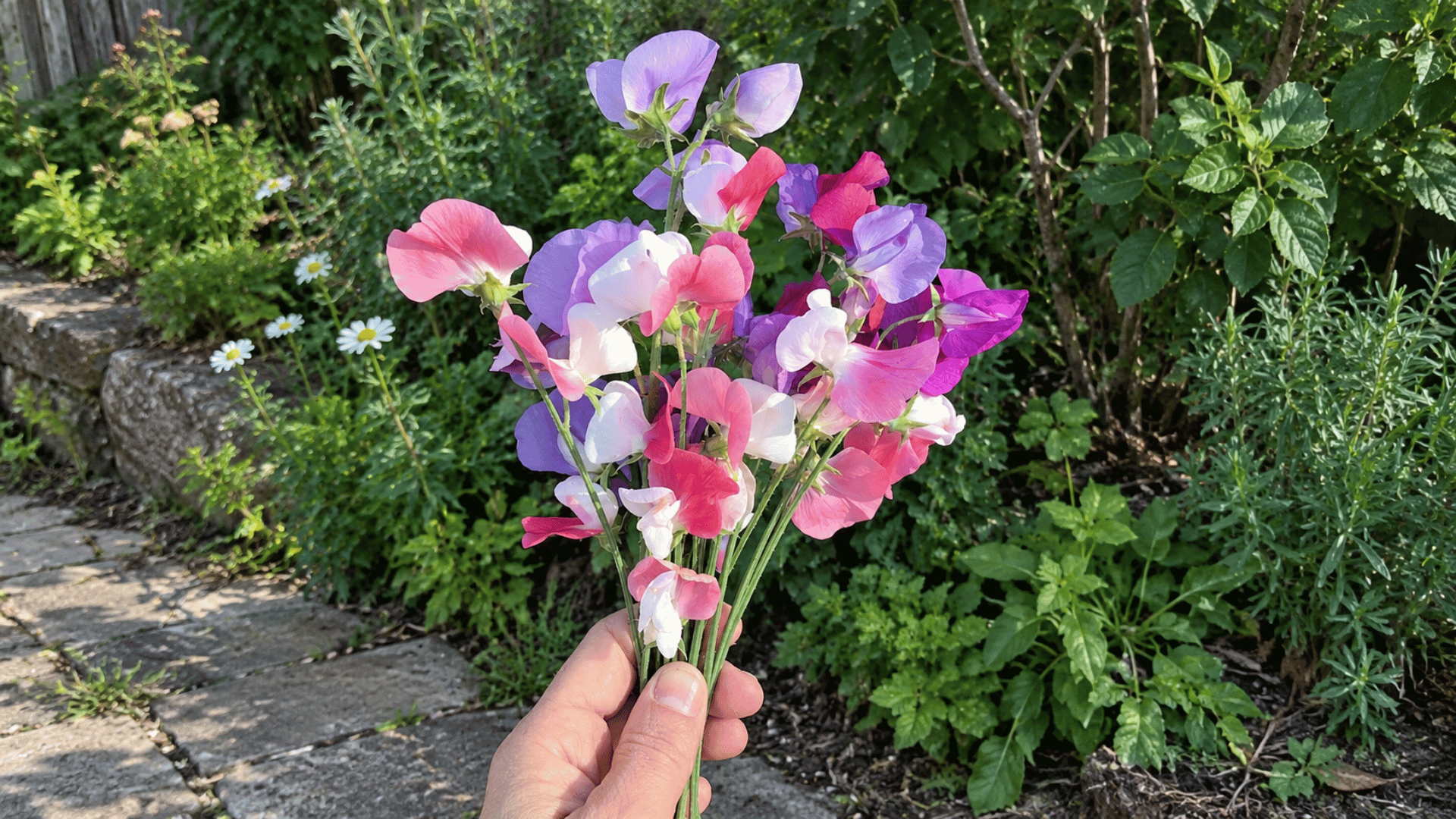
Sweet pea flowers stay popular for a few simple reasons.
First, it’s the smell. Soft, sweet, and unforgettable.
Then there’s the color range. Pinks, purples, and whites are gentle on the eyes.
I think the climbing vines are part of the fun too. They twist up trellises and fences, turning empty spaces into something alive. In gardens, they add height. In bouquets, they bring softness.
But here is something to remember. Sweet peas bloom in cooler weather, so timing matters.
Picking the right seeds, planting them on time, and keeping your vines happy is easier than you might think.
Whoa, the next bit could save your whole season.
Sweet Pea Flower Facts That Make Growing Easier
The sweet pea flower, botanically named Lathyrus odoratus, is an annual plant in the legume family, just like peas and beans.
It is a cool-season climber native to Sicily and southern Italy, grown mostly for its fragrant, ruffled blooms.
Even though it’s grown for beauty, it shares the same kind of vine structure. Sweet peas are climbers that use curly tendrils to pull themselves up anything nearby.
They need support to grow well, like trellises, fences, or netting, and they show a few traits that make them easy to spot:
-
Flowers are soft and ruffled, often shaped like little butterflies.
-
Vines can grow 3 to 6 feet tall, sometimes taller with care.
-
They need something to climb, or it will sprawl on the ground.
These flowers bloom best in cooler weather, like spring or early fall. Some varieties have a stronger scent than others. Cooler temperatures and good sunlight usually bring out their best fragrance.
Annual vs. Perennial Sweet Pea: How to Tell Them Apart?
There are two main types of sweet pea, and people mix them up all the time. It’s an easy mistake. The names are close, and the flowers look alike because they are related.
The annual sweet pea (Lathyrus odoratus) has a strong scent and pretty blooms. It’s my pick for cut flowers.
The perennial everlasting pea (Lathyrus latifolius) comes back every year and looks lovely, but it has little or no scent. That is a real trade-off, so the right choice depends on why you are growing them.
How to tell them apart at the garden center? Check the label. Seed packets and plant tags should list the botanical name, which is the only reliable way to know what’s in the bag.
My recommendation is simple.
-
If you want a plant that returns every year and don’t mind a missing scent, go with the perennial.
-
If fragrance is your priority, choose the annual. It’s the one I always grow.
Sweet Pea Varieties You Can Grow
Sweet peas get grouped by a handful of traits: scent, stem length, bloom form, and color.
Some are sold as color blends, while others are marketed for stem strength or bloom size, and the labels on the packets, “heirloom,” “fragrant,” and so on, hint at what the breeders were after.
“Heirloom” means an older seed line, and these tend to prioritize fragrance and traditional shape over big blooms and long stems.
“Fragrant” types usually live up to the label, but I would not treat it as a guarantee, since scent still varies with sunlight, soil, and even time of day.
A packet can only promise so much. So how do we choose? I start with what I actually want:
-
Want a strong scent? Go with heirlooms or anything marked “highly fragrant.”
-
Need long stems for cutting? Choose modern cut-flower types.
-
Live in a warm zone? Look for early bloomers or sow in late fall.
-
Short on space? Try dwarf or container-friendly varieties.
Heirloom and Old-Fashioned Sweet Peas
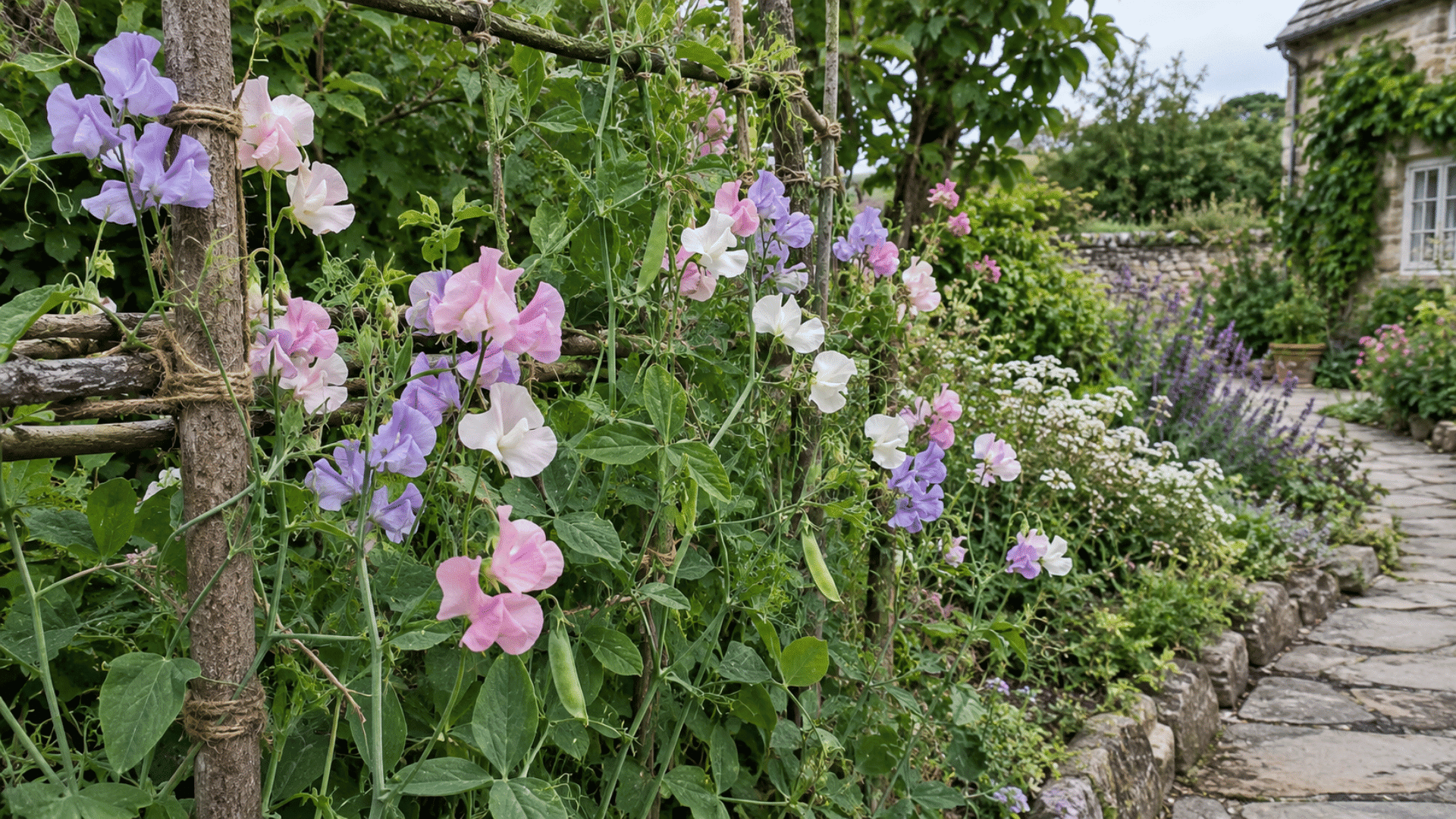
These have a strong scent and smaller blooms in soft, classic colors – lavender, blush pink, creamy white.
The stems are shorter, and there are fewer flowers, but the fragrance is excellent. If you value scent over size, or want something with a classic feel, these plants are for you.
They are popular in cottage gardens and along paths, where people can get close enough to smell them.
That’s the way it should be a fragrant plant placed where nobody can reach it is a wasted plant.
Modern Cut-Flower Types
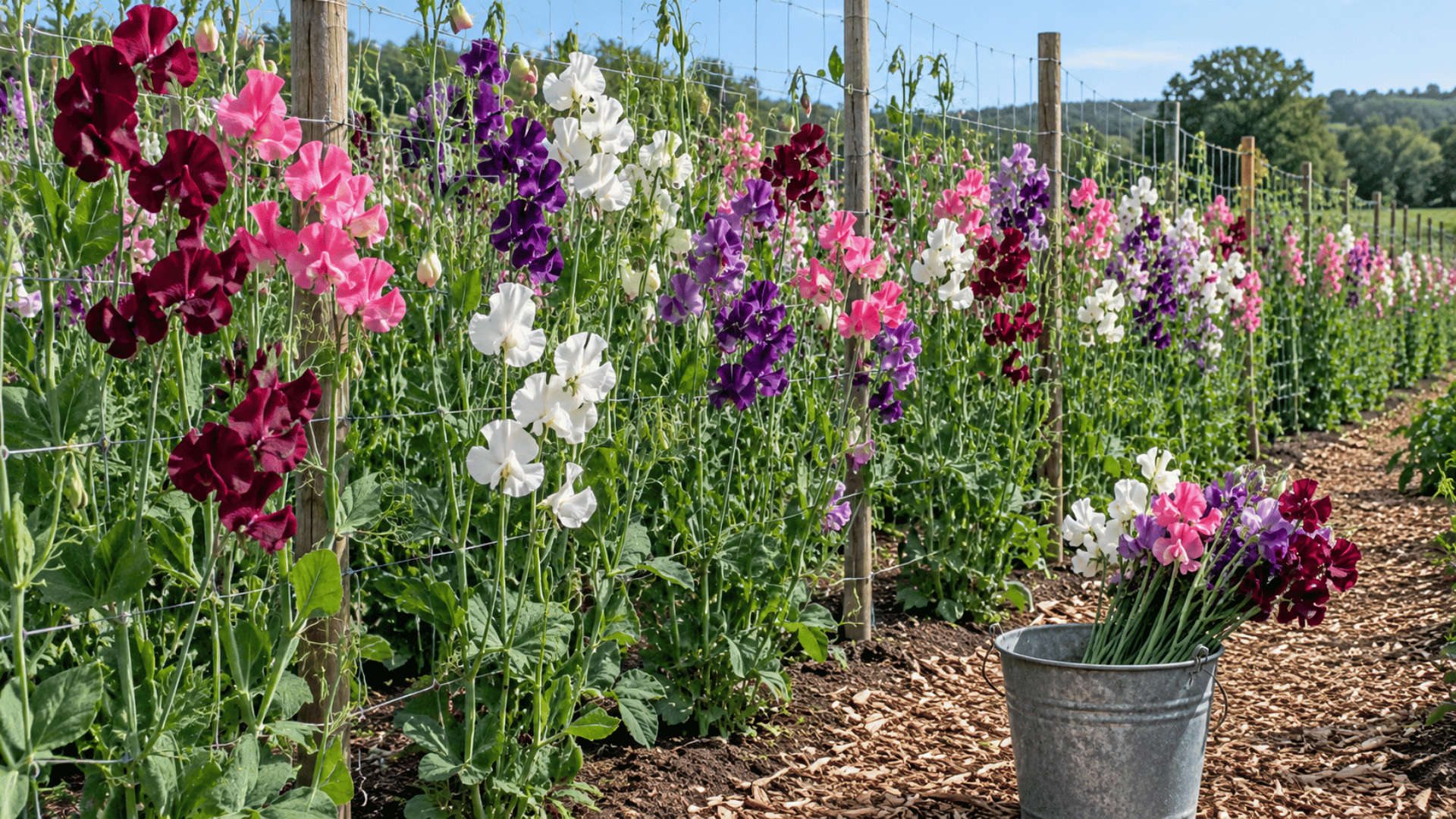
These are bred for cutting, with longer stems, large showy blooms, and more flowers per plant.
The colors are bolder and more uniform than the heirlooms, and if you make a lot of bouquets or sell at a market, they are a good fit.
They do ask more of the gardener, though. They need proper spacing, regular feeding, and netting or trellis support, and they do best with weekly attention.
Not a huge burden, but not set-it-and-forget-it either.
Color-Based Collections
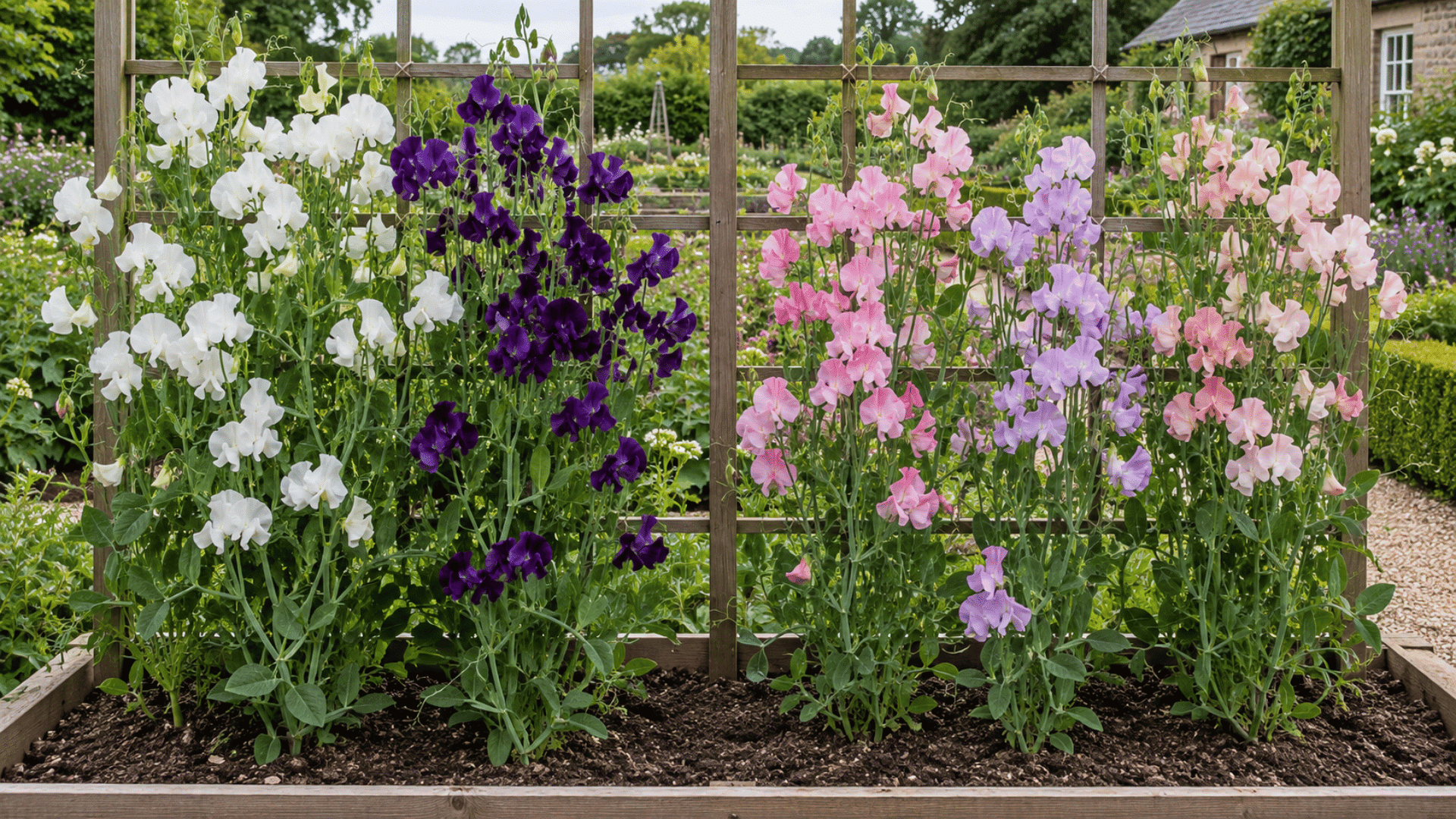
Some gardeners choose by color first, for a specific bed or an event, buying mixes or single shades. Soft pinks give a wedding look; deep purples stand out against green.
I might get a little cranky here. Mixes can turn muddy fast, and I have seen it happen in my own beds more than once.
If the planting is supposed to look good, I would use sharp contrast or stick to one color family, white with dark purple, say, or all pastels together, rather than crowding a dozen shades into a small space.
Neither reads as calm nor as bold. It just looks messy.
Sweet Pea Flower Colors: From Soft Pinks to Deep Purples
The color range is wider than most people expect.
I have grouped some well-known varieties by color family below to match what you see on seed packets.
|
Color Family |
Shade Range |
Variety Examples |
Notes |
|---|---|---|---|
|
Purples & Maroons |
Deep violet to burgundy |
‘Cupani’, ‘Matucana’, ‘Midnight’ |
Strong fragrance; classic heirloom look |
|
Pinks |
Blush to deep rose |
‘April in Paris’, ‘Gwendoline’, ‘Mollie Rilstone’ |
Soft and romantic; great for weddings |
|
Whites & Creams |
Pure white to ivory |
‘White Ensign’, ‘Cream Southbourne’, ‘Royal Wedding’ |
Clean palette; pairs well with everything |
|
Blues & Lavenders |
Sky blue to deep lavender |
‘Noel Sutton’, ‘Blue Ripple’, ‘Oxford Blue’ |
True blues are rare; most lean lavender |
|
Reds & Burgundies |
Bright red to wine |
‘Red Arrow’, ‘Winston Churchill’, ‘Burgundy’ |
Bold and eye-catching; strong stems |
|
Bi-colors & Streaked |
Two-tone petals |
‘Wiltshire Ripple’ (purple/white), ‘Painted Lady’ (pink/white) |
Adds depth and interest to arrangements |
A Note on Color: Sweet pea color shifts somewhat with soil pH and temperature. Cool weather brings out richer, deeper tones; heat makes them fade faster. Color can also vary within a single variety, and if the exact shade matters, say, for an event, it’s worth growing a few spare plants.
Color-Changing Varieties
And then there are the shape-shifters, varieties bred to change color as they age.
Since the flowers open from the bottom of the stem to the top, each stem shows a gradient, and these “shifters” change over a few days, which means a single plant shows several shades at once.
-
Blue Shift: Starts pink/mauve, ages to brilliant blue and aquamarine
-
Blue Vein: Opens orange-coral, develops striking blue-purple veining as it matures
-
Turquoise Lagoon: Begins pink, shifts to turquoise (stunning even as it fades)
These varieties tend to have smaller blooms than standard types but still carry the classic sweet pea fragrance. They are eye-catching on trellises and make for unusual bouquets since cut stems continue changing color in the vase.
Shifters work best planted alone or with solid whites so the color transition stays the focal point.
Where Do Sweet Pea Flowers Grow Best?
Sweet peas love cool weather, which, depending on the zone, means early spring or late fall.
When the heat comes, blooming slows or stops, so in warm regions we plant earlier to get flowers before summer arrives.
They want full sun, especially in cooler climates, though in warmer zones some afternoon shade can prolong flowering. The soil should be well-draining, with compost mixed in.
I skip the high-nitrogen fertilizer because it gives lots of foliage and not many flowers. Spacing the plants for good airflow helps prevent mildew.
And support from the start – netting, a trellis, or a simple fence – helps them climb and keeps them healthier.
When Should You Plant Sweet Peas?
I said timing would come up again. Here it is.
Sweet peas need cool weather, and if they are planted too late, there might be no flowers at all.
How I time it depends on the climate:
-
Cold Winters, Frozen Ground: plant in late winter or early spring
-
Mild Winters: sow in fall for earlier, stronger blooms
-
Hot Summers: plant even earlier, because they have to flower before the heat
A good window for planting is any time after the soil becomes workable and before the summer heat sets in.
You will see “workable” mentioned a lot without much explanation, but it simply means the ground has thawed and is not soggy.
If you squeeze a handful and it crumbles apart instead of forming a sticky ball, you are ready to plant.
The squeeze test is my method. I grab a handful and squeeze, and if it crumbles easily, it is ready, while if it sticks together like mud, I wait.
How to Start Sweet Pea Seeds?
A proper start gives strong young plants and better blooms later.
These are the two methods I trust, and which one you choose depends mostly on the season.
Should You Soak or Nick Seeds First?
Some sweet pea seeds have hard coats, and soaking or nicking them can speed up sprouting.
Soaking should last 6 to 8 hours and no longer, or the seeds may rot. To nick, I gently rub the seed coat with a nail file until a lighter layer shows through, which lets water in faster.
Is this always necessary? No. It is most useful for older seeds, or if you have had germination trouble in the past, while fresh seeds planted in damp, loose soil usually do not need either treatment.
Too much water or too much filing will ruin a seed, which defeats the purpose.
Starting Seeds Indoors or in Pots
This works well where the season is short or spring warms up slowly.
I use deep pots or root trainers, because sweet peas grow long taproots and they do not like having them disturbed; shallow cell packs are not their friend.
The containers get moist potting soil, with seeds planted about 1 inch deep, set in a bright spot with good air circulation.
Once the seedlings are a few inches tall, I harden them off by putting them outside for a few hours a day and increasing the time over about a week.
Skipping this step is how perfectly good seedlings get shocked into sulking.
-
Use deep containers.
-
Keep the soil moist, not soggy.
-
Harden off before transplanting.
Direct Sowing Outdoors
This makes sense when the soil is ready early, and the weather stays cool.
I loosen the soil, mix in compost for drainage, and sow the seeds 1 inch deep and 2 to 3 inches apart. After the seedlings come up, they get thinned to about 5 inches apart, which gives each plant room and airflow.
And I watch for slugs and snails right away, because they love new shoots and can wipe out a row of seedlings fast, overnight, sometimes.
-
Mix in compost first.
-
Thin once seedlings emerge.
-
Protect against slugs and snails from the start.
How to Plant, Pinch, and Support Sweet Peas?
Each plant gets about 5 inches of space. That helps airflow and cuts down on disease, and it also encourages strong, straight stems, which matters when growing for cutting.
At transplant time, I set the plant at the same depth it was growing in the pot and firm the soil gently around the base to keep the roots stable.
No need to stomp on it.
Then comes pinching, which is the step that feels wrong to me every year.
When the plant is 4 to 6 inches tall, I snip off the top growing tip.
Yes, the part that’s growing. It produces more side shoots, and more side shoots means more flowers – one of those gardening practices that seems counterintuitive until we see the results.
For training, I use soft ties to attach the stems to a trellis or fence, tied loosely.
The idea is to guide the plant, not strangle it, since tight ties damage stems as they grow, and then all that good work is undone.
Harvesting Sweet Pea Flowers for Bouquets
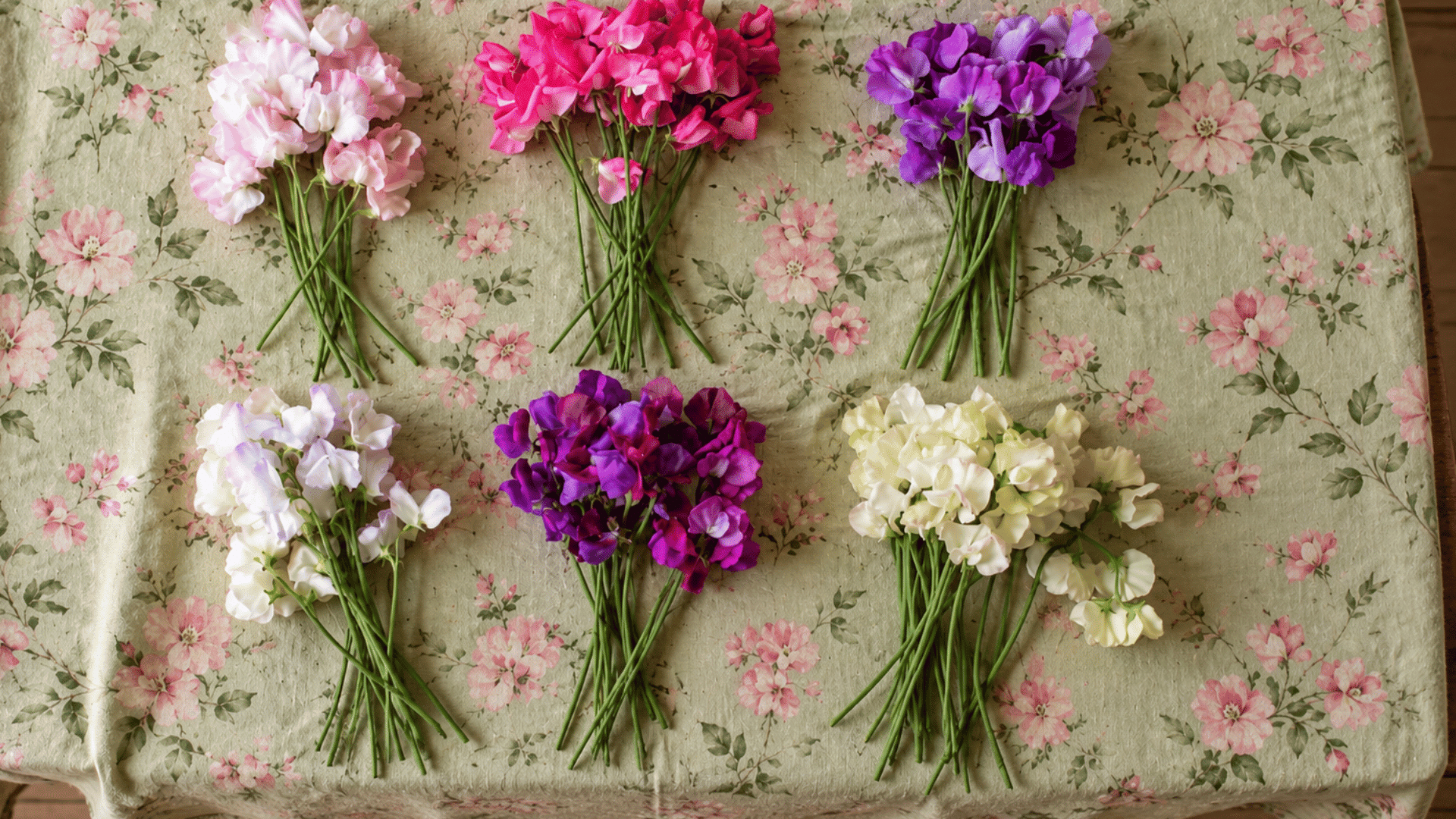
I cut early in the morning, while it is cool and the blooms are at their freshest.
The best time to cut a stem is when the lowest flower is fully open, and the top buds are still closed, because the buds will keep opening in sequence once they are inside, which means a longer vase life.
The stems go into cool water immediately, in a clean vase, and I re-trim the ends before arranging them. The vase should sit somewhere cool and out of direct sun; a sunny windowsill is about the worst place for it.
I expect 3 to 5 days in the vase. That is not long, I know, though changing the water daily and re-trimming the stems will stretch it a bit. (There are many lovely things in life that last a lot shorter.)
RELATED: If you want something that holds up in a vase for a week or more, these long-lasting cut flowers are worth adding to your garden, but sweet peas are best cut often and enjoyed fresh.
Sweet peas look best next to soft textures that do not hide their ruffles:
-
Soft herbs like mint or basil
-
Small roses or ranunculus
-
Filler flowers like baby’s breath or feverfew
How to Keep Sweet Peas Blooming for Longer?
Sweet peas stay productive well into the season when the routine stays steady, and this is the approach I follow with mine:
-
Cut Often: Cut every two to three days, picking open blooms with long stems. Remove faded flowers promptly, since seed pods slow flowering.
-
Water Deeply: Soak the soil at the base two to three times a week in the morning. Avoid light daily sprinkling, which weakens roots.
-
Feed for Flowers: Apply a low-nitrogen, bloom-boosting fertilizer every two weeks from the first buds through peak season to direct energy into flowers rather than leaves.
-
Mulch and Manage Heat: Spread mulch around the base to keep roots cool and moist. Provide morning sun and afternoon shade as temperatures climb.
-
Watch Containers: Pots dry out faster, so check daily and water whenever the topsoil feels dry. When heat slows blooms, let plants go.
Sweet peas are cool-season climbers, so flowering naturally fades once summer heat settles in, no matter how well the plants are looked after.
Why Your Sweet Peas Are Not Blooming
Sweet peas are pretty forgiving, but a few issues come up often enough that it is worth knowing what to look for. Most problems have simple fixes if you catch them early.
|
Problem |
Symptom |
Cause |
Fix |
|---|---|---|---|
|
Bud Drop |
Buds fall before opening |
Temperature swings, uneven watering, excess nitrogen |
Keep soil evenly moist; avoid high-nitrogen feed |
|
Aphids |
Small green insects on stems |
Sap-sucking pests spreading viruses |
Spray insecticidal soap or water early |
|
Powdery Mildew |
White dusty leaf coating |
Hot, dry weather; poor airflow |
Water at base, mulch, space plants |
|
Poor Germination |
Seeds not sprouting |
Old seeds or waterlogged soil |
Use fresh seeds; ensure good drainage |
|
All Leaves, No Flowers |
Lush foliage, few blooms |
Excess nitrogen |
Use low-nitrogen, bloom-focused fertilizer |
Most issues are about balance: not too wet, not too dry, not too much food, and good airflow. Fix what you can, learn from what you can’t, and try again next season.
What Sweet Pea Flowers Mean and When to Use Them?
Sweet peas are associated with farewells, gratitude, and gentle thoughts.
People give them to say thanks, or to mark the end of something special, softly, and kindly, and I think it is a nice tradition, not a heavy-handed one.
Color adds its own layer. Soft pink stands for friendship, purple for calm, and white for honesty or new beginnings.
If you like flowers to carry a message, you have plenty to work with.
They are a natural choice for farewell bouquets, spring events, and gestures of appreciation, and their early bloom and sweet scent make them popular in seasonal arrangements, too.
Their old-fashioned look also adds a personal, thoughtful touch to weddings, baby showers, and birthday bouquets, especially when the meaning matters as much as the beauty.
Frequently Asked Questions (FAQs)
Are Sweet Pea Flowers Edible or Safe Around Pets?
No, the flowers, pods, and seeds are toxic to people and pets. Keep plants out of reach and call a vet if anything is eaten.
How Long Do Sweet Peas Take to Bloom from Seed?
Most sweet peas flower roughly ten to twelve weeks after sowing, though early varieties bloom sooner and cold weather can delay the first flowers.
Can You Save Sweet Pea Seeds for Next Year?
Yes. At season’s end, let a few pods turn brown and brittle on the vine, then store the seeds in a cool, dry envelope.
Do Sweet Peas Attract Bees and Butterflies?
Yes, the fragrant blooms draw bees and other pollinators, making sweet peas a useful, pretty addition to a pollinator-friendly garden.
Wrapping It Up
Sweet pea flowers are easy to love, and a little patience goes a long way. They fill a garden with soft color and a scent that is hard to forget.
Old-fashioned heirlooms, long-stemmed cut flowers, and simple color plans each bring something special. Picking that first bunch and carrying it inside feels pretty great. Trust me, the mistakes along the way will be forgotten.
Give sweet peas a try this season.
And there’s plenty more where this came from in the other posts here. Happy growing!