
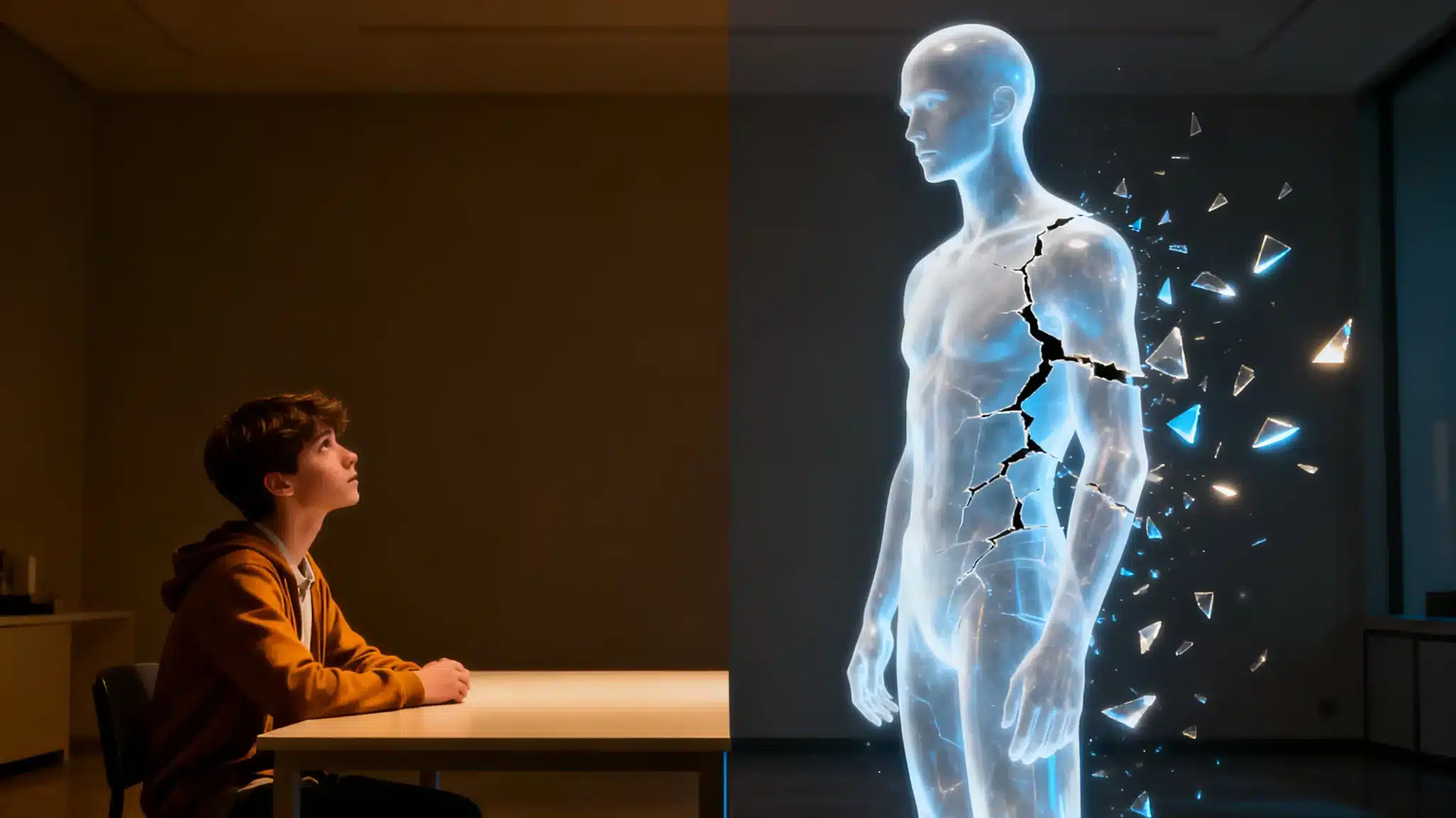
AI has been long sold to us as a tutor that doesn’t get tired, make mistakes or ignore you. It should always be correct, right? It will answer any of your questions and adapt to all the requirements your school has, or will it?
It’s true that AI has access to millions of resources no human will ever be able to read. Who else can talk with you about the history of geodesy while giving advice on how to make friends and quoting Ancient Greek philosophers? It’s never impatient or unfamiliar with a topic and overall sounds like the biggest accomplishment people had so far.
But if you dig deeper you find hallucinations, overpowering misinformation and perpetual bias. Since it works on the basis of prediction models, it can give immense importance to certain events and ignore others and there’s no way of realizing that unless you have real substantial knowledge in the subject.
Yet, people still trust it to be a tutor. And this has dangerous connotations. A wrong answer on the test is bad, yes, but what if a hallucinated fact gets dragged into a textbook and teaches so many more others a wrong idea? This can reshape their ideas or even change their world views and here’s where it gets really dangerous. So how do we find those mistakes and stop ourselves from giving into them?
Why the Perfect Tutor Story Is So Persuasive
AI fits nearly every expectation students have of convenient academic support. It is fast, conversational, personalized, and available without an appointment. It can simplify technical language, generate examples, create practice questions, and provide feedback in seconds. Those strengths make it easy to treat the system as an authority rather than a tool.
The interface reinforces that impression. AI usually produces a complete response with smooth transitions and an assured tone. Students encounter a psychological shortcut: fluent language feels like evidence of expertise. When an answer matches what they hoped to hear, the temptation to accept it grows.
This matters most when students lack enough subject knowledge to spot a mistake. An expert may recognize an invented citation or a missing logical step. A beginner may see only a clear answer. The same feature that makes AI accessible—its ability to make difficult ideas sound simple—can make false ideas unusually convincing.
Students use a mixed ecosystem of support: teachers, classmates, search engines, libraries, tutoring centers, and services offering paper writing help at WritePaper when they need structured assistance with research or drafting. The important distinction is not between technology and no technology. It is between support that can be questioned, traced, and checked, and output accepted because it sounds complete.
Fluency Is Not the Same as Accuracy
UNESCO’s guidance on generative AI in education calls for a human-centered approach, emphasizing ethical validation, age-appropriate use, data protection, and pedagogical oversight. Its central implication is that access to an AI system cannot replace learning design that keeps humans responsible for judgment.
The danger becomes clearer in high-stakes learning. A 2026 randomized trial involving 111 novice medical students found that plausible but misleading AI explanations significantly reduced diagnostic accuracy. Correct explanations did not produce a statistically significant improvement over a no-explanation control. Confidence also stopped reliably tracking correctness when students received misleading explanations. The AI did not merely lead learners to wrong answers; it helped them feel certain about them.
How AI Errors Become Student Beliefs

An isolated factual error can be corrected. A belief is harder to remove because it becomes part of the learner’s mental framework. AI can contribute to that process in several ways:
- It supplies a coherent story. Learners remember a clear cause-and-effect explanation, even when it is false.
- It removes productive uncertainty. AI may present one neat interpretation where the evidence is mixed.
- It invents authority signals. Fake citations, quotations, and specific-looking statistics make weak claims appear documented.
- It repeats errors consistently. Restating the same mistake in new language can feel like confirmation.
- It agrees too easily. A leading prompt may cause the system to validate an assumption rather than test it.
These patterns are harmful in subjects where one false claim can support later reasoning. In history, a fabricated quotation can distort an entire interpretation. In literature, an invented scene can anchor an essay. In science, an oversimplified mechanism can become the basis for future conclusions. Students may build new knowledge on a false foundation without realizing it.
The Real Problem Is Unequal Ability to Verify
“Just fact-check it” assumes students know what needs checking and where to look. Verification is a learned academic skill that requires background knowledge and ample time to compare claims.
If you know your subject, you can use AI as a debate partner, but for those less experienced AI becomes the answer sheet. How do you identify everything wrong with the answer?
This creates a new educational inequality: students who need this guidance the most are the least equipped to detect unreliable output.
The only viable solution for now is to integrate AI literacy as part of the curriculum. Students use chatbots and will continue to do so, the only answer to that is teaching them how to use them correctly.
While changes in curriculum are still far and away between, here’s a checklist for you to follow:
- determine which claims the GPT model is making
- identify the sources that support it
- ask for evidence that could disprove the claim
- try doing an online search comparing the answers AI gave you
- write your own answer based on the claims.
AI Mistakes Can Still Become Useful Lessons
The solution is not to ban AI or pretend it has no educational value. Its errors can become teaching material when they are deliberately examined. A teacher can present an AI-generated explanation and ask students to annotate unsupported claims. Students can compare answers, locate contradictions, rank sources, and revise flawed reasoning.
This changes AI’s role. It is no longer the perfect tutor delivering truth. It becomes an imperfect participant in a structured learning process. The teacher sets standards, the student evaluates, and the AI provides material to question.
Schools can reinforce this model by rewarding verification. Students might submit a claim-checking appendix, provide a source trail, describe where the AI was wrong, or explain why they rejected a generated suggestion. Assessment should value judgment, not only polish.
From Answer Getting to Knowledge Building
The myth of the perfect AI tutor survives because it offers a comforting promise: every student can receive immediate, personalized expertise. The reality is more complicated. AI can expand access to explanations and practice, but it can also deliver falsehoods with confidence that makes them difficult to detect.
Education should not train students to fear AI or obey it. The goal is disciplined use. A fluent answer is a starting point, not proof; a citation is a lead, not verification; and confidence is a style of delivery, not a measure of truth.
The strongest learners of the AI era will not be those who obtain answers fastest. They will be those who pause, investigate, compare, and revise. Once that habit becomes central to learning, AI’s mistakes stop functioning as hidden lessons. They become visible problems—and opportunities to teach students how knowledge is built.
Sources Consulted
- UNESCO, “Guidance for Generative AI in Education and Research.”
- Abdulhadi Shoufan and Ahmad-Azmi-Abdelhamid Esmaeil, “AI Hallucination from Students’ Perspective: A Thematic Analysis.”
- Da Teng and colleagues, “Impact of AI Misinformation on Diagnostic Accuracy and Confidence Calibration in Novice Medical Students.”