
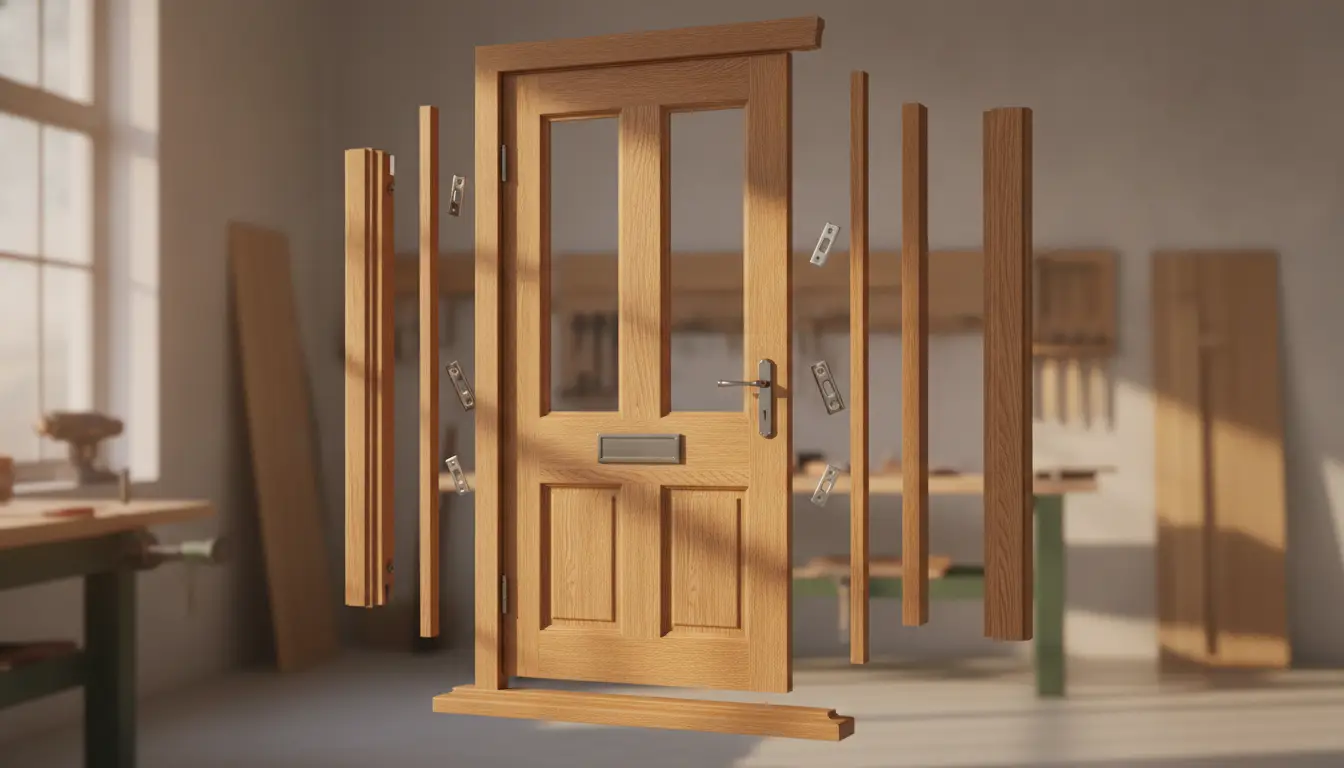
Door jargon sounds familiar until someone asks you about the jamb, stile, mullion, or threshold and you realise you are mostly guessing. The vocabulary shows up constantly: on product pages, in quotes, during conversations with installers, on spec sheets. Nobody explains it because everyone assumes you already know it.
This is not a complete A–Z glossary. It is the 17 terms people encounter most often and least often get properly explained. Each one comes with a plain-English definition and a note on why it actually matters when you are buying or replacing a door.
If you want a broader reference beyond the terms below, Latham’s guide to door part terminology is a useful reference point that covers the full vocabulary of door construction and specification.
Why Door Terminology Confuses So Many People
The confusion is understandable. Door vocabulary mixes structural parts (frame, jamb, head), aesthetic details (architrave, stile, rail), glazing terms (fanlight, mullion, beading), and performance language (U-value, multi-point lock) in the same conversations without distinguishing them.
Most terms are not actually difficult — they are just words that nobody translated into plain English at the moment they mattered. That is what this article does.
The Structural Terms: Frame, Leaf, and Named Parts (Terms 1–10)
The diagram below labels the main structural terms on a typical panelled external door. Refer back to it as you read through the definitions — the terms are much easier to remember once you can picture where they sit.
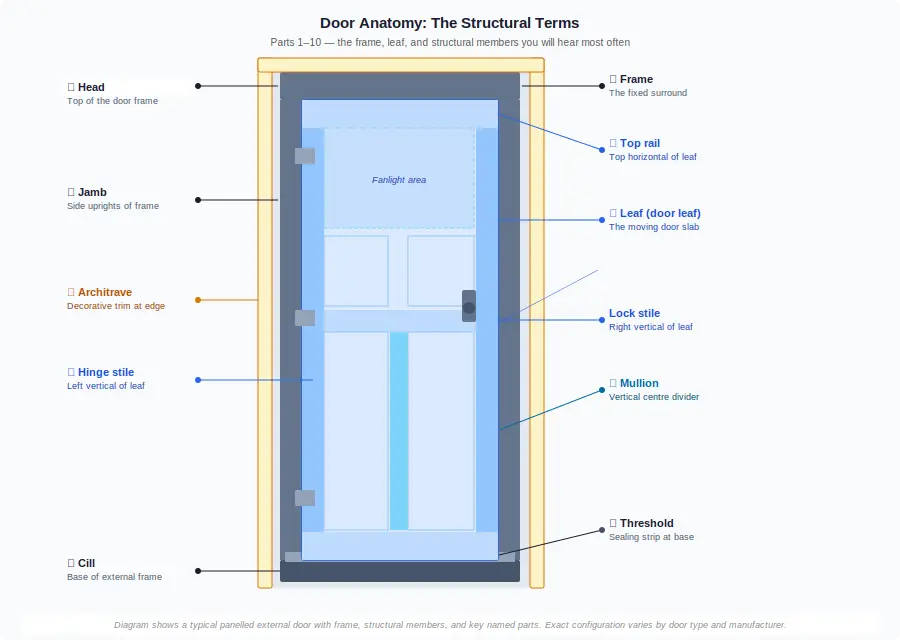
A typical panelled external door with its main structural parts labelled. Most of the confusion around door terminology comes from terms that sit very close to each other on this diagram but mean different things.
|
1 Door leaf — structural The door leaf is the actual door — the moving slab that opens and closes. It is distinct from the frame around it. A “single leaf” door has one panel; a “double leaf” has two. When someone talks about the width or weight of a door, they usually mean the leaf. Why it matters: Knowing the difference between leaf and frame avoids confusion when ordering or discussing sizing. |
|
2 Frame — structural The frame is the fixed surround the door leaf sits in. It includes the jambs, the head, and the cill or threshold at the bottom. The frame is what gets built into the wall opening; the leaf hangs from it on hinges. Why it matters: Frames and leaves are often sold together as a “door set” — confirming what is included prevents surprises. |
|
3 Jamb — frame part The jambs are the vertical sides of the door frame — the uprights you see on either side of the doorway. The hinge jamb (hinge side) and the strike jamb (closing side) are sometimes distinguished. Hinges attach to the hinge jamb; the latch connects with a plate on the strike jamb. Why it matters: When installers talk about reinforcing a door frame, they usually mean the jambs — these are the weak points in most forced entry attempts. |
|
4 Head — frame part The head is the top horizontal part of the door frame — the crosspiece that spans across the top of the opening above the door. It is the upper counterpart to the cill or threshold at the bottom. Why it matters: Important when measuring a doorway: the head height determines usable door height. |
|
5 Threshold — frame / sealing The threshold is the sealing element at the bottom of the door — the part you step over. It sits on top of the cill and is designed to prevent draughts, weather ingress, and dirt from getting under the door. On external doors, the threshold is a critical weatherproofing component. Why it matters: A worn or poorly fitted threshold is one of the most common causes of cold draughts at the base of a front door. |
|
6 Cill (or sill) — frame part The cill is the lower structural base of an external door frame — the piece of timber or metal that sits at floor level and transitions between floor surfaces. In UK usage, cill and threshold are sometimes used interchangeably, but technically the cill is the structural base element and the threshold is the sealing strip above it. Both terms appear in product descriptions and quotes. Why it matters: Real-world usage is not always perfectly consistent — if in doubt, ask your installer which part they mean. |
|
7 Stile — door leaf A stile is a vertical member within the door leaf itself — the upright strips running down each side of the door panel. The hinge stile is on the hinge side; the lock stile (or closing stile) is on the side with the handle and latch. Not to be confused with the jambs, which are part of the frame. Why it matters: When specs mention stile width, they are talking about the visible border of the door panel — this affects both appearance and how hardware is fitted. |
|
8 Rail — door leaf A rail is a horizontal member within the door leaf — the counterpart to the stile. A panelled door typically has a top rail, a bottom rail, and sometimes a middle or frieze rail. The rails define the horizontal divisions of the door and help give it structural rigidity. Why it matters: Rail positions determine the proportions of the door panels — this is mostly an appearance consideration, but also affects where hardware can be positioned. |
|
9 Mullion — door leaf / glazing A mullion is a vertical dividing element — it separates sections of the door leaf, or separates glazed panels from each other. In a door with multiple glass panes or decorative panels, the mullions are the vertical strips between them. This is one of the most commonly misunderstood terms because it sounds structural but often describes a visual element. Why it matters: If a product description mentions a top mullion, mid mullion, or lower mullion, they are describing the vertical dividers between panel sections. |
|
10 Architrave — trim / finish The architrave is the decorative moulding fitted around the outside of the door frame, covering the joint between the frame and the surrounding wall. In UK usage, it is standard to fit an architrave on both faces of an internal door frame. On external doors it may be replaced by other weatherproof trim. It is purely a finish element — it does not affect how the door works, only how the installation looks. Why it matters: Architrave style significantly affects the overall appearance of a door opening — it is the part that makes the frame look finished rather than raw. |
Hardware, Glazing, and Performance Terms (11–17)
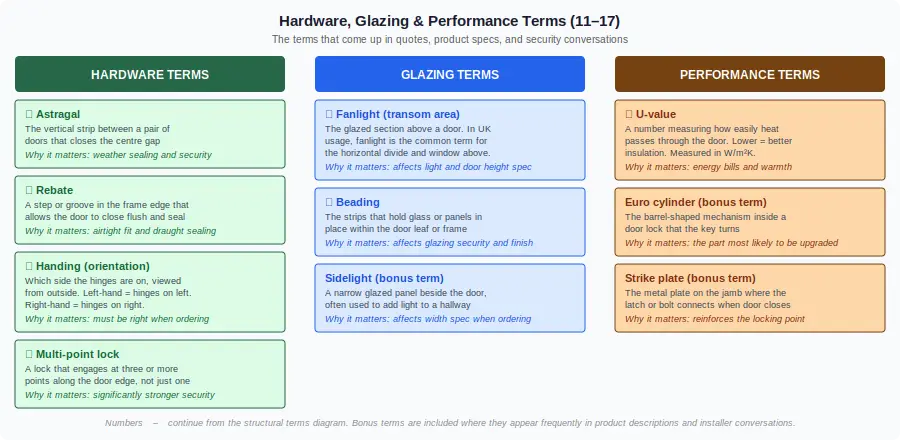
Terms 11–17 cover the words that appear in security, glazing, and performance conversations. These are often the terms that cause the most confusion in quotes and product descriptions.
|
11 Astragal — hardware / sealing An astragal is the vertical strip fitted between a pair of doors to close the gap where the two leaves meet in the middle. It is usually attached to one door face and covers the meeting edge of both leaves when closed. Its function is to prevent draughts, weather ingress, and reduce the gap that could otherwise be exploited for security breaches. Why it matters: On double doors, the astragal is an important part of both weatherproofing and security — worth checking for on any paired door specification. |
|
12 Rebate — frame / fitting A rebate is a step or groove cut into the frame or door edge that allows the door leaf to close into the frame neatly, creating a positive stop and a seal. A “rebated” door set is designed so the leaf rests against this step when closed, improving draught and weatherproofing performance. Single and double rebate refer to how this step is configured. Why it matters: A well-fitted rebate is essential for a door that seals properly — poorly rebated doors let in draughts and reduce weather performance. |
|
13 Handing (orientation) — fitting / ordering Handing describes which side the hinges are on and which way the door swings, as seen from the outside. Left-hand means the hinges are on the left when viewed from outside. Right-hand means hinges on the right. This determines which side the handle sits on and which way the door opens. Getting handing wrong when ordering is a common and easily avoided mistake. Why it matters: Always confirm handing before ordering a door. Installers will ask — knowing the answer saves a return trip. |
|
14 Multi-point lock — security / hardware A multi-point lock is a locking mechanism that engages at three or more points along the door edge when the key is turned — typically at the top, middle, and bottom of the door. Standard locks engage at a single point. Multi-point locks distribute the load across the full height of the door, making it considerably harder to force open by levering at one spot. Why it matters: If security is a priority, multi-point locking is one of the most important upgrades to ask about — it significantly improves resistance to forced entry. |
|
15 Fanlight (or transom area) — glazing / structure A fanlight is the glazed section above a door, separated from the main door panel by a horizontal bar (the transom or transform). In UK usage, fanlight is the common term for this glazed area above the door — the word comes from the traditional fan-shaped windows above Georgian doors. In product descriptions you may also see “transom window” used for the same element. Why it matters: Fanlights add light to hallways and can change the overall height specification of a door opening — check whether the quoted measurement includes or excludes the fanlight. |
|
16 Beading — glazing / finish Beading refers to the thin strips of material — usually timber, PVC, or metal — that hold glass or decorative panels in place within a door frame or leaf. When a glazier or installer talks about removing beading, they mean taking out the strips that hold the glass so it can be replaced. Front-fixed beading is on the exterior face; back-fixed beading is on the interior face. Why it matters: Bead position affects both security and maintenance — front-fixed beading can sometimes be removed from outside to access the glass. Back-fixed or internal beading is more secure. |
|
17 U-value — performance / energy A U-value measures how easily heat passes through a building element — in this case, a door. It is expressed in W/m²K (watts per square metre per kelvin). The lower the U-value, the better the insulation. UK building regulations set minimum U-value standards for replacement doors. A door with a U-value of 1.2 W/m²K insulates better than one rated at 2.0 W/m²K. Why it matters: If energy efficiency and heating bills are a concern, always ask for the U-value when comparing doors — it is the only reliable way to compare insulation performance across products. |
Quick Reference: Which Terms Matter for What
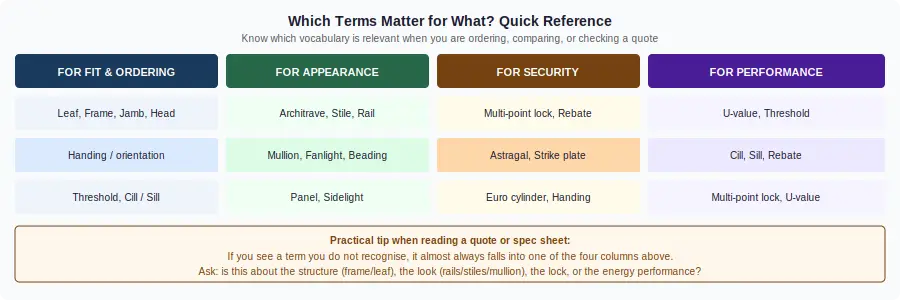
Use this as a mental filter when reading a quote or product page. Most unfamiliar terms fall into one of these four categories — knowing which one helps you ask the right question.
Which Terms Matter Most When You Are Actually Buying a Door
When Ordering or Getting Measured
Leaf, frame, jamb, head, threshold, cill, and handing are the terms most likely to appear in sizing, orientation, and specification conversations. Getting these right before ordering avoids mistakes that are time-consuming and expensive to fix.
When Talking About Appearance and Design
Architrave, stile, rail, mullion, fanlight, beading, and panel all describe the visible design elements of a door. These terms come up when choosing styles, glazing configurations, and decorative details from product ranges.
When Discussing Security and Locking
Multi-point lock, astragal, rebate, jamb, and strike plate are the terms most relevant to security performance. Understanding these makes it easier to compare how different doors and door sets handle the weak points in a standard installation.
When Comparing Energy Performance
U-value, threshold, and rebate are the terms most directly connected to draught and heat retention performance. U-value is the one number worth asking for in any energy-performance comparison.
|
Common mix-ups with door terminology
|
Door Jargon Is Simpler Than It Sounds
None of these terms is actually difficult once it is translated out of trade language. The confusion mostly comes from hearing words in context without anyone stopping to explain them.
The structural terms — leaf, frame, jamb, head, cill, threshold — describe the basic anatomy. The decorative terms — architrave, stile, rail, mullion, fanlight — describe how the door is divided and finished. The security and performance terms — multi-point lock, astragal, rebate, U-value — describe how it functions.
Once you know which category a term falls into, working out what it means in context becomes considerably easier.
FAQs
What Is the Difference Between a Door Jamb and a Frame?
The frame is the complete fixed surround — it includes the jambs, the head, and the cill or threshold. The jambs are specifically the vertical side members of that frame. So the jambs are part of the frame, but the frame is not the same thing as the jambs.
What Does Stile Mean on a Door?
A stile is a vertical member within the door leaf itself — the upright strips running down the sides of the door panel. The hinge stile is on the hinge side and the lock stile is on the closing side. Not to be confused with the jambs, which are part of the frame rather than the door leaf.
Is a Threshold the Same as a Sill?
Not exactly, though the terms are often used interchangeably. Technically, the cill or sill is the lower structural base of the frame at floor level, and the threshold is the sealing element above it that the door closes against. In practice, many product descriptions and installers use both terms loosely. If there is any ambiguity in a quote, it is worth asking which element is being referred to.
What Is a Mullion on a Door?
A mullion is a vertical dividing element within the door leaf or between glazed sections — the vertical strip that separates panels from each other. In a door with multiple glass panes or decorative panels, the mullions are the vertical separators. A transom or transform is the horizontal equivalent.
What Does Handing Mean When Ordering a Door?
Handing describes which side the hinges are on, as seen from the outside of the building. Left-hand hinging means the hinges are on the left when you face the door from outside, so the door swings to the right when you open it from inside. Getting handing wrong is one of the most common ordering mistakes — always confirm from the outside view.
Why Do People Talk About U-Values for Doors?
A U-value measures how easily heat passes through the door. Lower is better. Building regulations in the UK set minimum U-value standards for replacement external doors. When comparing doors on energy efficiency, the U-value is the only reliable number to compare — product descriptions like “insulated” or “thermally efficient” mean nothing without the actual figure.