The Commercial Light That’s Growing in Popularity in Homes
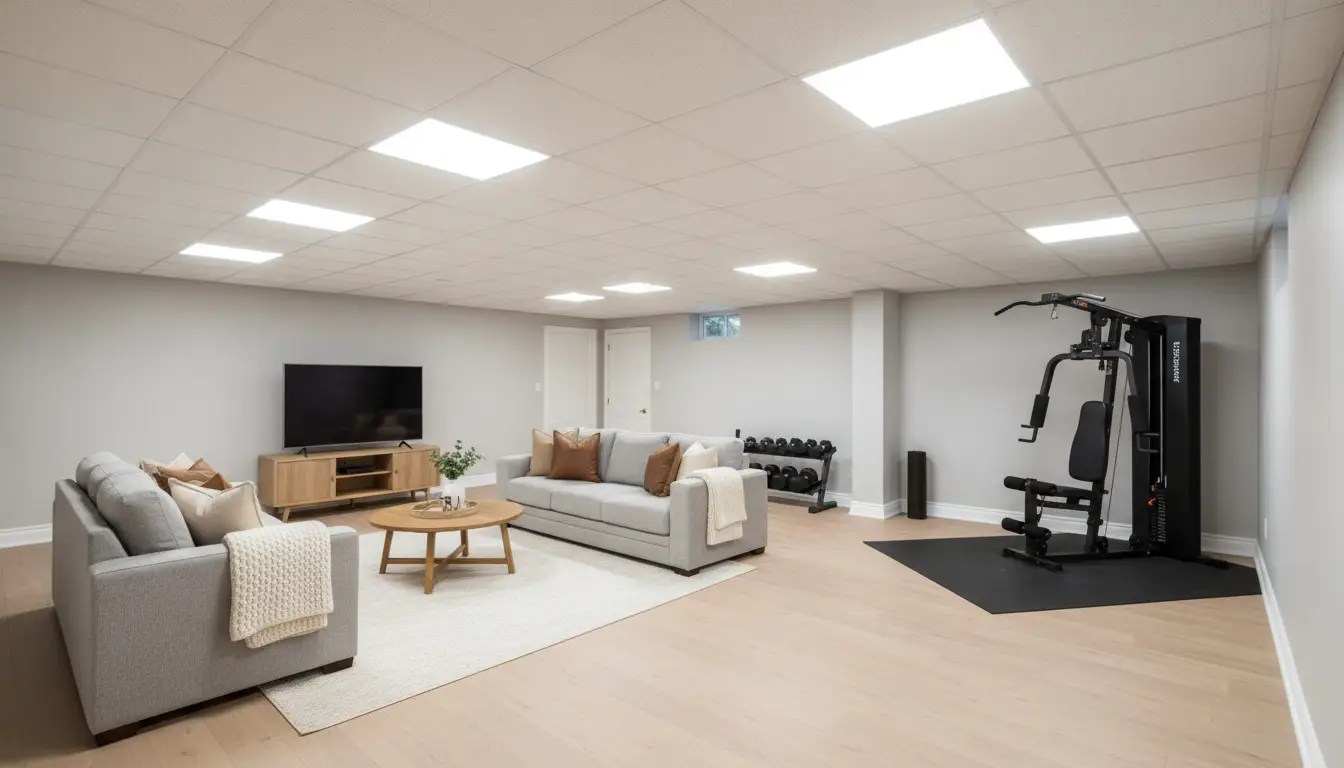
Most people associate drop ceiling lights with offices, schools, hospitals, and other commercial buildings—which makes sense, since for decades they have been the standard choice for illuminating offices and commercial spaces. Yet over the last several years, many homeowners have come to see the benefits of putting drop ceiling panel lights in basements. Putting in a drop ceiling in the basement covers up unsightly joists and ductwork, and adding several LED panels to the grid effectively creates a bright, cheerful environment where dark walls and a lack of natural daylight can easily lead to a dreary vibe.
When a basement renovation includes a suspended ceiling, the lighting conversation changes. Rather than adding dozens of recessed downlights, which can make the ceiling look like Swiss cheese, or relying on freestanding decorative fixtures, homeowners have an opportunity to use a fixture already designed for large, multi-purpose spaces.
Why So Many Finished Basements Use Drop Ceilings
Let’s be honest: no one installs suspended ceilings for the aesthetic appeal. Ceiling tiles are not very pretty to look at, but they replace the dusty array of plumbing, ducts, gas lines, electrical wiring, and other utilities that run along the ceiling while still keeping them accessible.
A drop ceiling is a lot easier to remove to fix a leak or renovate than an entire drywall ceiling. Drop ceilings simplify construction: instead of building soffits around every obstacle or finishing an irregular ceiling with drywall, installers can create a level ceiling beneath the utilities. Once that decision has been made, the question becomes straightforward: what type of lighting works best within the ceiling grid? That’s where LED panels stand out.
Why LED Dropped Ceiling Panels Work So Well in Basements
Basements present different lighting challenges than the rest of the home. Natural light is usually limited, wall colors are often darker, and many spaces serve several purposes at once. A basement might be a family game room during the evening, a workout space in the morning, and a workshop on the weekend.
Drop in ceiling LED panel lights were developed for environments where people perform a wide range of tasks throughout the day. In offices, the same lighting needs to be comfortable for reading printed documents, working at a computer, and collaborating in face-to-face meetings. In classrooms, students need enough illumination to take notes, read textbooks, complete assignments, and clearly see the teacher or presentation at the front of the room. Rather than lighting one specific task, panel lights are designed to create a comfortable, functional environment that supports many different activities.
Finished basements have similar demands. They can serve as a home gym, a rec room, a workshop, a craft corner—and everything in between, depending on the time of day. With broad, bright, and even illumination supported by dimmability, LED panels can properly light up any function with minimal switching.
How to Choose the Right Drop Ceiling LED
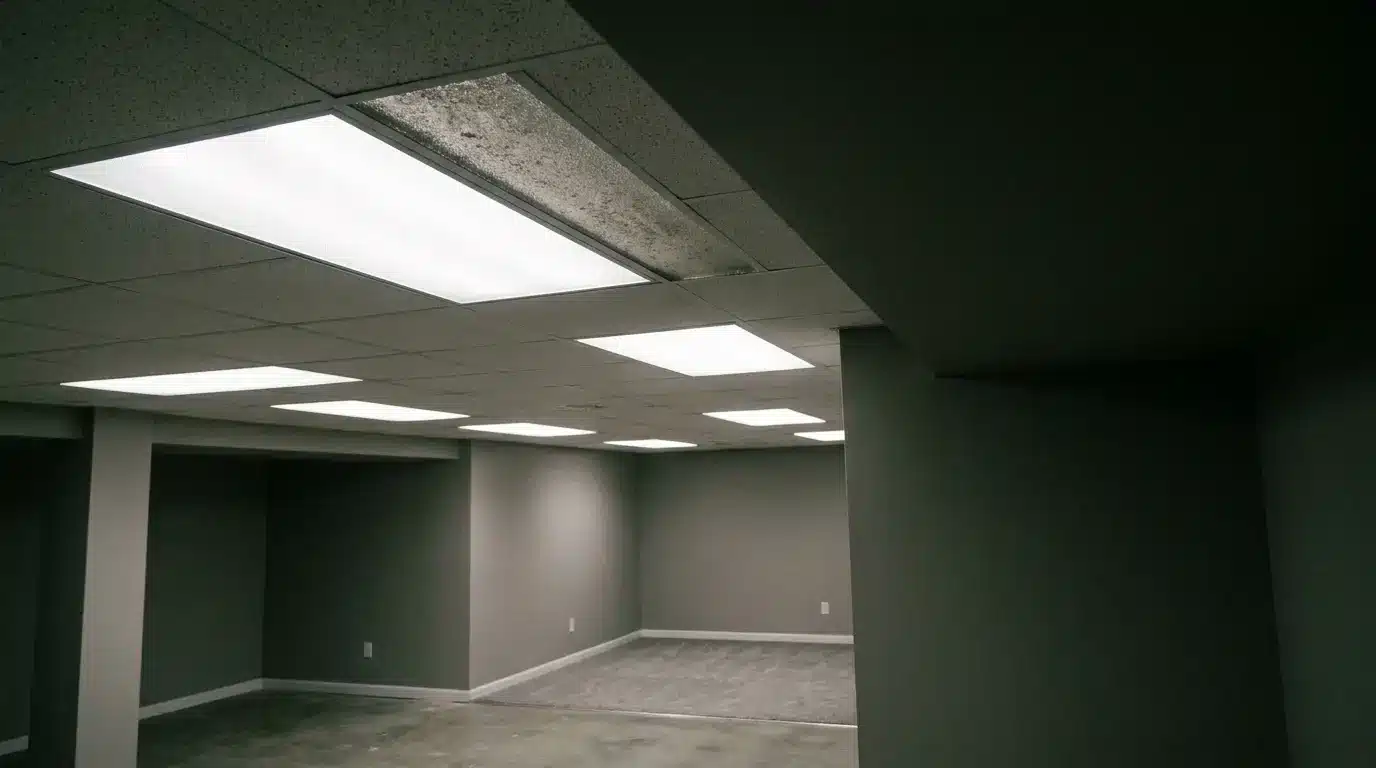
Obviously, not all LED drop ceiling panels are the same, so it’s worth paying attention to a few key specifications before buying.
First, let’s talk about panel size. For smaller basements or spaces divided into several areas 2×2 LED drop ceiling panel lights are enough. Larger areas are better suited to illumination from a few 2×4 fixtures rather than multiple smaller 2×2 ones. Choose your ceiling grid with the lighting plan in mind: since LED panels are designed to replace standard ceiling tiles, the fixture size must match the grid opening.
Brightness should be selected according to the size of the room and the fixture layout rather than wattage alone. All-purpose rooms need about 30-40 lumens per square foot, but if you intend to use your space as a workshop or any kind of detail work, you need 60-75 lumens. When in doubt, aim for higher illuminance and dim down to a comfortable level.
Color temperature also has a major impact on how the finished basement feels. Around 3000K creates a warm atmosphere that’s well suited for family rooms or entertainment spaces. A neutral 3500K works well in multipurpose basements, while 4000K is often preferred for workshops, laundry areas, and home gyms where visibility is more important. Reserve 5000K for utility rooms or mechanical spaces where maximum brightness is the priority.
Features Worth Paying For
When comparing products, focus on specifications that provide real value instead of marketing language. Selectable color temperatures (5CCT) allow you to fine-tune the appearance of the room before installation is complete. Dimming compatibility adds flexibility if the basement is used for different activities throughout the day.
Look for ETL certification from a nationally recognized testing laboratory to verify electrical safety. Energy Star or DLC certification is also a strong signal of quality. Make sure you buy from a reputable seller that strong warranty, since you don’t end up having to replace a fixture that failed after three months.
Planning Your Layout
Before installing fixtures, think about how the basement will actually be used. Instead of spacing every panel perfectly evenly, consider the activity zones within the room. A seating area, game table, workout space, or workbench may each benefit from slightly different fixture placement.Because LED panels fit directly into the suspended ceiling grid, planning is often simpler than laying out dozens of recessed fixtures. Taking time to sketch the room and identify where people spend the most time usually results in a more practical lighting design.
A Practical Choice for Basement Renovations
LED panel lights earned their reputation in commercial buildings because they reliably illuminate large spaces day after day. Finished basements share many of the same characteristics: open layouts, suspended ceilings, and rooms that need to support a variety of activities.
If your renovation already includes a drop ceiling, LED panels deserve serious consideration alongside recessed lighting. They integrate naturally into the ceiling grid, reduce installation complexity, and provide broad illumination with fewer fixtures. For homeowners looking to create a bright, flexible basement without overcomplicating the lighting plan, they remain one of the smartest solutions available.